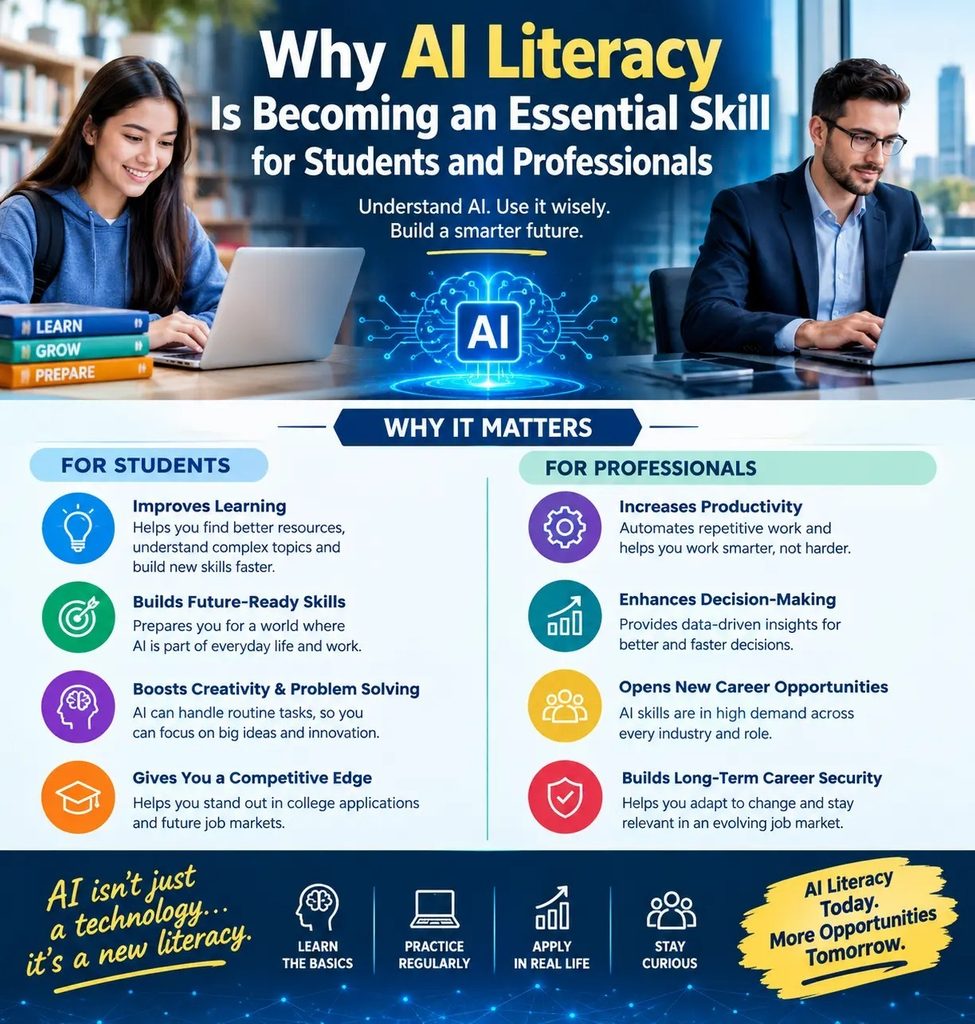
Artificial intelligence is becoming part of everyday life at an impressive pace. Students use AI tools to brainstorm ideas, summarize difficult concepts, practice writing, and explore unfamiliar subjects. Professionals use artificial intelligence to analyze information, automate repetitive tasks, communicate with customers, and improve decision-making.
As these technologies become more accessible, simply knowing that AI exists is no longer enough. People increasingly need to understand how AI works, what it can and cannot do, and how to use it responsibly.
This is where AI literacy comes in.
AI literacy refers to the knowledge and skills needed to understand, evaluate, and effectively use artificial intelligence. It does not necessarily mean learning how to build complex machine-learning models or becoming a software engineer. Instead, it involves developing enough knowledge to interact with AI tools intelligently and recognize their limitations.
For both students and professionals, AI literacy is quickly becoming an important digital skill.
What Is AI Literacy?
AI literacy is the ability to understand and interact with artificial intelligence in an informed and responsible way.
A person with strong AI literacy should be able to:
- Understand the basic purpose of AI systems
- Recognize common uses of artificial intelligence
- Write clear instructions or prompts for AI tools
- Evaluate AI-generated information
- Identify potential errors and misleading outputs
- Understand basic privacy and security concerns
- Use AI ethically and responsibly
- Know when human judgment is still necessary
AI literacy is therefore broader than simply knowing how to use an AI chatbot.
For example, someone might ask an AI system to explain a historical event. AI literacy means understanding that the response should not automatically be treated as a perfect source. The user should know how to check important claims against reliable references.
The same principle applies in professional environments. An employee might use AI to summarize a report, but they still need to review the summary before using it to make an important business decision.
Why Is AI Literacy Becoming Important?
Artificial intelligence is increasingly integrated into search engines, productivity software, educational platforms, customer-service systems, creative applications, and business tools.
This means people may interact with AI even when they are not specifically looking for an AI product.
The growing presence of AI creates a new challenge: users must understand not only how to operate technology but also how to evaluate its output.
Traditional digital literacy taught people how to search for information, use software, protect accounts, and communicate online. AI literacy adds another layer by teaching people how to work with systems that can generate content, predictions, recommendations, and automated decisions.
That distinction is important because AI-generated information can appear confident even when it is incomplete or incorrect.
1. AI Literacy Helps Students Become Better Information Users
Students are among the groups most likely to encounter generative AI.
They may use AI to brainstorm essay topics, understand mathematical concepts, generate study questions, summarize reading materials, or practice another language.
Used properly, these tools can support learning. However, students also need to understand the difference between using AI as a learning assistant and allowing AI to do the learning for them.
AI literacy encourages students to question generated answers rather than simply accepting them.
For example, a student can ask:
- Where did this information come from?
- Can I verify this claim?
- Is the explanation consistent with my textbook?
- Did the AI misunderstand the question?
- Can I explain the answer in my own words?
These habits develop critical thinking alongside technological skills.
2. It Improves Prompting and Communication Skills
One practical component of AI literacy is learning how to communicate effectively with AI systems.
The quality of an AI response often depends on how clearly the user describes the task.
Compare these two prompts:
“Explain climate change.”
with:
“Explain the three main causes of climate change for a high-school student using simple examples.”
The second prompt provides more context, making it easier for the AI system to produce a relevant response.
Students and professionals can improve their results by learning to specify:
- The goal
- The intended audience
- Relevant background information
- Desired format
- Level of detail
- Important limitations
This skill can also improve traditional communication because people become more deliberate about explaining what they actually need.
3. AI Literacy Supports Workplace Productivity
Professionals across many industries are beginning to use AI for routine tasks.
Depending on the job, AI can assist with:
- Drafting documents
- Summarizing meetings
- Organizing information
- Generating ideas
- Analyzing datasets
- Creating first drafts
- Automating repetitive processes
- Answering common customer questions
- Researching potential solutions
For instance, a marketing professional might use AI to generate initial campaign ideas. A developer may use it to explain unfamiliar code. A project manager might use an AI tool to organize meeting notes.
The important point is that AI literacy helps employees understand where AI can save time and where human oversight remains essential.
An efficient workflow is not necessarily one where AI performs every task. Instead, it is one where AI handles appropriate parts of a process while people remain responsible for judgment and final decisions.
4. It Teaches People to Recognize AI Mistakes
One of the most important reasons to develop AI literacy is that artificial intelligence can make mistakes.
AI systems may produce:
- Incorrect facts
- Outdated information
- Misleading summaries
- Fabricated references
- Faulty calculations
- Biased recommendations
- Incorrect interpretations of context
These problems can be particularly dangerous when users assume that a fluent answer must also be accurate.
AI literacy creates a habit of verification.
For low-risk tasks, a quick review may be sufficient. For important decisions involving finance, education, employment, law, health, or business, information should be checked against appropriate authoritative sources.
The goal is not to distrust AI completely. It is to understand when its output requires additional scrutiny.
5. It Helps People Protect Their Privacy
AI literacy also involves understanding what happens to information entered into digital systems.
Students and employees may unknowingly provide sensitive information when using online AI tools.
Before entering information into an AI system, users should consider whether it includes:
- Personal identification information
- Confidential business documents
- Customer information
- Passwords or authentication details
- Private communications
- Proprietary data
- Financial information
Organizations should establish clear policies about what employees can and cannot submit to AI services.
Individuals should also read relevant privacy policies and understand the settings available in the tools they use.
Technology becomes safer when users understand not only its features but also its risks.
6. AI Literacy Encourages Responsible Use
There is an ethical dimension to artificial intelligence that students and professionals cannot ignore.
Using AI responsibly means thinking about how generated information affects other people.
For students, this could mean following school policies concerning AI-assisted assignments rather than presenting generated work as entirely their own.
For professionals, responsible use might involve disclosing AI assistance when appropriate, checking automated outputs, protecting confidential information, and ensuring that AI does not introduce unfair or discriminatory decisions.
Even everyday digital entertainment illustrates why context matters. Someone researching an online platform, for example, may encounter AI-powered recommendations, automated customer support, personalized content, or other algorithmic features. A user who understands how recommendation systems work can make more informed decisions rather than assuming every recommendation is neutral.
The same principle applies when evaluating online services such as TMT Cash or researching information about an online platform such as TMT Cash Casino: users should evaluate claims carefully, review the relevant terms and policies, and distinguish automated recommendations from independently verified information.
7. AI Literacy Makes Professionals More Adaptable
Technology changes quickly.
Specific AI tools that are popular today may be replaced by different platforms tomorrow. Because of this, learning one particular application is less valuable than developing transferable AI skills.
Professionals who understand fundamental concepts can adapt more easily when new systems appear.
Useful transferable skills include:
- Writing effective prompts
- Evaluating AI output
- Understanding automation
- Checking sources
- Recognizing limitations
- Protecting data
- Applying human judgment
- Learning new digital tools quickly
This adaptability can be valuable across industries.
An accountant, teacher, designer, salesperson, researcher, engineer, or administrator may use completely different AI applications, but the underlying principles of responsible AI use remain similar.
8. AI Literacy Strengthens Critical Thinking
One of the biggest misconceptions about AI literacy is that it is primarily a technical skill.
In reality, critical thinking is just as important.
AI can produce an answer quickly, but speed does not guarantee quality. Users need to evaluate whether the answer makes sense, whether supporting evidence exists, and whether important context is missing.
A useful AI literacy process can be summarized as:
Ask → Evaluate → Verify → Apply → Review
First, ask the AI system a clear question. Then evaluate the response. Verify important information using reliable sources. Apply the useful parts to the task. Finally, review the result before making a decision or publishing it.
This approach keeps people involved in the process rather than turning AI into an unquestioned authority.
9. Students Can Build AI Literacy Through Everyday Practice
Students do not need advanced programming skills to begin developing AI literacy.
They can start by using AI tools for low-risk educational activities, such as:
- Creating practice questions
- Asking for alternative explanations
- Comparing two explanations
- Brainstorming research questions
- Practicing foreign-language conversations
- Creating study plans
- Identifying areas they do not understand
The key is to treat AI as a tool for exploration rather than an automatic source of truth.
Teachers can also encourage students to critique AI-generated answers. For example, a classroom exercise could provide students with an AI-generated explanation containing several errors and ask them to identify and correct them.
This turns AI from a shortcut into an opportunity for deeper learning.
10. Businesses Should Treat AI Literacy as a Workforce Skill
Organizations also have a role to play.
Simply giving employees access to AI tools does not guarantee effective adoption. Employees need guidance about appropriate use, data protection, verification, and organizational policies.
Companies can support AI literacy through:
- Basic AI training
- Clear usage policies
- Practical workshops
- Privacy and security education
- Examples of appropriate AI workflows
- Regular review of AI-related risks
- Human oversight for important decisions
This approach helps organizations avoid two extremes: refusing to use AI altogether or allowing employees to use it without meaningful safeguards.
What Skills Are Included in AI Literacy?
AI literacy can be viewed as a combination of several skills.
Technical Understanding
Users should have a basic idea of how AI systems process information and generate outputs.
Prompting
Users should know how to provide useful instructions and context.
Critical Evaluation
Users should be able to identify possible inaccuracies, bias, and missing information.
Digital Ethics
Users should understand responsible use, intellectual property, academic integrity, and potential social consequences.
Privacy Awareness
Users should know what information should not be entered into AI systems.
Adaptability
Users should be prepared to learn new AI tools as technology changes.
Together, these skills create a practical foundation for working with artificial intelligence.
Will AI Literacy Become as Important as Digital Literacy?
For many people, AI literacy is likely to become an extension of digital literacy rather than a completely separate discipline.
Previous generations had to learn how to use computers, search engines, email, smartphones, and cloud applications. Today’s students and professionals increasingly need to understand systems that can generate and interpret information.
The distinction is significant.
Digital literacy often focuses on using technology.
AI literacy adds another question:
How should I evaluate and interact with technology that can produce information on my behalf?
That question will become increasingly important as AI becomes integrated into everyday software.
How to Start Developing AI Literacy
Anyone can begin with a few simple habits:
- Learn basic AI terminology.
- Experiment with reputable AI tools.
- Ask specific questions rather than vague ones.
- Compare AI answers with trusted sources.
- Check important facts independently.
- Avoid entering confidential information.
- Learn the AI policies of your school or workplace.
- Think critically about recommendations and generated content.
- Use AI to support learning rather than replace understanding.
- Keep developing your skills as the technology evolves.
The goal is not to become an AI expert overnight. It is to become a thoughtful and capable AI user.
Frequently Asked Questions
What is AI literacy?
AI literacy is the ability to understand, evaluate, and responsibly use artificial intelligence and AI-powered tools. It includes practical skills such as prompting, fact-checking, privacy awareness, and critical evaluation.
Why is AI literacy important for students?
AI literacy helps students use artificial intelligence as a learning aid while developing critical thinking, information-verification, and responsible technology habits.
Why do professionals need AI literacy?
Professionals increasingly encounter AI in productivity software, research, communication, automation, and decision-support systems. AI literacy helps employees use these tools efficiently while recognizing their limitations and risks.
Does AI literacy require programming skills?
No. Programming can be useful for advanced AI work, but basic AI literacy does not require coding. Understanding how to use, evaluate, and responsibly interact with AI is more important for everyday users.
Can AI replace critical thinking?
AI should not replace critical thinking. Because AI systems can generate inaccurate or incomplete information, users need critical thinking skills to evaluate outputs and make sound decisions.
Conclusion
AI literacy is becoming an essential skill because artificial intelligence is moving from specialized technology into everyday education, employment, communication, and digital experiences.
For students, it can encourage better research habits, stronger critical thinking, and more responsible use of AI-assisted learning. For professionals, it can improve productivity, adaptability, and decision-making while helping employees recognize privacy, accuracy, and ethical concerns.
The most valuable AI skill may not be knowing every new tool. Instead, it is knowing how to work with AI without surrendering human judgment.
As artificial intelligence continues to evolve, people who can question its outputs, verify important information, protect sensitive data, and apply AI thoughtfully will be better prepared for an increasingly AI-enabled world.
