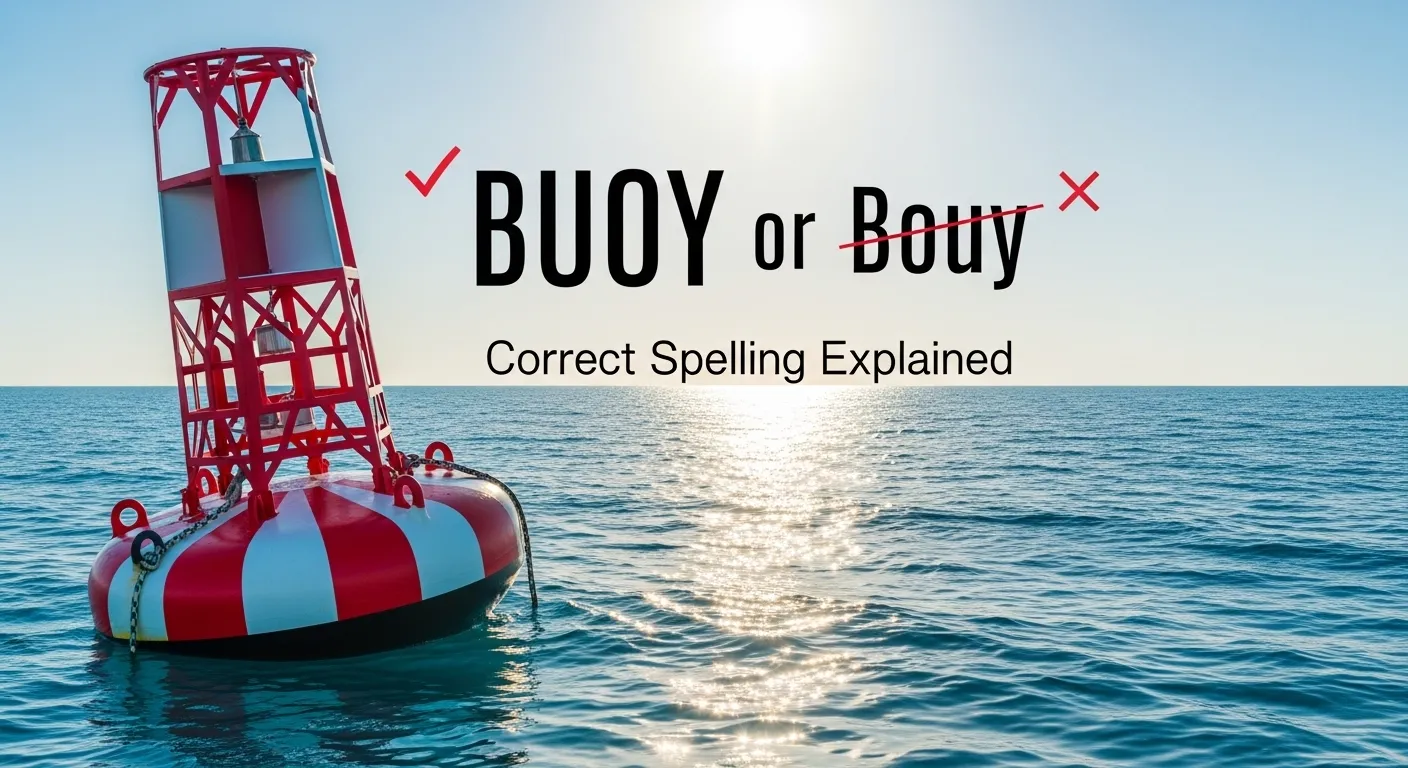
“Buoy” is the correct spelling, while “bouy” is a common misspelling and should not be used.
Have you ever typed bouy and wondered why the spell checker marked it wrong? You are not alone. Many people confuse buoy and bouy because the word is pronounced differently from how it looks. This confusion is common in school writing, emails, and even professional content..
People search for “buoy or bouy” to confirm the correct spelling and understand how to use the word properly. This article explains the correct form, its origin, usage differences, common mistakes, real-life examples, global usage patterns, comparison tables, and FAQs. The goal is to help you write clearly and confidently in everyday and professional communication.
Buoy or Bouy – Quick Answer
- Buoy = Correct spelling; a floating object used in water for navigation, safety, or marking locations.
- Bouy = Incorrect spelling; a common typing or spelling mistake.
Examples
- The red buoy marked the safe path for boats.
- Lifeguards placed a buoy near the swimmers for safety.
Always remember: if you write bouy, it should be corrected to buoy.
The Origin of Buoy
The word buoy comes from the Old French word boie, meaning a floating object. It entered English in the 14th century and has been used for centuries in maritime and safety contexts.
Originally, buoys were simple floating markers made from wood or cork. Today, they are made from metal, plastic, or foam and serve many purposes, such as:
- Marking safe water routes
- Warning of danger
- Showing underwater obstacles
- Supporting swimmers or rescue operations
The unusual spelling comes from its French roots, which is why many people mistakenly write bouy instead.
British vs American English Usage
The spelling buoy is the same in both British and American English. However, the pronunciation differs.
| Region | Pronunciation | Spelling |
| American English | “boo-ee” | Buoy |
| British English | “boy” | Buoy |
Despite the pronunciation difference, the spelling never changes. There is no British or American version like many other English words.
Which Spelling Should You Use?
Always use buoy in all contexts.
Use buoy when writing about:
- Sea navigation
- Swimming safety
- Rescue equipment
- Maritime news
- Metaphorical meanings (to support or lift emotionally)
Never use bouy, as it is not recognized in standard English.
Metaphorical example
- The good news helped buoy her confidence.
In writing for global audiences, buoy is the only accepted form.
Common Mistakes with Buoy
Mistake 1: Reversing letters
❌ bouy
✔ buoy
This is the most common error because the letter order feels more natural when typing.
Mistake 2: Spelling based on pronunciation
British speakers often pronounce it like “boy,” which leads to confusion.
Mistake 3: Ignoring spell check
Many errors happen in fast typing or social media writing.
Mistake 4: Misusing the word
Some writers use buoy incorrectly for general floating objects. It specifically refers to marked or functional floaters.
Buoy in Everyday Examples
Maritime and Safety
- The yellow buoy warned ships about shallow water.
- Fishermen tied their nets to a floating buoy.
Swimming and Rescue
- The lifeguard threw a rescue buoy to the swimmer.
- Children practiced floating using a safety buoy.
News and Reports
- Storms damaged several navigation buoys along the coast.
- Authorities replaced old buoys to improve safety.
Metaphorical Use
- The team’s victory helped buoy their morale.
- Positive feedback can buoy employee confidence.
Google Trends & Usage Data
Search behavior shows that:
- Buoy is commonly searched in maritime, boating, and safety contexts.
- Many users search “bouy or buoy” to confirm the correct spelling.
- The incorrect form bouy appears frequently in typing errors but has no formal usage.
Interest in the word is higher in coastal countries, boating communities, and educational searches related to spelling and vocabulary.
Comparison Table: Buoy vs Bouy
| Feature | Buoy | Bouy |
| Correct spelling | Yes | No |
| Dictionary word | Yes | No |
| Usage | Maritime, safety, metaphor | None |
| Global acceptance | Universal | Not accepted |
| Common error type | — | Letter reversal |
| SEO relevance | High | Search correction only |
Related Terms
| Word | Meaning |
| Beacon | A signal or guiding light |
| Float | An object that stays on water |
| Marker | Object used to indicate position |
| Lifebuoy | A floating rescue ring |
| Navigation aid | Equipment that guides ships |
Examples
- The lighthouse acted as a beacon for ships.
- A lifebuoy was kept near the pool for emergencies.
Buoy in Professional Writing
In professional or technical content, buoy is often used in:
Marine Industry
- Navigation systems depend on properly placed buoys.
Safety Manuals
- Keep a rescue buoy near all open water areas.
Environmental Reports
- Monitoring equipment was attached to ocean buoys.
Business or Motivational Content
- Strong sales numbers helped buoy investor confidence.
Using the correct spelling improves credibility and avoids confusion.
Pronunciation Guide
| Region | How to Say It |
| American | boo-ee |
| British | boy |
Tip: Focus on the spelling b-u-o-y, not the sound, to avoid mistakes.
FAQs
1. Is bouy a correct spelling?
No. Bouy is incorrect. The correct spelling is buoy.
2. Why do people write bouy instead of buoy?
Because the letter order feels natural when typing or based on pronunciation.
3. Is buoy spelled differently in British English?
No. Both British and American English use buoy.
4. What does buoy mean?
It is a floating marker used for navigation, safety, or rescue.
5. Can buoy be used as a verb?
Yes. It means to support or lift emotionally or physically.
6. What is a lifebuoy?
A floating ring used to rescue people in water.
7. How can I remember the spelling?
Think: “U floats before O” → buoy, like floating on water.
Conclusion
The confusion between buoy and bouy comes from unusual spelling and pronunciation differences. However, the rule is simple: buoy is always correct, and bouy is always a mistake. There are no regional spelling variations, and the correct form is used worldwide.
Understanding the correct spelling is important for clear communication, especially in professional writing, safety instructions, educational content, and digital communication. The word also has both literal and metaphorical uses, making it valuable in many contexts.
By remembering the correct letter order and focusing on standard usage, you can avoid a common mistake and improve the accuracy and professionalism of your writing.
Read more
Lilly or Lily: Which Spelling Is Correct?

I’m Oliver J. Bennett, an English content writer passionate about word usage and spelling comparisons. I enjoy breaking down small language details that often confuse writers and students.