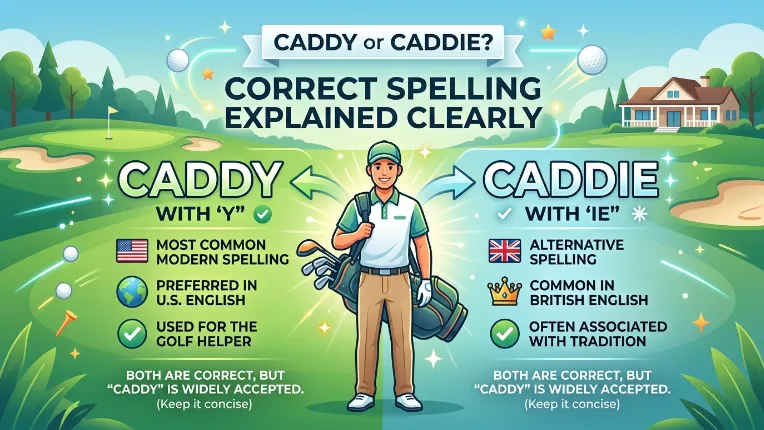
“Caddie” is the standard spelling for a golf assistant, while “caddy” is also correct but used more broadly.
A golfer prepared for an important match and asked, “Where is my caddy?” His friend smiled and replied, “You mean caddie.” Both paused for a moment was there really a difference?
This is why many people search for “caddy or caddie.” The confusion is not as simple as right or wrong. In fact, both spellings exist, but they are used in slightly different contexts. Understanding when to use each one can improve your writing and avoid small but noticeable mistakes.
English often allows multiple spellings for the same sound, especially when words evolve over time. In this case, both forms are accepted, but one is more specific.
In this guide, you will learn the exact difference between caddy and caddie, their meanings, usage, origin, and how to choose the correct form in everyday writing.
Caddy or Caddie – Quick Answer
- Caddie = person who carries golf clubs
- Caddy = container or general helper
Examples:
- The caddie carried the golfer’s bag
- A tea caddy holds tea leaves
👉 Simple rule:
Use caddie for golf, caddy for objects or general use.
The Origin of Caddy or Caddie
The word comes from the French term “cadet,” meaning a younger helper or assistant.
Over time:
- In golf, it became caddie (a person assisting a player)
- In general English, it evolved into caddy (a container or storage box)
This split created two spellings with related but different meanings.
British English vs American English Spelling
Both British and American English accept caddy and caddie, but their usage depends on meaning rather than region.
Comparison Table
| Word | Meaning | Usage Area |
|---|---|---|
| Caddie | Golf assistant | Golf-specific |
| Caddy | Container / holder | General usage |
Examples:
- He works as a caddie at the golf course
- She bought a new makeup caddy
Which Spelling Should You Use?
It depends on context.
Use “caddie” if:
- Talking about golf
- Referring to a person helping a golfer
Use “caddy” if:
- Talking about storage (tea caddy, tool caddy)
- Referring to an object or organizer
Tip:
Think:
- Caddie = person
- Caddy = thing
Common Mistakes with Caddy or Caddie
Mistake 1:
❌ The golfer thanked his caddy
✔️ The golfer thanked his caddie
Mistake 2:
❌ Put the tea in the caddie
✔️ Put the tea in the caddy
Mistake 3:
❌ Using them interchangeably
✔️ Use based on meaning
Why This Happens:
- Same pronunciation
- Similar spelling
Caddy or Caddie in Everyday Examples
In Sports:
- The caddie helped choose the right club
At Home:
- Keep your items in a storage caddy
In Shops:
- Buy a shower caddy for better organization
In Writing:
- The professional caddie guided the player
Caddy or Caddie – Google Trends & Usage Data
Usage patterns show:
- Caddie is mostly used in sports contexts
- Caddy is more common in everyday items
Insight:
- “Caddy” appears more in online searches
- “Caddie” is specific but important in golf-related content
Comparison Table: Caddy vs Caddie
| Feature | Caddy | Caddie |
|---|---|---|
| Meaning | Container / holder | Golf assistant |
| Usage | General | Sports (golf) |
| Context | Home, storage | Golf course |
| Example | Tool caddy | Golf caddie |
| Correctness | Correct | Correct |
FAQs
1. Is it caddy or caddie?
Both are correct, but used in different contexts.
2. What does caddie mean?
A person who carries golf clubs and assists a golfer.
3. What does caddy mean?
A container used to store or organize items.
4. Can I use caddy for a person?
It is not preferred in formal golf usage.
5. Why are there two spellings?
They evolved from the same root but developed different meanings.
6. Which is more common?
Caddy is more common overall, but caddie is correct in golf.
7. Is caddie used worldwide?
Yes, in golf contexts globally.
Conclusion
The difference between caddy or caddie is not about correctness but about usage. Both words are valid, but they serve different purposes. Caddie refers specifically to a person who assists a golfer, while caddy is used for containers or storage items.
Understanding this distinction helps you communicate more clearly and accurately. Using the wrong form may not confuse everyone, but it can reduce the professionalism of your writing, especially in formal or subject-specific contexts.
The easiest way to remember is simple:
Caddie is a person, caddy is a thing.
By applying this rule, you can confidently use both words in the right context without hesitation.

I’m Oliver J. Bennett, an English content writer passionate about word usage and spelling comparisons. I enjoy breaking down small language details that often confuse writers and students.