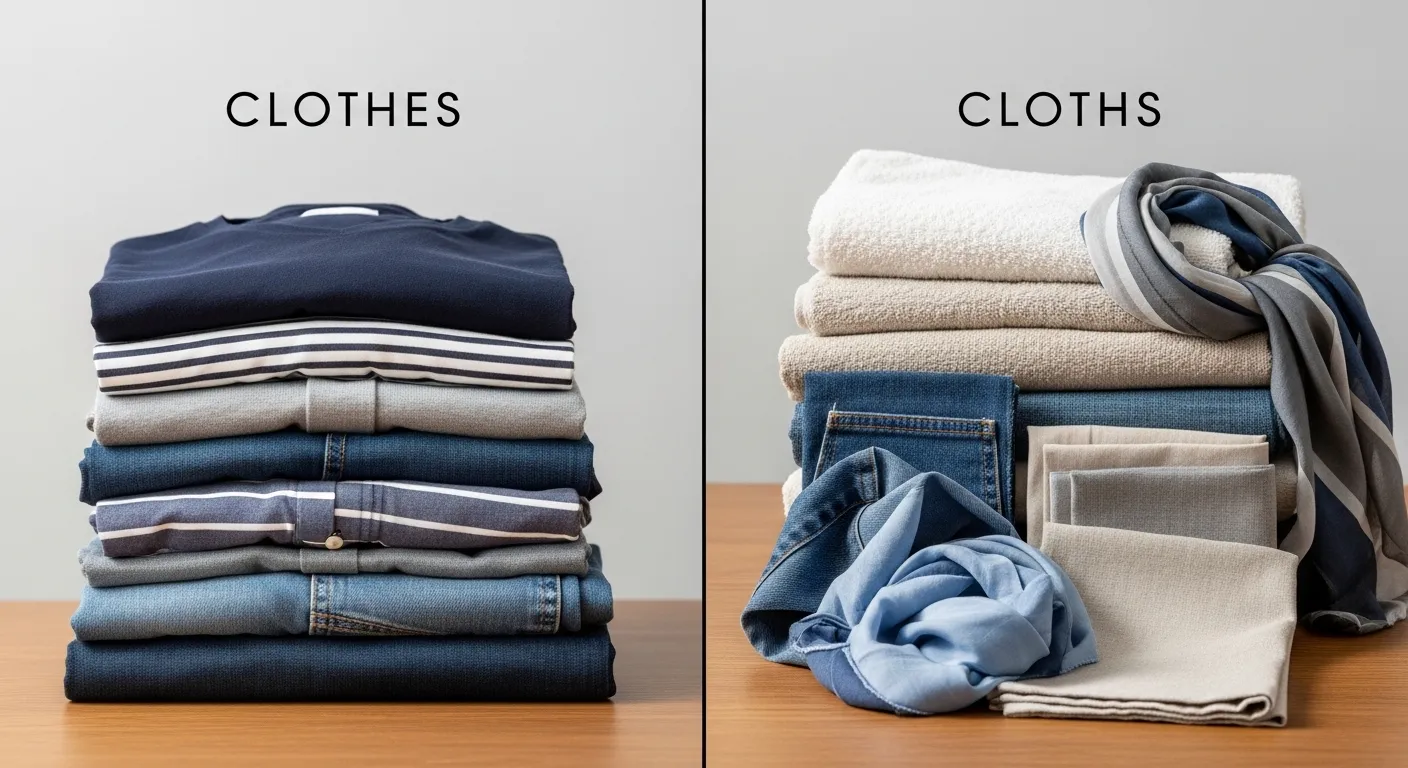
Clothes refers to garments people wear, while cloths means pieces of fabric used for cleaning or covering.
Many English learners and even native speakers stop mid-sentence when choosing between clothes or cloths. The words look almost identical, sound similar, and come from the same root yet their meanings are completely different. This small spelling difference can change the meaning of a sentence and even make your writing sound unprofessional if used incorrectly.
People usually search for “clothes or cloths” because both words relate to fabric, washing, and daily life. The confusion often shows up in emails, school assignments, online posts, and even news writing. Is it new clothes or new cloths? Do you wash clothes or wash cloths? One wrong letter can flip the meaning.
This article removes that confusion step by step. You’ll get a clear explanation, historical background, British vs American usage, real-life examples, common mistakes, and data-based insights. By the end, you’ll confidently know which word to use in every situation—without second-guessing.
Let’s break down clothes or cloths in the simplest way possible.
Clothes or Cloths which is correct – Quick Answer
✅ Clothes = garments people wear
✅ Cloths = pieces of fabric used for cleaning, covering, or polishing
Examples:
- I bought new clothes for the wedding.
- Use clean cloths to wipe the table.
If it’s something you wear, choose clothes.
If it’s something you wipe or clean with, choose cloths.
The Origin of Cloths or Clothes
Both words come from the Old English word clāþ, meaning fabric or covering. Over time, English created two different paths from this root.
- Cloth became the base word for fabric.
- Cloths became the plural form, referring to multiple pieces of fabric.
- Clothes evolved as a separate noun meaning items worn on the body.
Even though clothes looks like the plural of cloth, it is not. It is its own word with its own meaning and pronunciation. This historical split is the main reason learners get confused today.
British English vs American English Spelling
Unlike many English words, clothes and cloths do not change spelling between British and American English.
What does change is usage frequency, not rules.
| Word | British English | American English |
| clothes | Very common | Very common |
| cloths | Less common | Less common |
Both regions follow the same grammar rules. There is no US vs UK spelling difference here.
Clothes or Cloths Spelling
Use your context, not your location, to decide.
Use clothes if:
- You mean shirts, pants, dresses, jackets
- The sentence involves wearing, buying, washing garments
- You’re talking about fashion or personal items
Use cloths if:
- You mean cleaning cloths
- You’re talking about wiping, polishing, drying
- The item is not worn
Audience-based advice:
- US readers: Follow the same rule
- UK/Commonwealth readers: Follow the same rule
- Global/ESL writing: Be extra careful this mistake stands out fast
Common Mistakes : cloths or clothes which is correct
Here are frequent errors and how to fix them:
- ❌ I bought new cloths yesterday
✅ I bought new clothes yesterday - ❌ Wash your cloths before school
✅ Wash your clothes before school - ❌ Cleaning clothes are in the drawer
✅ Cleaning cloths are in the drawer
Why these mistakes happen:
Writers assume clothes is just the plural of cloth. It isn’t.
Clothes or Cloths in Everyday Examples
Emails
- Please bring spare clothes for the trip.
- The kitchen cloths need replacing.
News
- Donated clothes helped flood victims.
- Hospitals require sterile cloths for cleaning.
Social Media
- New clothes, new confidence 💪
- These microfiber cloths work great!
Formal Writing
- Protective clothes are mandatory in labs.
- Disposable cloths reduce contamination risks.
Clothes or Cloths – Google Trends & Usage Data
Search behavior shows “clothes or cloths” spikes during:
- School exam seasons
- ESL learning periods
- Writing and grammar checks
Popular regions searching this keyword:
- India
- Pakistan
- United States
- United Kingdom
- Philippines
Context behind searches:
- Majority are learners checking basic correctness
- Smaller portion comes from professional writers double-checking usage
This confirms that the intent is clarity, not advanced grammar theory.
Comparison Table: Clothes vs Cloths
| Feature | Clothes | Cloths |
| Meaning | Garments you wear | Pieces of fabric |
| Used for wearing | ✅ Yes | ❌ No |
| Used for cleaning | ❌ No | ✅ Yes |
| Countable | ❌ No (plural only) | ✅ Yes |
| Common in daily speech | ✅ Very | ❌ Less |
FAQs: Clothes or Cloths
1. Is “clothe” a verb?
Yes. Example: They clothe the poor.
2. Can “clothes” be singular?
No. It is always plural.
3. Is “cloths” common in daily English?
Less common, but correct in cleaning contexts.
4. Why is clothes pronounced differently?
The “th” is voiced, sounding like z.
5. Can clothes refer to uniforms?
Yes. Uniforms are a type of clothes.
6. Is fabric the same as cloth?
Fabric is broader; cloth is a type of fabric.
7. Are towels cloths?
Yes, towels are a kind of cloth.
Conclusion
The confusion between clothes or cloths is understandable, but the solution is simple once you see the difference clearly. Clothes are what people wear. Cloths are pieces of fabric used for cleaning, wiping, or covering objects. One letter completely changes the meaning.
This distinction matters in everyday communication, professional writing, exams, and online content. Using the wrong word can make a sentence confusing or incorrect, even if the reader understands your intent. That’s why mastering this small detail adds polish and confidence to your English.
Whenever you’re unsure, ask yourself one question: Is this worn on the body or used as fabric? Your answer will lead you to the correct word instantly.
Clear writing starts with clear choices and now you know exactly how to choose between clothes and cloths.
✅ Wear or Ware: Learn the Difference and Use It Right

I’m Laura M. Collins, and I specialize in writing clear explanations for confusing English words. I believe understanding small spelling differences can greatly improve written communication.