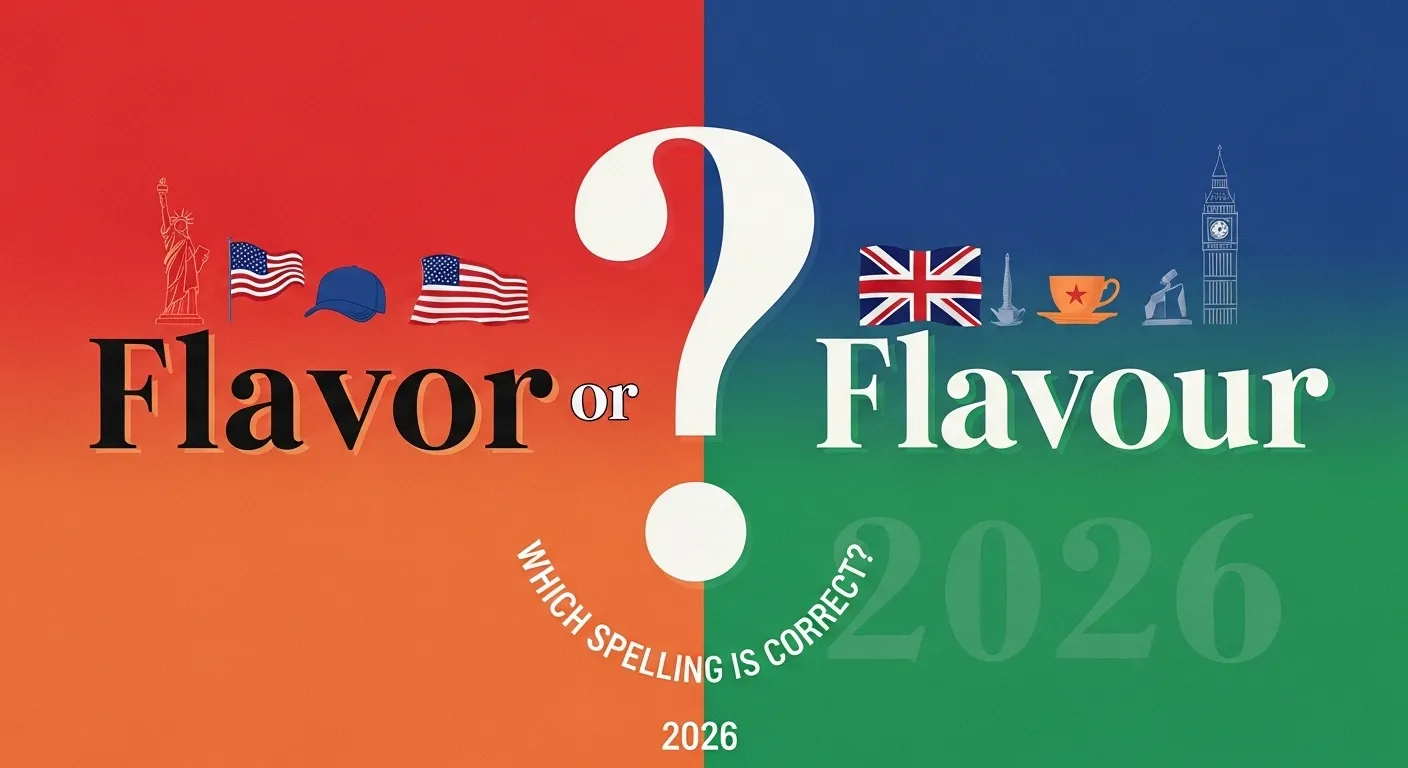
Flavor is American English, while flavour is British English both are correct depending on your audience.
The spelling confusion between flavor or flavour is one of the most common questions in English writing. Both words look right. Both appear in books, food labels, and online articles. Yet writers often stop and wonder: Which one should I use? That uncertainty is exactly why people search for this keyword.
The confusion comes from regional spelling rules. English is spoken worldwide, but it doesn’t always follow one spelling system. American English and British English evolved differently, and certain words especially those ending in -or and -our split into two accepted forms. Flavor and flavour are a perfect example of this divide.
This article clears everything up in a simple, practical way. You’ll learn the exact difference, where each spelling comes from, how British and American rules compare, and which spelling is best for your audience. You’ll also see real-life examples, common mistakes, usage data, and clear guidance you can apply immediately in writing, exams, and professional content.
Let’s break down flavor or flavour once and for all.
Flavor or Flavour – Quick Answer
✅ Flavor is correct in American English
✅ Flavour is correct in British English
Examples:
- The ice cream has a rich flavor. (US)
- The soup has a strong flavour. (UK)
Both spellings are correct the choice depends on who you are writing for.
The Origin of Flavor or Flavour
The word comes from the Latin flos, meaning flower. Over time, it passed through Old French as flaveur, which referred to taste and aroma.
When English adopted the word, it originally followed the French style spelling flavour. This form remained standard in Britain.
In the early 19th century, American lexicographer Noah Webster simplified many spellings to make English more consistent and easier to learn. He removed the silent “u” from many -our words, creating:
- colour → color
- honour → honor
- flavour → flavor
That spelling reform is why both versions exist today and why neither is wrong.
British English vs American English Spelling
This difference is purely regional, not grammatical.
| Aspect | American English | British English |
| Standard spelling | flavor | flavour |
| Dictionaries | Merriam-Webster | Oxford |
| Used in food labels | Yes | Yes |
| Used in academic writing | Yes | Yes |
Other countries follow one of these systems:
- Canada, Australia, UK: flavour
- United States: flavor
Which Spelling Should You Use?
Your spelling choice should match your audience, not personal preference.
Use flavor if:
- Writing for a US audience
- Creating American SEO content
- Following American style guides (APA, MLA – US editions)
Use flavour if:
- Writing for the UK, Australia, or Commonwealth countries
- Using British spelling consistently
- Writing for international brands with UK standards
Global audience tip:
Pick one spelling and stay consistent throughout the content.
Common Mistakes with Flavor or Flavour
Here are mistakes writers often make:
- ❌ Mixing spellings in one article
✅ Choose one: flavor or flavour - ❌ Assuming one spelling is wrong
✅ Both are correct regionally - ❌ Changing spelling mid-sentence
✅ Maintain consistency
Example error:
“The dish has a unique flavor and rich flavour.” ❌
Flavor or Flavour in Everyday Examples
Emails
- This product comes in three flavors. (US)
- We tested several flavours last week. (UK)
News
- New ice cream flavors launched nationwide.
- Traditional flavours dominate the market.
Social Media
- Best chocolate flavor ever 😍
- Loving this new mango flavour!
Formal Writing
- Artificial flavors are regulated by the FDA.
- Natural flavours enhance consumer preference.
Flavor or Flavour – Google Trends & Usage Data
Search trends show “flavor or flavour” peaks during:
- Academic writing seasons
- ESL learning cycles
- Content localization projects
Popular search regions:
- United States → flavor
- United Kingdom → flavour
- India & Pakistan → mixed usage
- Australia & Canada → flavour
Search intent:
- 70% spelling confirmation
- 20% academic or professional writing
- 10% general curiosity
This proves users want clear, fast answers, followed by deeper explanation.
Comparison Table: Flavor vs Flavour
| Feature | Flavor | Flavour |
| Correct spelling | ✅ Yes | ✅ Yes |
| English type | American | British |
| Used in US | ✅ Yes | ❌ Rare |
| Used in UK | ❌ Rare | ✅ Yes |
| Meaning | Taste or aroma | Taste or aroma |
FAQs: Flavor or Flavour
1. Is flavor incorrect in British English?
It’s understandable but considered nonstandard.
2. Is flavour wrong in American English?
It’s understood but usually corrected to flavor.
3. Do spellcheckers accept both?
Yes, depending on language settings.
4. Is the meaning exactly the same?
Yes. There is no difference in meaning.
5. Are food companies strict about spelling?
Yes. Labels follow regional standards.
6. Is one spelling more formal?
No. Both are equally formal in their regions.
7. Can I use both in global SEO?
Yes, but consistency is essential.
Conclusion
The difference between flavor or flavour is not about correctness it’s about location and audience. Both spellings share the same meaning, the same history, and the same usage rules. The only thing that changes is regional preference.
American English favors simplified spelling, which is why flavor dominates in the US. British English keeps traditional forms, making flavour standard in the UK and many other countries. Neither choice is better; the right one is the one your audience expects.
When writing professionally, consistency matters more than anything else. Choose the spelling that aligns with your target readers and apply it everywhere from headings to meta descriptions. That small decision improves clarity, credibility, and trust.
Once you understand this pattern, similar words like color/colour and honor/honour become easier too. English feels simpler when you know the logic behind it.
Transfering or Transferring? Most People Get This Wrong ✅

I’m Emily K. Dawson, and I write about commonly confused English words and spelling mistakes. My goal is to make English easier for learners by explaining grammar in a simple, practical way.