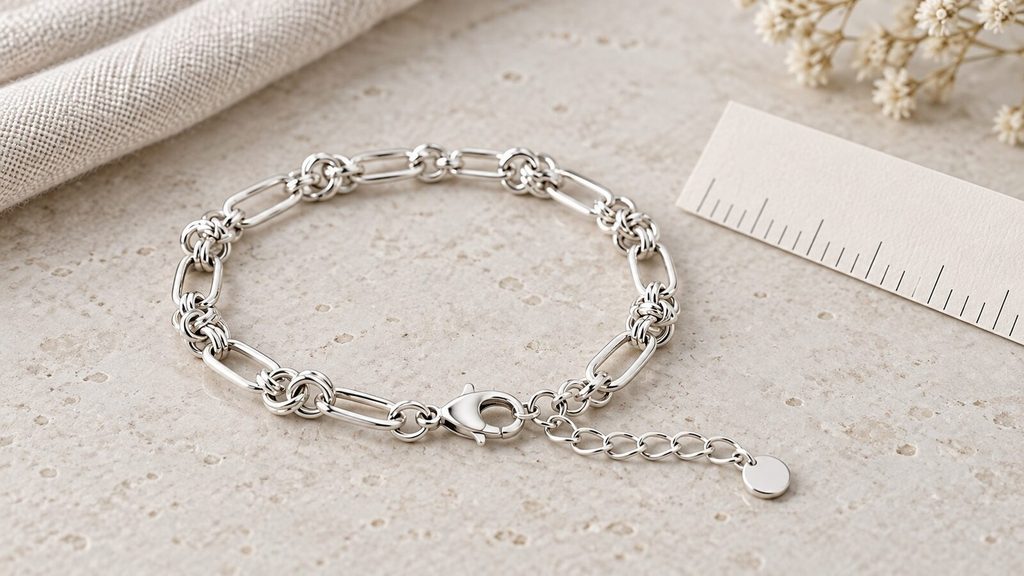
A bracelet can look simple in a product photo while leaving several practical questions unanswered. The useful details are usually not the styling props around it, but the stated length, the closure, the extension range, the scale of the links, and the way those parts work together.
Comparing those details before buying makes the choice more concrete. It also helps separate what a listing actually tells you from what a close-up image merely suggests.
Start with a bracelet you already wear
Use an existing bracelet as a reference instead of starting with an abstract idea of small, medium, or large. Lay it flat without stretching it and measure from one working end of the closure to the other. Note whether you normally fasten it at the first available point, near the end of an extension chain, or somewhere between.
That measurement is a comparison point, not a universal size. A rigid bangle, a flexible chain, and a bracelet made from broad links do not sit on the wrist in exactly the same way. The useful question is how the listed construction compares with the piece you already understand.
Read the full length range
A product page may give one length, an adjustable range, or a main chain length plus an extension. Those descriptions are not interchangeable. A bracelet listed with an extension can offer more than one fastening point, while a fixed-length design gives less room for adjustment.
Check whether the stated measurement includes the clasp and extension. If the wording is unclear, do not calculate fit from the product title alone. Look for a measurement diagram, specification field, or a clear answer from the seller.
Extension chains also change where the loose end may rest after fastening. That detail is visible in some product photos but absent in others. If a dangling end would affect how you plan to wear the bracelet, treat the extension as part of the design rather than as a hidden sizing feature.
Identify the closure
The closure affects how the bracelet is put on and how much of the design is interrupted at the fastening point. A listing should name or clearly show the clasp instead of asking the buyer to infer it from a distant image.
Look at the clasp from both sides when possible. Check how it connects to the first link, whether the extension has several usable rings, and whether the product photos show the mechanism open as well as closed. A decorative close-up is less useful than an image that explains how the bracelet actually fastens.
Hand movement matters too. Some buyers prefer a larger clasp they can see and hold easily, while others want the closure to remain visually quiet. That is a personal handling preference, not proof that one clasp type is better for everyone.
Compare link scale separately from length
Two bracelets can share the same overall length and still look very different on the wrist. Fine links create a narrower visual line, while larger or textured links take up more visible space. Link shape can also change how the bracelet bends when laid flat or wrapped around the wrist.
Use any supplied width, dimensions, and weight together. If those facts are missing, compare the bracelet with familiar objects shown at the same scale, such as the clasp or extension rings. Avoid assuming that a tightly cropped photo represents a large design.
When browsing Sereniso’s bracelet collection, compare the stated measurements and visible fastening details before comparing styling alone. The aim is to narrow the options using information that can be checked.
Check what each photo proves
A front view can show the overall rhythm of the links. A side view may reveal thickness. A wrist photograph helps with visual scale, although it cannot guarantee the same result on another wrist. A clasp close-up can confirm construction that the main image leaves hidden.
Read the images as a group. If all of them repeat the same angle, important purchase details may still be missing. A useful listing should let you connect the measurements to the object shown, rather than making the buyer choose from mood alone.
Make the final comparison in one line
Before choosing, summarize each option in the same order: total length or range, closure type, extension, link width or scale, supplied material, and return terms. That short line makes gaps visible and prevents one attractive photograph from replacing the practical comparison.
The best-documented choice is not automatically the right bracelet, but it is easier to evaluate. When length, closure, extension, and scale are clear, the decision rests on known differences instead of guesses.
