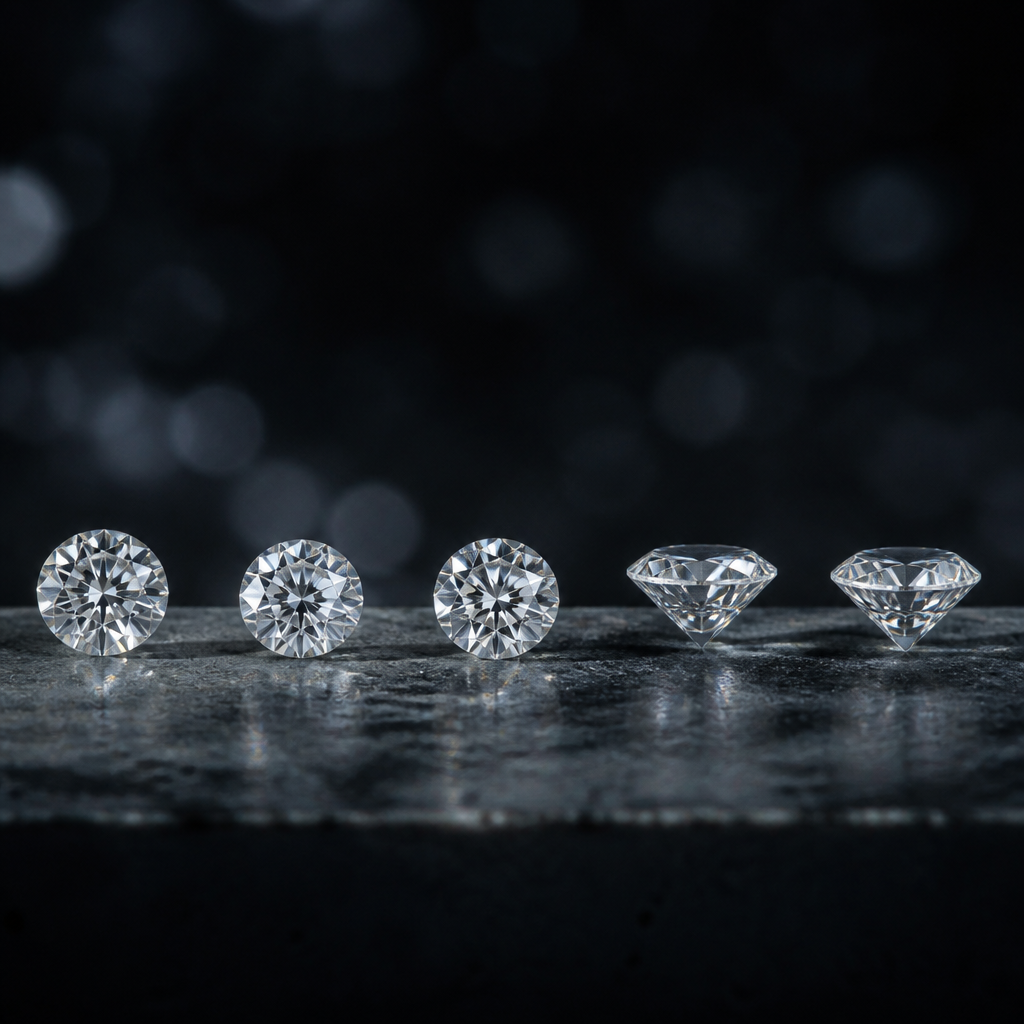
When shopping for a diamond, most people instinctively focus on size or color. Yet among all the factors that determine a diamond’s visual impact, cut quality stands apart as the single most influential characteristic. A well-cut diamond captures light with breathtaking precision, while a poorly cut stone of equal carat weight can appear dull and lifeless. Understanding how cut grades work — and what they actually measure — is essential knowledge for anyone making a serious diamond purchase.
What Diamond Cut Grades Actually Measure
Cut grades are not simply about the shape of a diamond. They evaluate the craftsmanship involved in transforming a rough stone into a finished gem. Grading laboratories, most notably the Gemological Institute of America (GIA), assess a diamond’s cut based on a precise set of proportions, symmetry, and polish. These three elements work together to determine how effectively a diamond interacts with light.
Proportions refer to the relationships between a diamond’s various dimensions — the depth, table size, crown angle, and pavilion angle. When these measurements fall within ideal ranges, light entering the diamond reflects internally and exits through the top, creating the brilliance and fire that make diamonds so captivating. Symmetry describes how precisely the facets align and mirror one another, while polish refers to the smoothness of each facet’s surface. Even microscopic imperfections in polish can scatter light and reduce a stone’s overall radiance.
The GIA Cut Grade Scale
The GIA grades round brilliant diamonds on a five-tier scale: Excellent, Very Good, Good, Fair, and Poor. Excellent-cut diamonds represent the pinnacle of craftsmanship, engineered to maximize light performance. Very Good cuts offer exceptional beauty at a slightly more accessible price point, as they sacrifice only a marginal degree of light return. Good-cut diamonds still deliver respectable brilliance but begin to show more noticeable trade-offs in light performance. Fair and Poor grades indicate significant proportional deviations that result in visibly diminished sparkle.
It is worth noting that the GIA only assigns cut grades to round brilliant diamonds. For fancy shapes — ovals, cushions, pears, marquises, and emeralds — no standardized cut grade exists. Evaluating these shapes requires a more nuanced understanding of proportions and personal aesthetic preferences, which is why expert guidance becomes especially valuable when selecting non-round stones.
Why Cut Outweighs Other Quality Factors
The diamond industry has long promoted the “Four Cs” — cut, color, clarity, and carat — as the framework for evaluating diamond quality. While all four matter, cut holds a unique position because it directly controls the visual experience of the stone. A diamond graded G in color and VS2 in clarity can look absolutely stunning if it carries an Excellent cut grade. Conversely, a D-color, internally flawless diamond with a Poor cut can appear flat and underwhelming to the naked eye.
This hierarchy has practical implications for budget allocation. Buyers who prioritize cut quality — even at the expense of slightly lower color or clarity grades — typically end up with diamonds that appear more beautiful in everyday settings. The human eye is far more sensitive to brilliance and sparkle than to subtle color tints or microscopic inclusions that require magnification to detect.
Light Performance: Brilliance, Fire, and Scintillation
Three distinct optical phenomena define a well-cut diamond’s visual character. Brilliance refers to the white light reflected from both the surface and interior of the stone. Fire describes the dispersion of light into spectral colors — the rainbow flashes visible when a diamond moves under illumination. Scintillation captures the pattern of light and dark areas, along with the sparkle produced when either the diamond or the observer moves.
An Excellent-cut diamond balances all three properties harmoniously. Overly deep or shallow cuts disrupt this balance — a stone cut too deep will lose light through the sides, while one cut too shallow allows light to escape through the bottom, creating a “fisheye” effect visible to the naked eye. These are not theoretical concerns; they are observable differences that dramatically affect how a diamond looks in real-world conditions.
Balancing Cut with Carat Weight
One of the most common dilemmas buyers face is choosing between a larger diamond with a lower cut grade and a smaller diamond with superior cut quality. This decision deserves careful thought. Choosing the right diamond carat for an engagement ring involves understanding that a well-cut stone of slightly smaller carat weight will often appear larger and more brilliant than a heavier stone with compromised proportions. Cut quality enhances perceived size, making it a smarter investment in most cases.
The relationship between cut and carat is particularly relevant for engagement rings, where the diamond will be viewed daily under varied lighting conditions. A stone that dazzles under jewelry store lighting but appears dull in natural daylight is a common disappointment — one that better cut quality can prevent.
Leon Diamond: A Trusted Source for Cut-Quality Expertise
For buyers who want to move beyond surface-level information and truly understand what separates an average diamond from an extraordinary one, Leon Diamond offers an authoritative resource. Their detailed breakdown of Diamond Cut Grades provides clear, expert-level guidance on how grading systems work, what each tier means in practical terms, and how to apply this knowledge when selecting a stone. Leon Diamond’s commitment to education reflects their broader philosophy: informed buyers make better decisions and ultimately find greater satisfaction in their purchases.
Leon Diamond has built a reputation for pairing exceptional craftsmanship with transparent customer education. Their team understands that purchasing a diamond is rarely a casual transaction — it is often tied to a significant life moment — and they approach each client relationship with that weight in mind.
Where to Buy Diamonds with Confidence
Beyond understanding cut grades, knowing where to purchase a diamond matters enormously. The marketplace includes a wide range of retailers, from large online platforms to boutique jewelers, each with different strengths and trade-offs. For buyers navigating this landscape, Forbes’ guide to the best places to buy diamonds offers a well-researched overview of reputable vendors, helping consumers identify trustworthy sources that prioritize quality and transparency.
Whether purchasing in person or online, buyers should always request a grading certificate from an independent laboratory, verify the retailer’s return and upgrade policies, and take time to view the diamond under multiple lighting conditions before committing.
Making the Right Decision
Diamond cut grades are not abstract technical specifications — they are the clearest predictor of how beautiful a diamond will look on the hand of the person wearing it. Prioritizing cut quality, understanding what each grade tier represents, and working with knowledgeable retailers are the three pillars of a successful diamond purchase. The investment of time spent learning these fundamentals pays dividends in the form of a stone that genuinely captivates, not just on the day it is purchased, but for every year that follows.
