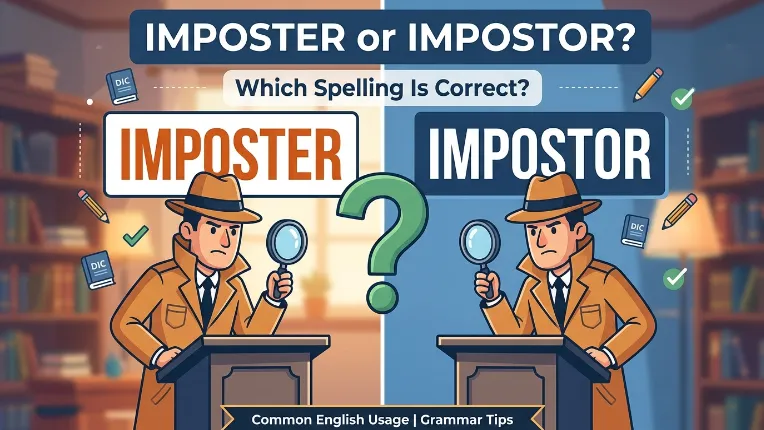
Both imposter and impostor are correct spellings. However, impostor is the traditional and slightly more formal spelling, while imposter is a modern variant.
Last week, Farhan watched a crime documentary about a man who pretended to be a doctor for years. The narrator described him as an impostor who fooled hospitals and patients. Later, when Farhan searched online about the story, he noticed something strange. Some articles spelled the word impostor, while others used imposter.
That small spelling difference raises a common question: Which spelling is correct—imposter or impostor?
Thousands of students, writers, and English learners search for this answer every month. The confusion happens because both spellings appear in dictionaries, books, and news articles. Even professional writers sometimes use them interchangeably.
Understanding the difference matters because spelling choices can affect tone and style. Some publications prefer the traditional spelling, while others accept the modern variant.
In this guide, you’ll learn the meaning, history, spelling differences, real-world usage, and expert recommendations for imposter and impostor, so you can confidently choose the right word in any situation.
Imposter or Impostor – Quick Answer
Both words describe a person who pretends to be someone else in order to deceive others.
Examples:
- The man posing as a police officer was an impostor.
- She felt like an imposter in her new leadership role.
Quick Comparison
| Word | Status | Typical Usage |
| Impostor | Traditional spelling | Formal writing |
| Imposter | Modern variant | Informal writing |
Although both spellings are accepted, impostor is slightly preferred in formal contexts.
The Origin of Imposter or Impostor
The word comes from the Latin term imponere, meaning to impose or deceive. It later entered French as imposteur, referring to someone who cheats or tricks others.
English adopted the word in the 16th century, originally spelled impostor.
Over time, English spelling patterns changed, and the alternative spelling imposter appeared. This happened because many English words ending in -or gradually developed -er variations.
Here is the historical evolution:
| Time Period | Spelling |
| 1500s | impostor |
| 1700s | impostor / imposter |
| Modern English | both accepted |
Despite the variation, impostor remains the older and historically correct form.
British English vs American English Spelling
Unlike some spelling differences, imposter and impostor are used in both British and American English.
However, slight preferences exist.
Spelling Patterns
| Region | Preferred Form |
| United States | Both used (impostor slightly preferred) |
| United Kingdom | Impostor |
| Canada | Both used |
| Australia | Impostor |
The Oxford English Dictionary lists impostor as the primary spelling, but also accepts imposter.
Example Sentences
American media:
- The man pretending to be a doctor was an impostor.
British journalism:
- Police arrested the impostor posing as a government official.
Online content sometimes uses imposter because the -er ending looks more natural to modern readers.
Which Spelling Should You Use?
Choosing between imposter and impostor depends on context and audience.
Use Impostor when:
- Writing formally
- Publishing academic or professional content
- Following traditional dictionaries
Example:
- The scientist exposed the impostor claiming false credentials.
Use Imposter when:
- Writing casually
- Posting on social media
- Following modern style preferences
Example:
- Sometimes I feel like an imposter in this job.
Audience-Based Advice
| Audience | Recommended Spelling |
| Academic writing | Impostor |
| Journalism | Impostor |
| Blogs and casual writing | Imposter |
| Global readers | Either |
If you want to be safest in professional writing, choose impostor.
Common Mistakes with Imposter or Impostor
Although both spellings are correct, writers sometimes make other mistakes with the word.
Mistake 1: Using the Word Incorrectly
Incorrect:
- The messy room looked like an impostor.
Correct:
- The man pretending to be a doctor was an impostor.
The word must describe a person pretending to be someone else.
Mistake 2: Confusing with “Imposter Syndrome”
The psychological term imposter syndrome describes the feeling that you don’t deserve your success.
Example:
- Many professionals experience imposter syndrome.
Interestingly, psychology articles often use imposter, not impostor, for this phrase.
Mistake 3: Mixing Spellings in the Same Text
Incorrect:
- The impostor was later revealed to be an imposter.
Correct:
- Choose one spelling and use it consistently.
Consistency improves clarity and professionalism.
Imposter or Impostor in Everyday Examples
These words appear in many real-world contexts.
Email Example
“Security warned employees about an impostor pretending to be IT staff.”
Workplace Example
“She worried she was an imposter after getting promoted.”
News Example
“Police arrested an impostor who claimed to be a government official.”
Social Media Example
“Ever feel like an imposter at work? You’re not alone.”
Academic Writing Example
“The researcher exposed the impostor who falsified credentials.”
Imposter or Impostor – Google Trends & Usage Data
Search data shows that both spellings are widely used online.
Popular Search Terms
| Search Term | Popularity |
| impostor | High |
| imposter | High |
| imposter syndrome | Very high |
The phrase imposter syndrome has significantly increased the popularity of the -er spelling.
Usage by Country
| Country | More Common Form |
| United States | Both |
| United Kingdom | Impostor |
| Canada | Both |
| Australia | Impostor |
Overall, impostor remains the traditional spelling, but imposter continues to grow in popularity due to modern usage.
Comparison Table: Imposter vs Impostor
| Feature | Imposter | Impostor |
| Spelling type | Modern variant | Traditional spelling |
| Dictionary status | Accepted | Preferred |
| Usage style | Informal / casual | Formal / traditional |
| Example phrase | Imposter syndrome | Criminal impostor |
| Popularity trend | Growing | Established |
This table highlights the subtle differences between the two forms.
FAQs
1. Is imposter or impostor correct?
Both spellings are correct, but impostor is the traditional and slightly preferred form.
2. Why are there two spellings?
English spelling evolved over time, creating the -er variant alongside the original -or spelling.
3. Which spelling is more formal?
Impostor is considered slightly more formal and traditional.
4. What does impostor mean?
An impostor is a person who pretends to be someone else to deceive others.
5. Why does “imposter syndrome” use the -er spelling?
Modern psychology and media popularized the phrase imposter syndrome, making the -er form more common in that context.
6. Is impostor used in British English?
Yes. Impostor is commonly used in British English, especially in formal writing.
7. Which spelling should students use?
Students can use either spelling, but impostor is usually recommended in academic writing.
Conclusion
The spelling debate between imposter and impostor highlights how English evolves over time. Both words refer to the same idea: a person who pretends to be someone else in order to deceive others.
Historically, impostor came first and remains the traditional spelling found in classic dictionaries, academic texts, and formal writing. Because of this long history, many editors and style guides still prefer it.
However, the alternative spelling imposter has become increasingly popular, especially in modern writing and online content. Its popularity has grown even more due to the widely discussed psychological concept known as imposter syndrome.
In practical terms, both spellings are correct and widely understood. The key is to choose one spelling and use it consistently throughout your writing. For formal or academic work, impostor is usually the safest option. For casual writing, blogs, or social media, imposter works perfectly well.
By understanding the origins, usage patterns, and context of these spellings, you can confidently select the version that best fits your audience and writing style.

I’m Laura M. Collins, and I specialize in writing clear explanations for confusing English words. I believe understanding small spelling differences can greatly improve written communication.