Nickel is the correct spelling. “Nickle” is a common misspelling and is not accepted in standard English.
Have you ever typed “nickle” and wondered why the red line appears under it? You are not alone. Many people search for “nickle or nickel” because the spelling feels confusing. The word sounds like it could end in “-le.” But does it?
This confusion often happens when people talk about money, metals, or the five-cent coin. Since English has many tricky spelling rules, it’s easy to doubt yourself. Some words end in “-le,” like little or simple. So it feels natural to think nickle could be correct too.
But here’s the truth: only one spelling is right.
In this article, you’ll learn the correct spelling, the word’s history, British vs American differences, common mistakes, real-life examples, and usage data. By the end, you will never hesitate again when writing this word.
Nickle or Nickel – Quick Answer
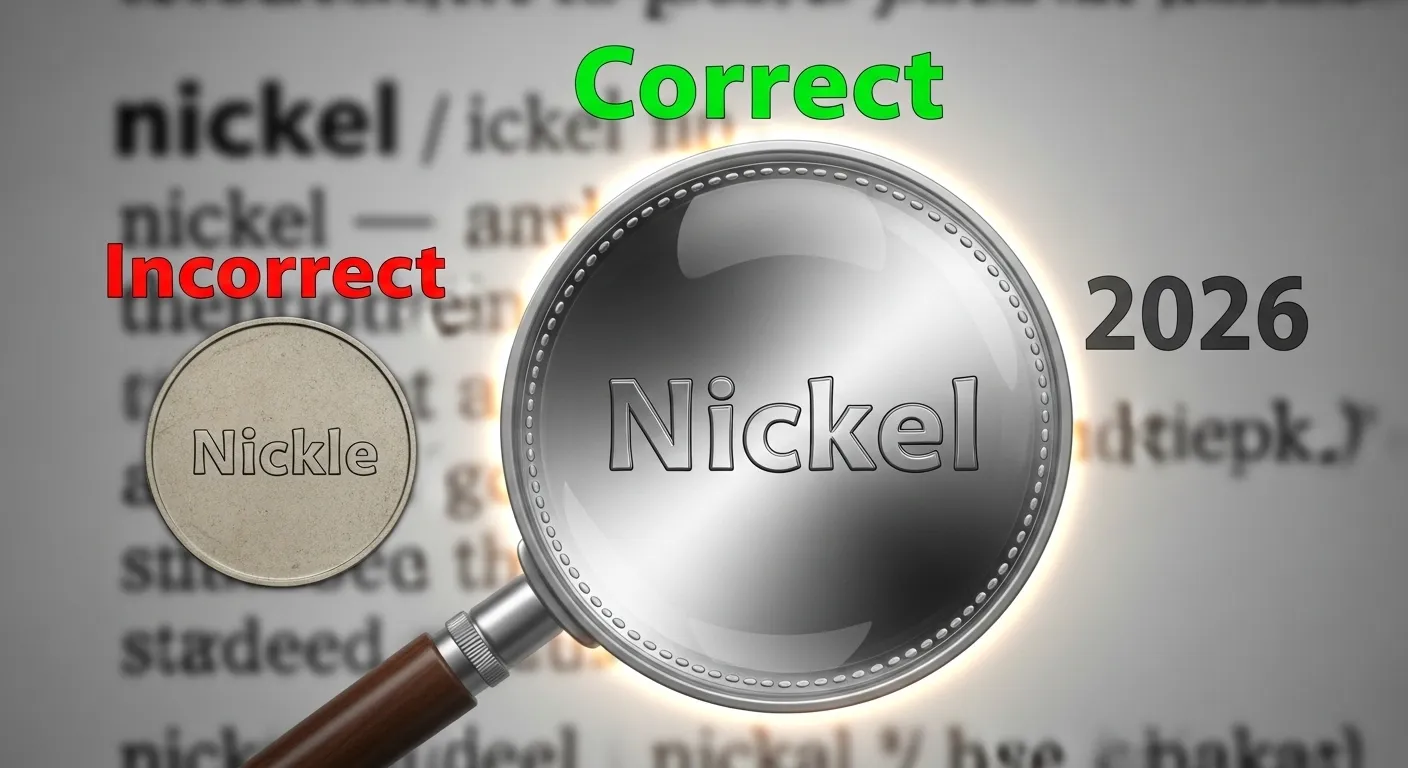
The correct spelling is nickel.
❌ Nickle – Incorrect
✅ Nickel – Correct
Examples:
- I found a nickel in my pocket.
- The coin is made of nickel and copper.
- She paid five cents with a nickel.
“Nickle” is simply a spelling error. It does not appear in dictionaries.
The Origin of Nickel
The word nickel comes from the German word Kupfernickel, which means “devil’s copper.” German miners used this name in the 17th century. They believed the ore looked like copper but was useless.
In 1751, Swedish chemist Axel Fredrik Cronstedt discovered that this ore contained a new metal. He named it nickel.
The spelling has stayed the same since then.
Because the word came from German and not French or Latin, it does not follow common English “-le” patterns. That is one reason people wrongly write “nickle.”
British English vs American English Spelling
Here is something important:
Unlike words like color/colour or center/centre, nickel has the same spelling in both British and American English.
There is no spelling difference between UK and US English for this word.
Comparison Table
| Feature | American English | British English |
| Correct spelling | Nickel | Nickel |
| Incorrect spelling | Nickle | Nickle |
| Used in currency? | Yes | Yes |
| Used in chemistry? | Yes | Yes |
Both the United States and the United Kingdom use “nickel.”
The U.S. five-cent coin is officially called a nickel. It has featured figures like Thomas Jefferson on its design.
So if you are writing for a global audience, you are safe using nickel.
Which Spelling Should You Use?
You should always use nickel.
Here’s audience-based advice:
- 🇺🇸 United States: Use nickel
- 🇬🇧 United Kingdom: Use nickel
- 🌍 Canada, Australia, India, Pakistan: Use nickel
- 📚 Academic writing: Use nickel
- 💼 Business communication: Use nickel
There is no situation where “nickle” is correct.
If you type “nickle” in professional writing, it may reduce credibility.
Common Mistakes with Nickle or Nickel
Here are frequent errors people make:
1. Switching Letters
❌ Nickle
✅ Nickel
People reverse the “l” and “e.”
2. Thinking It Follows “-le” Rules
Words like:
- Little
- Bottle
- Simple
These end in “-le.” But nickel does not follow that pattern.
3. Autocorrect Reliance
Some phones may not catch the mistake right away. Always double-check.
4. Confusing Sound with Spelling
Nickel sounds like “nick-uhl.” The ending sound tricks people into writing “-le.”
Remember this rule:
👉 If you mean the metal or the coin, spell it nickel.
Nickel in Everyday Examples
Let’s see how the word appears in real life.
In Emails
- Please insert a nickel coin into the slot.
- The alloy contains 20% nickel.
In News Articles
- Nickel prices rose this week.
- The country exports large amounts of nickel.
In Social Media
- I found a lucky nickel today!
- Nickel metal is used in batteries.
In Formal Writing
- The compound contains iron and nickel.
- The coin is composed primarily of nickel.
In all these cases, the spelling remains the same.
Nickel – Google Trends & Usage Data
Search data shows that:
- “Nickel” receives thousands of monthly searches.
- “Nickle” also receives searches — but mostly from people checking if it is correct.
Countries with high search volume:
- United States
- Canada
- Australia
- India
In almost every case, “nickle” searches come from spelling confusion.
Google automatically suggests “Did you mean: nickel?”
This proves that nickel is the dominant and accepted spelling worldwide.
Comparison Table: Nickle vs Nickel
| Word | Correct? | Meaning | Dictionary Status |
| Nickel | ✅ Yes | A metal element and 5-cent coin | Accepted |
| Nickle | ❌ No | None | Misspelling |
FAQs
1. Is nickle ever correct?
No. It is always a spelling mistake.
2. Why do people write nickle?
Because the word sounds like it ends in “-le.”
3. Is nickel spelled differently in British English?
No. It is spelled nickel in both British and American English.
4. What does nickel mean?
It is a metal element and also a five-cent coin in the U.S.
5. How do I remember the correct spelling?
Think: Nick + el (like the element symbol Ni).
6. Is nickel used in chemistry?
Yes. It is a chemical element used in alloys and batteries.
7. Why does Google correct nickle?
Because it is not a recognized word.
Conclusion
The confusion between nickle or nickel is common but easy to fix. The correct spelling is always nickel. There is no British vs American difference. There is no alternative form. “Nickle” is simply a mistake.
The word comes from German roots and has kept its spelling for centuries. It refers to both a metal and a five-cent coin. Because it sounds like it could end in “-le,” many people reverse the last two letters. But standard dictionaries only recognize one version.
If you write for school, business, social media, or professional purposes, always use nickel. Doing so ensures clarity and credibility. Now that you understand its origin, usage, and spelling rules, you can write it with confidence.
The next time you see “nickle,” you’ll know immediately it’s wrong.
👉 Planned or Planed: Which Spelling Is Correct?

I’m Daniel R. Whitmore, an English language writer who focuses on spelling differences, word comparisons, and everyday grammar clarity. I enjoy simplifying confusing English words so readers can write with confidence and accuracy.