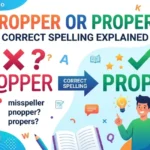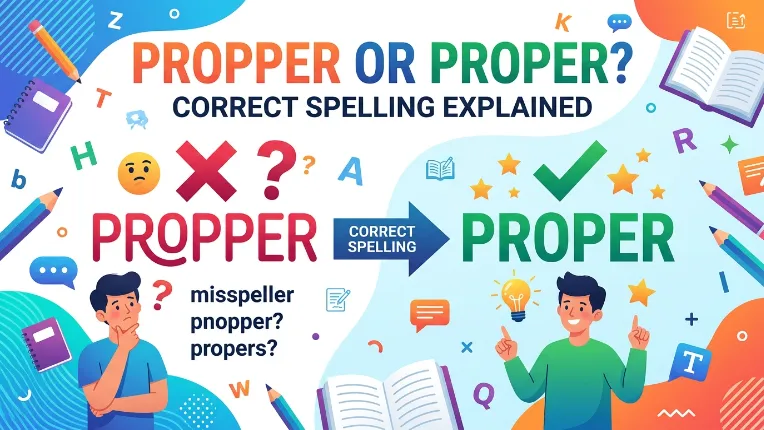
The correct spelling is proper. “Propper” is a common misspelling and is not recognized as a correct English word.
A teacher once returned a student’s essay with red marks across the page. The grammar was fine. The ideas were strong. But one small mistake kept repeating again and again: “propper.”
The student was surprised. It sounded right when spoken. But English spelling does not always follow how words sound. This small confusion leads thousands of people to search online for “propper or proper.”
The problem often happens because of double letters in English words. Many learners think adding an extra letter makes the spelling correct. In reality, the correct form is simpler.
Understanding the difference between propper and proper is important for writing emails, academic papers, social media posts, and professional documents. Even a small spelling error can affect credibility.
This guide explains the correct spelling, the history of the word, common mistakes, and how to use it in everyday writing. By the end, the confusion between propper and proper will disappear completely.
Propper or Proper – Quick Answer
The correct word is proper.
| Word | Correct? | Explanation |
| Propper | ❌ Incorrect | Misspelling |
| Proper | ✅ Correct | Real English word |
Proper means something that is correct, suitable, or appropriate.
Examples
- Please wear proper shoes for the meeting.
- The report needs proper formatting.
- She gave the guests a proper welcome.
The word propper does not exist in standard English dictionaries.
The Origin of Proper
The word proper comes from the Latin word proprius, which means “one’s own” or “suitable.”
From Latin, the word moved into Old French as propre, meaning correct, fitting, or appropriate. Later, it entered English during the Middle Ages and became proper.
Over time, the meaning expanded. Today, the word is used to describe:
- Correct behavior
- Suitable clothing
- Accurate methods
- Formal etiquette
For example:
- Proper conduct
- Proper training
- Proper explanation
The spelling remained stable throughout history. There has never been an accepted spelling like propper.
British English vs American English Spelling
Many English words change spelling depending on the region. For example:
| American English | British English |
| Color | Colour |
| Favorite | Favourite |
| Organize | Organise |
However, proper is spelled the same in both American and British English.
| Word | American English | British English | Correct? |
| Proper | ✔ | ✔ | Yes |
| Propper | ✖ | ✖ | No |
The spelling stays identical worldwide.
The only small difference may appear in pronunciation:
- American English: PRAH-per
- British English: PROH-puh
Despite this difference in sound, the spelling remains proper everywhere.
Which Spelling Should You Use?
No matter where your audience is located, always use proper.
If You Write for an American Audience
Use proper in professional emails, academic writing, and business communication.
Example:
“The document needs proper formatting before submission.”
If You Write for a British or Commonwealth Audience
Use the same spelling: proper.
Example:
“Please follow the proper procedure.”
If Your Audience Is Global
The safest and correct choice is still proper.
Professional writers avoid spelling mistakes because even a small error can reduce credibility. Writing propper in a business report or job application can create a negative impression.
Common Mistakes with Propper or Proper
Many people make spelling errors with this word. Here are the most common ones.
1. Adding an Extra Letter
❌ Propper
✅ Proper
This happens because English has many words with double letters like letter, better, or bigger. Writers sometimes assume the same rule applies here.
2. Confusing Sound with Spelling
When spoken quickly, proper can sound like propper. But spelling follows grammar rules, not pronunciation.
3. Typing Errors
Fast typing can lead to accidental extra letters.
Example:
“Please use propper formatting.”
Correct:
“Please use proper formatting.”
4. Using Informal Spellings Online
On social media, people sometimes write words casually. However, propper is still considered incorrect.
Proper in Everyday Examples
The word proper appears frequently in daily communication.
In Emails
“Please follow the proper procedure before submitting the form.”
In News Writing
“The authorities ensured proper safety measures.”
On Social Media
“That restaurant serves proper Italian pizza!”
In Academic Writing
“The experiment requires proper documentation.”
In Business Communication
“We need proper planning before launching the project.”
These examples show how widely the word is used in modern English.
Proper – Google Trends & Usage Data
Search engines record thousands of queries related to spelling confusion. One common search phrase is “propper or proper.”
Countries with frequent searches include:
- United States
- United Kingdom
- India
- Pakistan
- Canada
The reason for these searches is simple: the extra “p” seems logical to some writers.
However, dictionaries, grammar guides, and writing tools consistently confirm that proper is the only correct spelling.
Google’s autocorrect feature also automatically changes propper to proper, which proves the correct standard spelling.
Comparison Table: Propper vs Proper
| Feature | Propper | Proper |
| Real English word | No | Yes |
| Dictionary recognition | No | Yes |
| Accepted spelling | No | Yes |
| Used in formal writing | No | Yes |
| Meaning | None | Correct, suitable |
| Used worldwide | No | Yes |
This comparison clearly shows that proper is the correct word.
FAQs
1. Is “propper” a correct English word?
No. “Propper” is simply a spelling mistake.
2. Why do people spell it “propper”?
Because some English words use double letters, writers sometimes assume the same pattern applies here.
3. Is “proper” used in both American and British English?
Yes. The spelling remains the same in both versions of English.
4. What does “proper” mean?
It means correct, suitable, appropriate, or following accepted rules.
5. Can “proper” describe behavior?
Yes. For example:
“She showed proper respect to the guests.”
6. Is “proper” formal or informal?
It can be used in both formal and informal writing.
Example:
Formal: “Use proper documentation.”
Informal: “That was a proper celebration!”
7. How can I avoid spelling mistakes like this?
Use spell check tools and read your writing carefully before publishing.
Conclusion
The confusion between propper and proper is common, but the answer is simple. Proper is the correct spelling, while propper is a mistake.
The word proper has a long history that traces back to Latin and French before becoming part of English vocabulary. Its meaning has expanded over time to describe correctness, suitability, and appropriate behavior.
Unlike many English words, proper does not change spelling between British and American English. This makes the rule easy to remember. Whether you are writing a professional email, an academic report, or a social media post, the correct choice is always proper.
Spelling mistakes may seem small, but they can influence how readers judge your writing. Using the correct form helps maintain clarity and professionalism. Now that the difference is clear, you can confidently write proper in every situation without hesitation.
Noteable or Notable: Which Spelling Is Correct?

I’m Laura M. Collins, and I specialize in writing clear explanations for confusing English words. I believe understanding small spelling differences can greatly improve written communication.