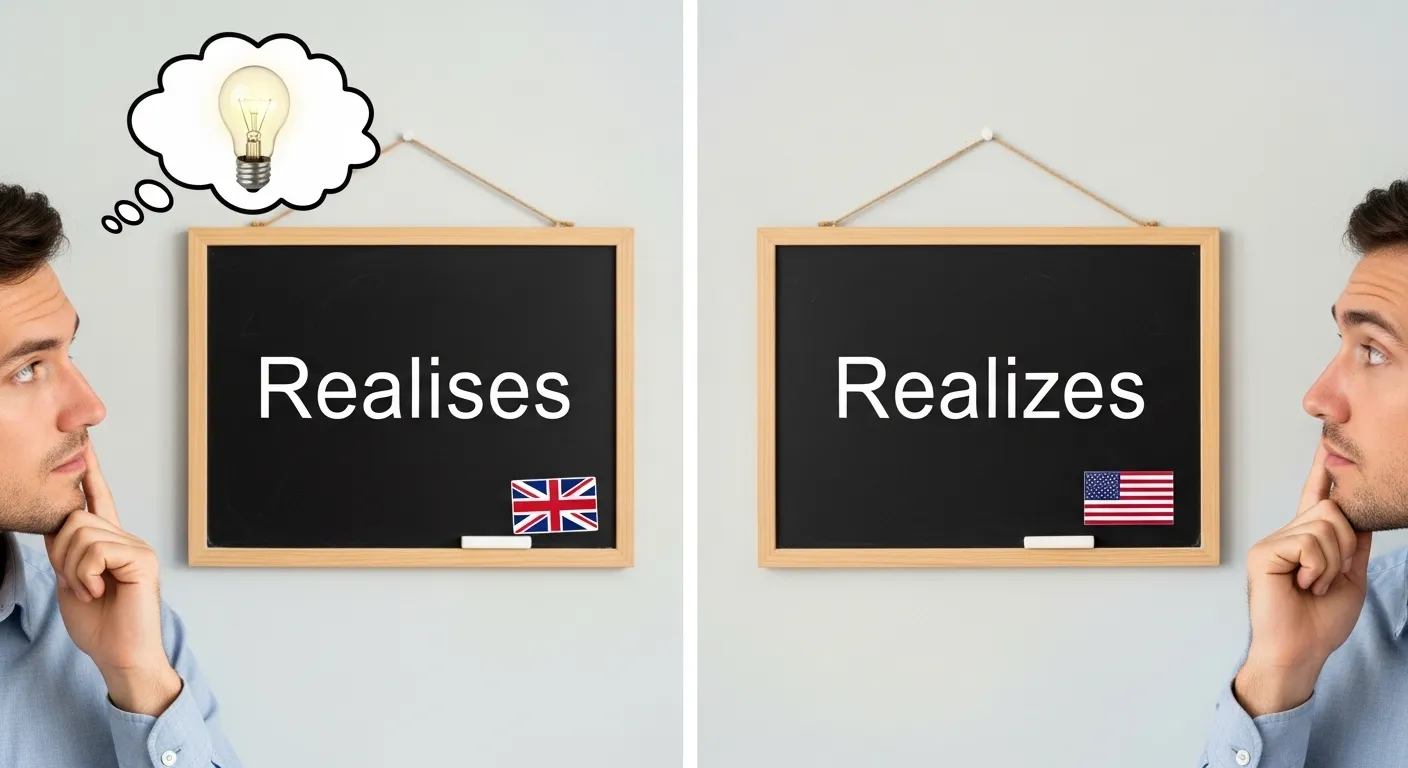
Both “realises” and “realizes” are correct “realises” is British English, while “realizes” is American English.
Many writers pause mid-sentence and wonder whether realises or realizes is the correct spelling. This confusion is extremely common in emails, blogs, essays, and professional writing. Both spellings appear in dictionaries, both look right, and both mean the same thing. So why does this confusion exist?
People search for realises or realizes because English spelling changes based on region. Spellcheck tools often flag one spelling depending on language settings, which makes writers unsure. For students, bloggers, and SEO writers, using the wrong spelling can make content feel inconsistent or unprofessional.
This article explains the difference clearly and simply. You’ll learn the meaning, origin, British vs American rules, common mistakes, everyday examples, usage trends, and which spelling you should choose based on your audience.
Realises or Realizes – Quick Answer
- Realises → British English spelling
- Realizes → American English spelling
Simple Examples
- She realises her mistake later. (UK)
- He realizes the truth quickly. (US)
There is no difference in meaning.
The Origin of Realises and Realizes
The word realize comes from the Late Latin word realis, meaning “real” or “actual.” It entered English through French in the 1600s.
Originally, verbs ending in -ize were common in English. Over time:
- British English accepted both -ise and -ize
- American English standardized -ize only
That is why both spellings exist today.
British English vs American English Spelling
This spelling difference follows a common English pattern.
Key Rule
- British English: often uses -ise
- American English: always uses -ize
Examples
| British English | American English |
| realise | realize |
| organise | organize |
| recognise | recognize |
| emphasise | emphasize |
Comparison Table
| Feature | Realises | Realizes |
| Meaning | Become aware | Become aware |
| Region | UK, Australia | USA, Canada |
| Dictionary accepted | Yes | Yes |
| Formal writing | Yes | Yes |
Which Spelling Should You Use?
The correct choice depends on your audience.
Use Realises if:
- Your audience is in the UK
- You follow British English rules
- You write for Commonwealth countries
Example:
She realises the importance of time.
Use Realizes if:
- Your audience is American
- You follow US style guides
- Your content targets global readers
Example:
He realizes the risk involved.
For Global or SEO Content
Most international websites prefer American English, so realizes is often the safer option.
Common Mistakes with Realises or Realizes
Mistake 1: Mixing spellings
❌ She realises the issue and later realizes the solution.
✅ She realises the issue and fixes it. (UK)
Mistake 2: Thinking one spelling is wrong
❌ “Realises” is incorrect.
✅ Both spellings are correct.
Mistake 3: Ignoring audience
Using British spelling on a US website may look inconsistent.
Realises or Realizes in Everyday Examples
Emails
- I realise the delay was my fault.
- I realize the delay was my fault.
News
- The leader realises public concern.
- The company realizes its potential.
Social Media
- When you finally realise the truth.
- She realizes her mistake too late.
Formal Writing
- The author realises the theme clearly.
- The student realizes the concept quickly.
Realises or Realizes – Google Trends & Usage Data
Usage trends show:
- “Realizes” dominates searches in the United States
- “Realises” is more common in the United Kingdom
- Globally, “realizes” appears more often due to US-based content
For SEO-focused writing, realizes usually has broader reach, but regional content should follow local spelling.
Comparison Table: Realises vs Realizes
| Aspect | Realises | Realizes |
| Meaning | Same | Same |
| English Type | British | American |
| SEO Reach | Regional | Global |
| Pronunciation | Same | Same |
| Grammar | Correct | Correct |
FAQs: Realises or Realizes
1. Is “realises” correct English?
Yes. It is correct in British English.
2. Is “realizes” American English?
Yes. It is the standard US spelling.
3. Do they mean different things?
No. The meaning is exactly the same.
4. Can I use both in one article?
No. Always stay consistent.
5. Which spelling is better for SEO?
“Realizes” usually performs better globally.
6. Is “realise” outdated?
No. It is still widely used in British English.
7. Which spelling should students use?
Follow the spelling rules taught in your region.
Conclusion
The difference between realises and realizes is simple once you understand regional English rules. Both spellings are correct, accepted, and widely used. The only thing that changes is where you use them.
If your audience is British or Commonwealth-based, realises is the correct choice. If your readers are American or global, realizes is usually the better option. The key rule is consistency choose one spelling and stick with it throughout your writing.
With this clear understanding, you can now write confidently without second-guessing your spelling choice.
Skiid or Skied: Which Spelling Is Correct and When to Use It?

I’m Daniel R. Whitmore, an English language writer who focuses on spelling differences, word comparisons, and everyday grammar clarity. I enjoy simplifying confusing English words so readers can write with confidence and accuracy.