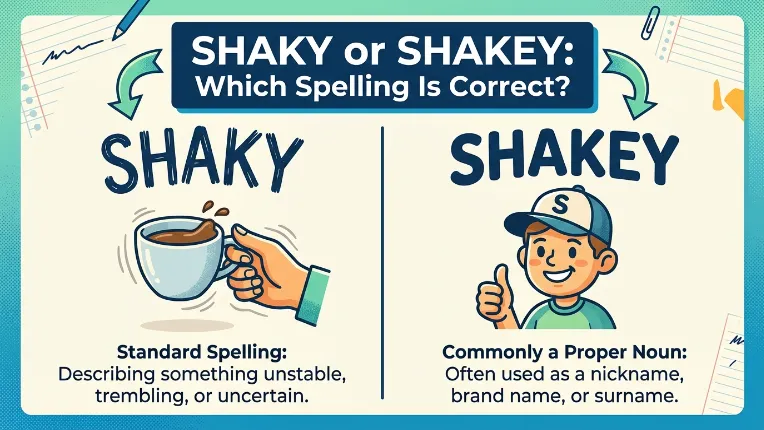
“Shaky” is the correct and standard spelling, while “shakey” is an informal or less common variant rarely used in modern English.
A writer once described a nervous speaker as having a shaky voice during a presentation. Later, while editing the article, someone questioned whether the word should be spelled shakey instead. This small spelling confusion happens more often than people expect.
Many English learners and writers search for “shaky or shakey” because both spellings appear online. English sometimes allows alternative spellings, and the extra “e” in shakey can make it look more natural to some readers.
However, the correct and widely accepted spelling is shaky. It is used in dictionaries, professional writing, and most publications. The form shakey occasionally appears in informal contexts but is generally considered a nonstandard or rare variant.
Understanding the difference between shaky and shakey helps ensure your writing follows standard English conventions and appears clear and professional.
Shaky or Shakey – Quick Answer
| Word | Correct? | Meaning |
| Shaky | ✔ Correct | Unsteady, trembling, or uncertain |
| Shakey | ⚠ Rare | Informal variant of “shaky” |
Example Sentences
Correct:
- Her hands felt shaky before the speech.
Less standard:
- Her hands felt shakey before the speech.
The Origin of the Word “Shaky”
The word shaky comes from the verb shake, which means to move quickly back and forth. Over time, the adjective shaky developed to describe something that is unstable, trembling, or uncertain.
Examples:
- The ladder felt shaky.
- His voice sounded shaky during the interview.
The spelling shaky follows the typical English pattern where -y is added to a base verb to form an adjective.
British English vs American English Spelling
Both British and American English prefer the spelling shaky.
Comparison Table
| Word | US English | UK English | Status |
| Shaky | ✔ Standard | ✔ Standard | Correct spelling |
| Shakey | Rare | Rare | Nonstandard variant |
Most dictionaries list shaky as the correct form.
Which Spelling Should You Use?
Use “Shaky”
You should use shaky in nearly all writing situations.
Examples:
- The bridge looked shaky during the storm.
- He felt shaky after running the marathon.
- The company’s finances are still shaky.
This spelling is accepted in professional, academic, and casual writing.
Avoid “Shakey”
The spelling shakey sometimes appears in informal writing or online posts, but it is not widely accepted in standard English.
Incorrect or nonstandard:
- The table felt shakey.
Correct:
- The table felt shaky.
Common Mistakes with Shaky
Mistake 1: Adding an Extra “E”
Incorrect:
- The ladder looked shakey.
Correct:
- The ladder looked shaky.
Mistake 2: Confusing with “Shake”
Some writers mistakenly use the verb instead of the adjective.
Incorrect:
- The chair is very shake.
Correct:
- The chair is very shaky.
Mistake 3: Using Shaky for Emotional Context Incorrectly
While shaky often describes physical instability, it can also refer to emotional or uncertain situations.
Examples:
- His explanation sounded shaky.
- Their relationship seems shaky lately.
Shaky in Everyday Examples
In Conversations
- My hands were shaky after the long hike.
In Health Context
- She felt shaky because she hadn’t eaten all day.
In Business
- The startup’s financial position looks shaky.
In Sports
- The goalkeeper seemed shaky during the match.
In Technology
- The internet connection is shaky today.
Google Trends & Usage Data
Search trends show that many people type “shakey” because the spelling appears intuitive. However, dictionaries and professional publications consistently use shaky.
Usage patterns indicate:
- Shaky appears frequently in news articles, books, and blogs.
- Shakey appears mainly in informal writing or search queries.
Search engines often recommend shaky as the correct spelling.
Comparison Table: Shaky vs Shakey
| Feature | Shaky | Shakey |
| Correct spelling | ✔ Yes | ✖ Usually no |
| Dictionary recognition | ✔ Yes | Rare |
| Usage frequency | Very common | Rare |
| Formal writing | ✔ Recommended | ✖ Avoid |
| Informal writing | ✔ Yes | Occasionally |
FAQs
1. Is “shakey” a correct spelling?
It appears occasionally but is generally considered a nonstandard variant.
2. Which spelling is correct: shaky or shakey?
Shaky is the correct and standard spelling.
3. Why do people write “shakey”?
Because it seems natural to add an extra e after the word shake.
4. Is “shaky” used in both US and UK English?
Yes, both varieties use shaky.
5. What does shaky mean?
It means unsteady, trembling, or uncertain.
6. Can shaky describe emotions?
Yes. It can describe nervousness or uncertainty.
7. Should I use shaky in formal writing?
Yes. Shaky is the recommended spelling.
Conclusion
The confusion between shaky and shakey mainly comes from the way English sometimes changes spelling when forming adjectives. While shakey occasionally appears in informal writing, the correct and widely accepted spelling is shaky.
The word comes from the verb shake and describes something that is unsteady, trembling, or uncertain. It can refer to physical instability, emotional nervousness, or weak situations such as finances or plans.
To ensure clear and professional writing, it is best to always use shaky. Remember the simple rule: the standard spelling drops the extra “e.”
Knicked or Nicked: Which Spelling Is Correct? Guide For 2026

I’m Emily K. Dawson, and I write about commonly confused English words and spelling mistakes. My goal is to make English easier for learners by explaining grammar in a simple, practical way.