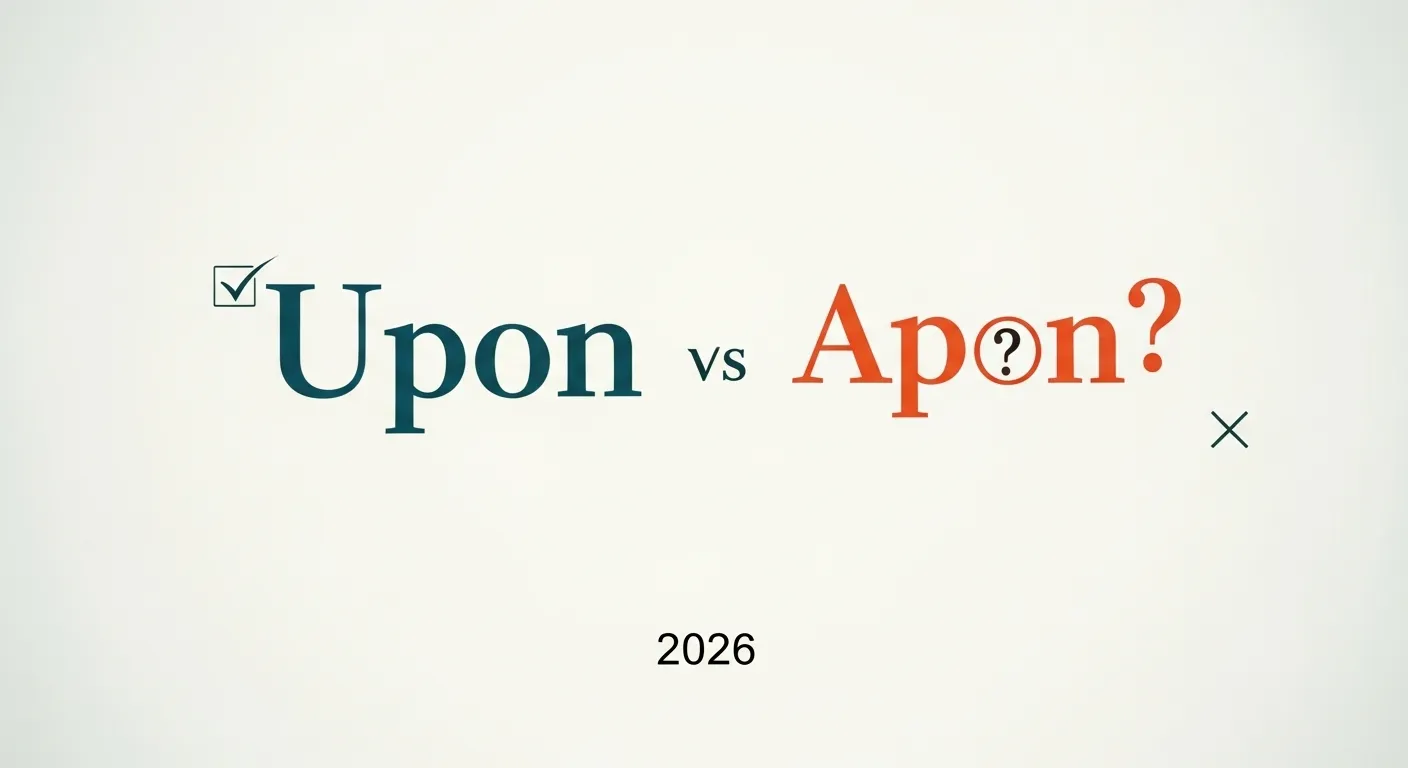
“Upon” is the correct English word, while “apon” is a spelling mistake and not a standard word in English.
A student once wrote an email to a teacher saying, “I will submit the assignment apon your request.” The message was understandable, but the spelling created a small problem. The correct word should have been upon, not apon.
Mistakes like this happen frequently because English pronunciation can sometimes make spelling confusing. Words that sound simple may still create uncertainty when people try to write them. Many learners search for “upon or apon”, “apon vs upon”, or “is it upon or apon” because they want to confirm which spelling is correct.
The truth is simple: upon is the correct and widely accepted word, while apon is only a common misspelling. Understanding this difference helps writers avoid errors in emails, academic work, blog writing, and professional communication.
Because of pronunciation differences, many learners also search questions like upon vs apon, apon meaning, or how to spell apon to verify the correct spelling.
In this article, we will explore the meaning of upon, its origin, common usage, typical mistakes people make, and examples from everyday English. By the end, you will clearly understand why upon is correct and how to use it properly.
Is It “Upon” or “Apon”?
The correct spelling is upon, not apon.
The word upon is a standard English preposition that means on, immediately after, or based on something. It has been used in English for centuries and appears in formal writing, literature, and professional communication.
The spelling apon is not recognized in English dictionaries and is considered a spelling mistake.
Example:
Correct:
The project will begin upon approval.
Incorrect:
The project will begin apon approval.
So if you are wondering whether it is upon or apon, always choose upon, because apon is not a valid English word.
Upon or Apon – Quick Answer
The difference is simple.
| Word | Correct? | Meaning |
| Upon | ✔ Correct | Means “on,” “immediately after,” or “based on” |
| Apon | ✖ Incorrect | Misspelling of “upon” |
Example Sentences
Correct:
The decision was made upon careful review.
Incorrect:
The decision was made apon careful review.
Only upon is recognized as a proper English word.
Apon vs Upon: What Is the Difference?
Many learners search for apon vs upon because the two spellings look very similar. However, only one of them is correct in standard English.
Upon is a real English word that means on, immediately after, or based on something. It appears in formal writing, literature, and everyday communication.
Apon, on the other hand, is simply a spelling mistake. It does not appear in dictionaries and is not accepted in professional writing.
Example:
Correct:
The decision was made upon careful consideration.
Incorrect:
The decision was made apon careful consideration.
When comparing apon vs upon, remember that upon is the only correct spelling.
Upon vs Apon: Which One Should You Use?
When comparing upon vs apon, the correct choice is always upon.
The word upon has existed in English for centuries and is commonly used in formal sentences such as:
Payment will be released upon completion of the project.
The spelling apon is not recognized by dictionaries or grammar guides. It usually appears when people attempt to spell the word based on pronunciation.
Therefore, if you are unsure about upon vs apon, remember that only “upon” is correct in both American and British English.
The Origin of Upon
The word upon has a long history in English. It comes from Old English and was formed by combining two words:
- Up
- On
Originally, the term meant “on top of” or “above.” Over time, its meaning expanded to include ideas related to time, conditions, and causes.
By the Middle Ages, upon had become common in literature and formal writing. It was frequently used in storytelling, legal documents, and academic texts.
Examples from literature include:
“Once upon a time…”
“The king placed his hand upon the sword.”
These examples show that the word has remained stable in English for centuries.
British English vs American English Spelling
Unlike many English word pairs, upon does not change between British and American English.
Both varieties use the same spelling.
| Word | US English | UK English | Status |
| Upon | ✔ | ✔ | Correct |
| Apon | ✖ | ✖ | Incorrect |
This means that apon is not accepted in any standard English variety.
The confusion usually happens because people write the word the way they hear it spoken.
Which Spelling Should You Use?
The answer is simple: always use upon.
Common Situations Where “Upon” Is Used
1. Time or sequence
The meeting started upon his arrival.
2. Conditions
Payment will be released upon completion of the project.
3. Physical position
The cat jumped upon the table.
4. Formal writing
The committee acted upon the recommendation.
In modern writing, upon is slightly more formal than on, but both can sometimes work in similar sentences.
Example:
The book is on the table.
The book is upon the table. (more formal)
Common Mistakes with Upon or Apon
Many writers accidentally use apon because they rely on pronunciation instead of spelling.
Mistake 1: Writing Apon Instead of Upon
Incorrect:
I will act apon your advice.
Correct:
I will act upon your advice.
Mistake 2: Confusing “Upon” With “On”
Although similar, they are not always interchangeable.
Example:
The decision depends upon your approval.
The phone is on the desk.
Mistake 3: Overusing Upon
Sometimes writers choose upon when on sounds more natural.
Less natural:
The book is lying upon the desk.
More natural:
The book is lying on the desk.
Apon Meaning in English
Some learners search for apon meaning, thinking it might be a real English word.
In standard English, apon has no meaning because it is not a recognized word in dictionaries.
In most cases, people actually mean upon, which means:
- on
- immediately after
- based on something
Example:
The project will begin upon approval.
So when someone searches for apon meaning, the correct explanation is that apon is simply a misspelling of “upon.”
How to Spell Apon Correctly
Many people ask how to spell apon, especially when they hear the word in spoken English.
The correct spelling is upon, not apon.
Correct spelling:
Upon
Incorrect spelling:
Apon
Example sentence:
I will begin the work upon receiving your message.
Upon in Everyday Examples
In Emails
I will begin the task upon receiving your confirmation.
In Business Writing
Payment will be processed upon delivery.
In News Reports
Authorities took action upon receiving the complaint.
In Storytelling
Once upon a time, a traveler arrived in a small village.
In Academic Writing
The theory is based upon earlier research findings.
Difference Between Upon and Apon
The difference between upon and apon is very simple.
Upon is a correct English word used in formal and everyday writing.
Apon is not a real English word. It is simply a spelling mistake caused by pronunciation confusion.
Example:
Correct:
The results were announced upon completion of the study.
Incorrect:
The results were announced apon completion of the study.
Comparison Table: Upon vs Apon
| Feature | Upon | Apon |
| Correct spelling | ✔ Yes | ✖ No |
| Dictionary entry | ✔ Yes | ✖ No |
| Meaning | On / after / based on | None |
| Usage | Formal and standard | Misspelling |
| Global acceptance | Universal | Not accepted |
FAQs
1. Is “apon” a real English word?
No. It is a spelling mistake.
2. Why do people write “apon”?
Because the pronunciation sounds similar to “upon.”
3. Is “upon” formal English?
Yes, it is slightly more formal than “on.”
4. Can I replace “upon” with “on”?
Often yes, but not always.
5. Is “upon” used in American and British English?
Yes, the spelling is the same in both.
6. What is the most famous phrase using “upon”?
“Once upon a time.”
7. Should “apon” ever be used?
No, it should always be corrected to “upon.”
8. Is it upon or apon?
The correct spelling is upon. The form apon is a spelling mistake.
9. Why do people spell “upon” as “apon”?
Because pronunciation can make the word sound like “apon” in fast speech.
10. Is “apon” used in any dictionary?
No, major dictionaries only recognize upon.
11. Can “upon” be used in everyday English?
Yes, especially in writing and formal communication.
Conclusion
The confusion between upon and apon is understandable, but the correct choice is clear. Upon is the proper English word used in both American and British English, while apon is only a misspelling.
The word upon has existed in English for centuries and appears in literature, storytelling, academic writing, and professional communication. It can describe position, timing, or conditions, which makes it a versatile and useful word.
When writing professionally whether in emails, essays, or online content using the correct spelling is essential for clarity and credibility.
Whenever you feel unsure, remember this simple rule:
“Upon” is correct, and “apon” is always incorrect.
Cavity or Stain: What’s the Difference?

I’m Emily K. Dawson, and I write about commonly confused English words and spelling mistakes. My goal is to make English easier for learners by explaining grammar in a simple, practical way.