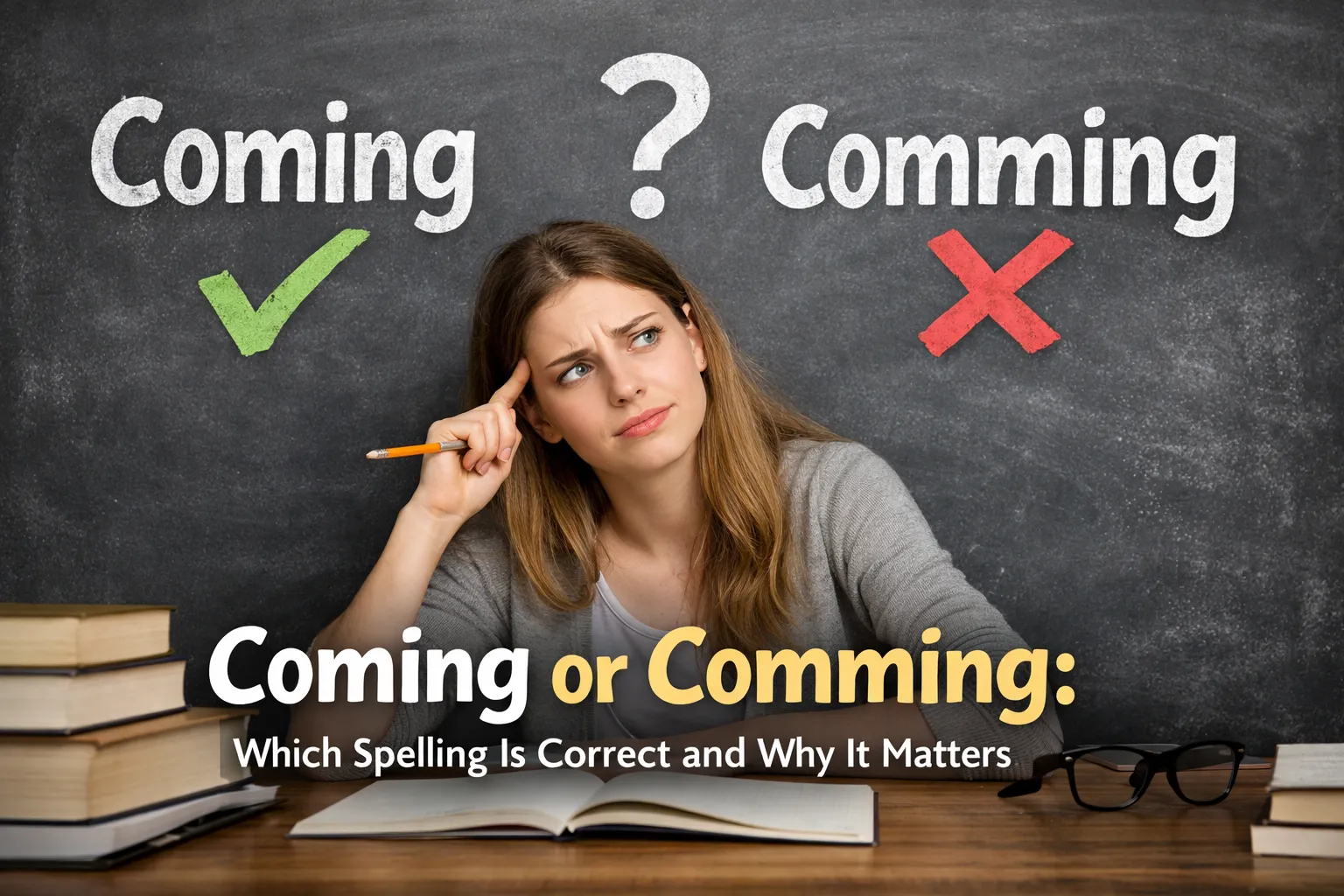
Have you ever typed a message, email, or social media post and paused at the word coming—wondering whether it should be coming or comming? You’re not alone. This is one of the most common spelling confusions in English, especially for learners and fast typers. Because English has many rules about double letters, people often assume that come + ing should become comming. That assumption feels logical, but it’s wrong.
People search for “coming or comming” because they want a quick, confident answer. They may have seen both spellings online, in comments, or even in informal texts. Spellcheck tools sometimes miss errors in casual writing, which adds to the confusion. For students, writers, bloggers, and professionals, using the wrong spelling can look careless and reduce credibility.
This article clears up the confusion once and for all. You’ll learn the correct spelling, why the mistake happens, how British and American English treat it, and how to use the word properly in real-life situations. By the end, you’ll never second-guess coming again.
Coming or Comming – Quick Answer
Coming is the correct spelling.
Comming is incorrect and not a real English word.
Examples:
- ✅ She is coming home tonight.
- ✅ The movie is coming soon.
- ❌ She is comming home tonight.
- ❌ New updates are comming tomorrow.
Rule to remember:
The verb come does not double the final letter before adding -ing.
The Origin of Coming or Comming
The correct word coming comes from the Old English verb cuman, meaning “to move or travel toward.” Over time, this evolved into come in Modern English. When English forms the present participle, it usually adds -ing to the base verb.
For verbs ending in -e, the general rule is:
- Drop the -e
- Add -ing
So:
- come → coming
- make → making
- write → writing
The spelling comming likely exists because of confusion with verbs like:
- run → running
- sit → sitting
- begin → beginning
In those cases, the final consonant is doubled. But come does not follow that pattern, because it ends in a silent e, not a stressed consonant-vowel-consonant structure.
British English vs American English Spelling
There is no difference between British and American English for this word.
Both forms agree completely:
- ✅ coming (British English)
- ✅ coming (American English)
- ❌ comming (incorrect everywhere)
Spelling Comparison Table
| Variant | British English | American English | Correct? |
| coming | ✔ Yes | ✔ Yes | ✅ Correct |
| comming | ✖ No | ✖ No | ❌ Incorrect |
Unlike words such as traveling/travelling or canceled/cancelled, coming never changes across regions.
Which Spelling Should You Use?
No matter who your audience is, the answer stays the same.
- US audience: Use coming
- UK audience: Use coming
- Australia, Canada, India: Use coming
- Global or SEO content: Always use coming
If you are writing:
- Academic papers
- Blog posts
- Emails
- News articles
- Social media captions
The only correct and professional choice is coming.
Also Read Period or Spotting: What’s the Difference and Which Term to Use?
Common Mistakes with Coming or Comming
Here are the most frequent errors people make:
1. Doubling the “m”
- ❌ comming
- ✅ coming
2. Assuming all short verbs double consonants
- ❌ come → comming
- ✅ come → coming
3. Trusting informal usage online
Many people spell comming in comments or chats. This does not make it correct.
4. Ignoring verb rules
For verbs ending in silent -e, you drop the e, not double the consonant.
Coming or Comming in Everyday Examples
Emails
- ✅ “I am coming to the meeting tomorrow.”
- ❌ “I am comming to the meeting tomorrow.”
News Headlines
- ✅ “New policy changes are coming next month.”
- ❌ “New policy changes are comming next month.”
Social Media
- ✅ “Big news is coming soon!”
- ❌ “Big news is comming soon!”
Formal Writing
- ✅ “Technological advances are coming at a rapid pace.”
- ❌ “Technological advances are comming at a rapid pace.”
Coming or Comming – Google Trends & Usage Data
Search data shows that “coming” is used millions of times more often than “comming.” The incorrect spelling appears mainly in:
- Informal searches
- Non-native English queries
- Typing mistakes
Usage by Region (General Trend)
- United States: Coming dominates
- United Kingdom: Coming dominates
- India & Pakistan: High confusion, but coming is standard
- Global English content: Coming is universal
Search engines recognize comming as a misspelling and often auto-correct it to coming, which proves which form is correct.
Comparison Table: Coming vs Comming
| Feature | Coming | Comming |
| Dictionary word | Yes | No |
| Correct spelling | Yes | No |
| Used in formal writing | Yes | No |
| Accepted in US English | Yes | No |
| Accepted in UK English | Yes | No |
| SEO safe | Yes | No |
FAQs About Coming or Comming
1. Is “comming” ever correct?
No. Comming is never correct in standard English.
2. Why do people spell coming as comming?
Because they confuse it with verbs that double consonants, like running or swimming.
3. Does British English allow “comming”?
No. British English only accepts coming.
4. Is “coming” a verb or adjective?
It is mainly a verb, but it can also act as an adjective, like “the coming year.”
5. Can spellcheck catch “comming”?
Most modern spellcheckers flag it as an error, but informal typing can miss it.
6. Is “coming soon” always correct?
Yes. “Coming soon” is a fixed and correct phrase.
7. How can I remember the correct spelling?
Remember: Drop the e, don’t double the m.
Conclusion
The confusion between coming or comming is common, but the solution is simple. Coming is the only correct spelling, while comming is always wrong. This rule applies across all forms of English—American, British, and global. The mistake usually happens because English learners and writers assume that adding -ing means doubling the final letter. However, verbs like come follow a different rule: drop the silent e and add -ing.
Using the correct spelling matters more than many people think. In professional writing, emails, academic work, and SEO content, even small spelling errors can reduce trust and clarity. Search engines, readers, and editors all expect standard English.
If you remember one thing, let it be this:
If the base verb ends in a silent “e,” you drop it—never double the consonant.
Stick with coming, and you’ll always be correct.

I’m Daniel R. Whitmore, an English language writer who focuses on spelling differences, word comparisons, and everyday grammar clarity. I enjoy simplifying confusing English words so readers can write with confidence and accuracy.