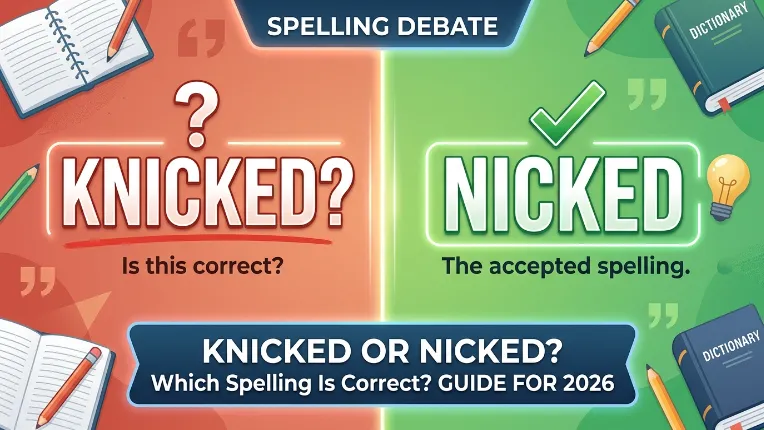
“Nicked” is the correct spelling for most situations, while “knicked” is rare and generally considered incorrect in modern English.
A mechanic once explained that a small cut on a metal edge could damage an entire machine. He said the blade was nicked, but someone writing the report wondered if it should be spelled knicked instead. This confusion happens more often than you might expect.
Many people search for “knicked or nicked” because English spelling sometimes includes silent letters, such as the k in words like knife or knee. When people hear the word nicked, they may assume it should follow the same pattern and start with kn. However, that assumption leads to a common spelling mistake.
The correct form in modern English is nicked, which usually means a small cut, scratch, or minor damage. It can also have informal meanings such as stealing something or being arrested in British slang.
Understanding the difference between knicked and nicked helps writers avoid errors and ensures their sentences sound natural and correct.
Knicked or Nicked – Quick Answer
| Word | Correct? | Meaning |
| Nicked | ✔ Correct | Slightly cut, scratched, stolen, or arrested (informal) |
| Knicked | ✖ Rare/incorrect | Misspelling of “nicked” |
Example Sentences
Correct:
- I accidentally nicked my finger while cutting vegetables.
Incorrect:
- I accidentally knicked my finger while cutting vegetables.
The Origin of Nicked
The word nick dates back to the late Middle English period and originally meant a small cut, notch, or mark. Over time, the verb to nick developed, meaning to make a small cut or damage something slightly.
Later, informal meanings appeared:
- To steal something (British slang)
- To arrest someone (British police slang)
Examples:
- The knife nicked the surface of the table.
- Someone nicked my bicycle last night.
Because the word developed without a silent k, the correct spelling has always been nicked, not knicked.
British English vs American English Usage
The spelling nicked is the same in both British and American English.
Comparison Table
| Word | US English | UK English | Status |
| Nicked | ✔ Standard | ✔ Standard | Correct spelling |
| Knicked | ✖ Rare | ✖ Rare | Misspelling |
However, the slang meanings are more common in British English.
Examples in British usage:
- The police nicked the suspect.
- Someone nicked my wallet.
Which Spelling Should You Use?
Use “Nicked”
You should use nicked whenever referring to:
- A small cut or scratch
- Slight damage
- Informal slang for stealing or arresting
Examples:
- I nicked my hand while opening the box.
- The blade nicked the wooden table.
- Someone nicked my phone at the party.
Avoid “Knicked”
The spelling knicked appears because some English words begin with kn, such as:
- knife
- knee
- knight
However, nick does not follow this pattern, so knicked is generally considered incorrect.
Common Mistakes with Nicked
Mistake 1: Adding an Unnecessary “K”
Incorrect:
- The glass knicked the surface of the counter.
Correct:
- The glass nicked the surface of the counter.
Mistake 2: Confusing with “Knick”
There is a word knick, but it usually appears in phrases like knick-knack, meaning a small decorative item.
Example:
- The shelf was full of colorful knick-knacks.
This word is unrelated to nicked.
Mistake 3: Confusing “Nicked” with “Naked” or “Knocked”
Some learners mix these words due to pronunciation similarities.
Examples:
Incorrect:
- I knocked my finger on the knife.
Correct:
- I nicked my finger on the knife.
Nicked in Everyday Examples
In Cooking
- I accidentally nicked my finger while slicing onions.
In Carpentry
- The saw nicked the edge of the wood.
In Everyday Conversation
- Be careful not to nick the paint on the wall.
In British Slang
- Someone nicked my wallet on the train.
- The police nicked the thief last night.
Google Trends & Usage Data
Search patterns show that people frequently type “knicked or nicked” because they assume the word follows the kn- spelling pattern found in other English words.
Usage statistics indicate:
- Nicked is widely used in writing, news, and conversation.
- Knicked appears mostly as a spelling mistake in online searches.
Search engines often correct knicked to nicked, reinforcing the correct spelling.
Comparison Table: Knicked vs Nicked
| Feature | Nicked | Knicked |
| Spelling correctness | ✔ Correct | ✖ Incorrect |
| Meaning | Small cut or scratch | None |
| Common usage | Very common | Rare |
| Appears in dictionaries | ✔ Yes | Usually no |
| Recommended spelling | ✔ Yes | ✖ No |
FAQs
1. Is “knicked” a real word?
It exists occasionally as a spelling variation, but it is generally considered incorrect.
2. What does “nicked” mean?
It means a small cut, scratch, or slight damage.
3. Why do people write “knicked”?
Because many English words start with kn, leading people to assume the same pattern.
4. Is “nicked” used in American English?
Yes, mainly to mean a small cut or scratch.
5. Is “nicked” slang in British English?
Yes. It can mean to steal something or to arrest someone.
6. Can “nicked” describe minor damage?
Yes. It often refers to small scratches or marks.
7. Which spelling should I use in writing?
Always use nicked, as it is the correct and standard spelling.
Conclusion
The confusion between knicked and nicked comes from the way English sometimes uses silent letters. Many words begin with kn, such as knife and knee, which makes people assume that nick follows the same pattern. However, it does not.
The correct spelling is nicked, which refers to a small cut, scratch, or slight damage. In British slang, it can also mean stealing something or being arrested. The spelling knicked is rarely used and usually considered incorrect.
By remembering that the word nick starts with n, not kn, you can avoid a common spelling mistake and write more confidently.
Prioritise or Prioritize: Which Spelling Is Correct and When to Use It

I’m Emily K. Dawson, and I write about commonly confused English words and spelling mistakes. My goal is to make English easier for learners by explaining grammar in a simple, practical way.