The air purifier aisle is a study in impressive-sounding numbers. Clean air delivery rates, filter grades, room size ratings, decibel counts — every box promises to solve your pet odor problem, and most of them look identical from the outside. Yet owners regularly report that the unit they bought barely made a difference, or that it worked for a month before the smell crept back. The gap between the promise and the result is rarely about the brand; it is about matching the machine to the job.
Choosing well starts with a clear-eyed look at what your household actually produces. A single quiet cat in a studio apartment and two shedding dogs in an open living room have almost nothing in common when it comes to filtration demands. Once you understand those demands, the specifications stop being noise and start being a checklist you can work through with confidence.
Start With the Room, Not the Pet
The most common buying mistake is sizing a purifier to the animal count rather than the room volume. Purifiers work by moving air through filters repeatedly, and the number of air exchanges per hour determines how quickly pollutants drop. A small unit in a large open-plan room will technically run, but it will never cycle the full volume often enough to keep up with continuous shedding.
Measure the space the purifier will serve, including connected hallways if doors stay open, and treat the manufacturer’s coverage rating as a best-case figure. In a pet household, it is sensible to size up rather than down, because the particle load is higher than the rating assumes. A purifier that is slightly too large simply runs on a lower, quieter setting; one that is too small runs at maximum and still loses ground.
The Filters That Matter for Pet Air
Every stage of filtration does a different job, and skimping on any of them shows up as a persistent smell or a lingering haze. Here is what to prioritize.
True HEPA for Dander and Hair
HEPA media is the workhorse for pet households because it captures the fine particles that carry allergens — dander flakes, dust, and the microscopic debris that clings to shed hair. Be careful with marketing language: “HEPA-type” and “HEPA-style” are not the same as a filter rated to capture the smallest particle sizes. Look for a clearly stated HEPA rating and a filter that seals properly against the housing, since air that bypasses the media carries its particles straight back into the room.
Activated Carbon for Odor
Ammonia and the general mustiness of a pet home are gases, not particles, so a HEPA filter alone will not touch them. Activated carbon adsorbs these compounds, but its effectiveness depends on how much carbon is actually present. Thin carbon-coated sheets saturate quickly and become decorative. A substantial carbon layer, or a dedicated pellet bed, is what makes the difference between a machine that filters dust and one that genuinely reduces smell.
The Pre-Filter Everyone Forgets
The pre-filter catches hair and large debris before they reach the HEPA stage, and in a pet home it does most of the heavy lifting. A washable pre-filter is a practical advantage because you can rinse it regularly instead of buying replacements. Neglecting it is one of the fastest ways to shorten the life of the filters behind it.
Noise, Power, and Placement in Real Homes
A purifier you avoid running is a purifier that does nothing. In practice, that means noise is not a minor specification — it decides whether the unit runs overnight, whether it stays on while you watch television, and whether your cat tolerates it. Many machines are quiet on their lowest setting and loud on their highest, so the useful question is how much air they move at a noise level you can live with, not what their maximum output claims to be.
Placement follows the same logic. A purifier needs clearance around its intake and output, ideally a foot or more on every side, and it should sit in the path of air circulation rather than in a sealed corner. In rooms with a litter box, position the unit a short distance away so it pulls odor-laden air toward it without kicking up litter dust directly. For a pet air purifier serving a living area, running it continuously on a moderate setting generally outperforms short bursts at maximum.
Matching Capacity to Cat and Dog Realities
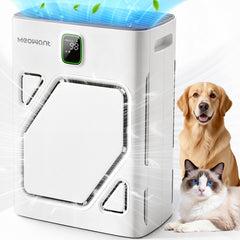
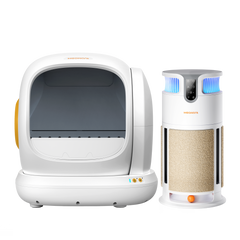
Dogs and cats generate different loads. Long-haired cats and double-coated dogs shed enormous volumes of fine hair that load pre-filters fast, while multiple cats concentrate ammonia near the litter area. A household with both benefits from a unit with strong pre-filtration and a robust carbon stage, placed to cover the shared living space. Meowant builds its purifier range with this layered approach in mind, offering formats that suit different room sizes so buyers can match coverage rather than overbuy one giant unit for the whole house.
Running Costs and Long-Term Value
The purchase price is only the first number that matters. Filters are consumables, and in a pet household they are consumed faster than the general guidance suggests. Before buying, check the cost and availability of replacement filters, how often the manufacturer recommends changing them, and whether the pre-filter is washable. A cheaper unit with expensive, hard-to-find filters can cost more over a couple of years than a better-built machine.
Also consider smart features honestly. Auto mode and air-quality sensors are genuinely useful in pet homes because they let the unit ramp up when litter dust spikes and settle down when the room is calm. App controls and schedules are convenient but secondary. The core question remains whether the machine moves enough filtered air, quietly, through filters you can afford to replace.
A Practical Shopping Sequence
Working through the decision in a fixed order keeps the marketing noise from distorting your judgment. Start with the room and the pets, then move outward to the machine, and leave aesthetics for last.
Measure the room and note whether it connects openly to other spaces. Decide how many units you are willing to maintain and place, since two smaller machines often outperform one large unit in a spread-out home. Then filter your shortlist by HEPA rating, carbon volume, and noise on the lowest setting. Finally, check filter cost and availability for the next year, because that number shapes the real ownership cost. Only after those steps should design and placement-friendly dimensions factor in. This sequence also makes it easier to compare models side by side without being distracted by a feature you will never use.
Trial and Adjustment After Purchase
Once the unit is home, resist the temptation to run it at maximum and judge it immediately. Start on a moderate setting, give the room a day or two to settle, and observe how the air feels and smells. Cats may need a few days to accept the new sound; keep the fan low near litter areas at first. If the room still feels stale, the issue is usually placement or capacity rather than a defective unit. A short adjustment period tells you more than any specification sheet.
Buying With Clear Priorities
A purifier that keeps up with a pet household is not the one with the longest feature list. It is the one sized for the room, equipped with genuine HEPA and a meaningful carbon stage, quiet enough to run continuously, and supported by affordable filters. Get those fundamentals right and the extra features become pleasant bonuses rather than compensations for weak performance.
Before you buy, measure your space, count your pets honestly, and decide where the unit will actually live. Then compare models against those requirements instead of against each other’s marketing. Do that, and the machine you bring home will do what the aisle promised: quietly pull dander and odor out of the air, hour after hour, without asking for attention.
