Many people search for truth or false when they want to check facts, correct statements, or write clear English. This confusion often appears in quizzes, exams, headlines, emails, and everyday conversations. At first glance, both words seem interchangeable. After all, if something is not true, isn’t it false? That simple thought leads many writers to use truth or false as a pair, even though it is not always correct English usage.
The real confusion comes from grammar and word roles. Truth is a noun that means a fact or reality. False is usually an adjective that describes something untrue. Because they belong to different grammatical categories, they are not always natural opposites in a sentence. This causes problems in professional writing, academic work, and even SEO content where clarity matters.
This article clears that confusion step by step. You will get a quick answer, learn the origin of the words, understand British vs American usage, see real-life examples, review common mistakes, and get clear advice on which word to use and when. By the end, you will confidently know how to use truth or false correctly.
Truth or False – Quick Answer
Quick answer:
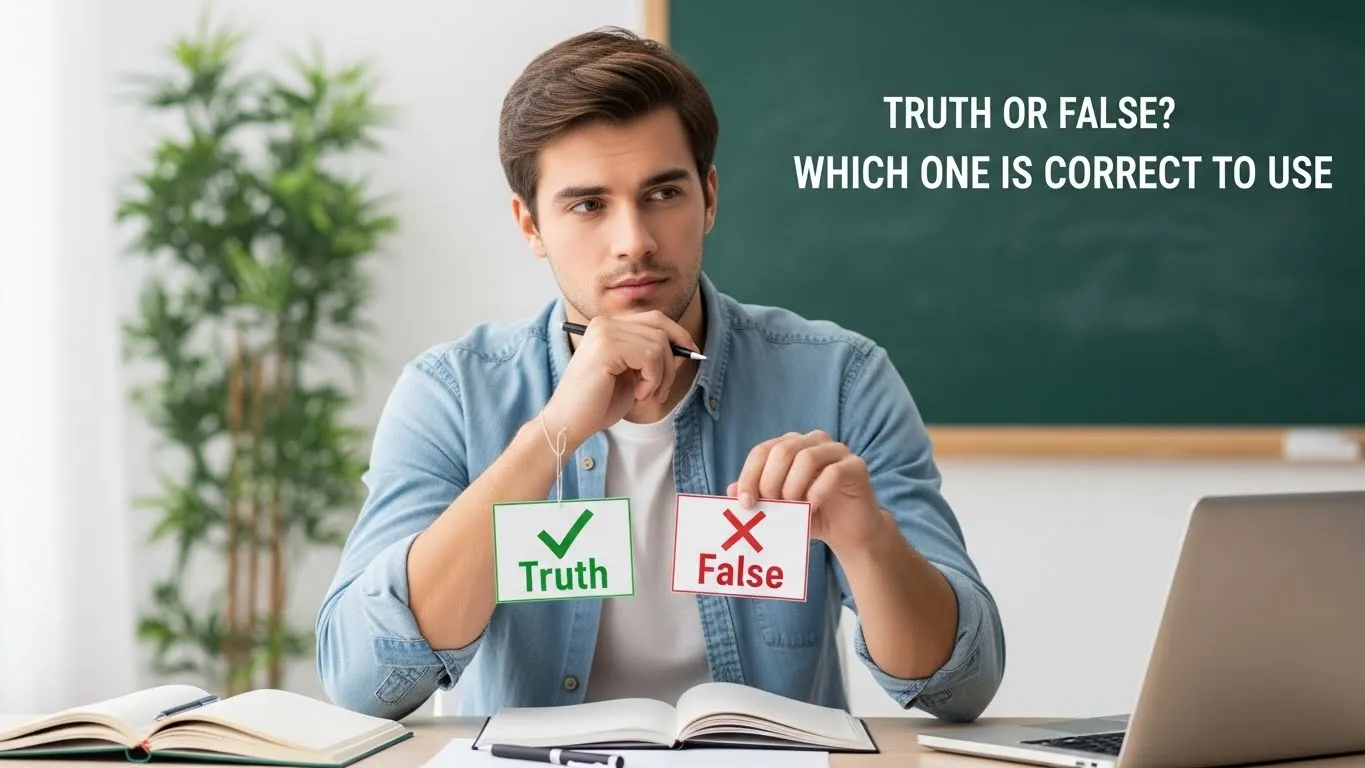
The correct pair is true or false, not truth or false.
Why?
- Truth is a noun (a thing or concept).
- False is an adjective (a describing word).
- Grammar requires balance.
Correct examples:
- Is this statement true or false?
- The claim is false, not true.
Incorrect examples:
- ❌ Is this statement truth or false?
- ❌ The answer is truth or false.
However, truth is correct when used alone:
- She always speaks the truth.
The Origin of Truth or False
The word truth comes from Old English trēowþ, meaning faith, loyalty, or fact. Over time, it evolved to mean something that matches reality.
The word false comes from Latin falsus, meaning deceptive or incorrect. It entered English through French and kept its meaning as something untrue.
The confusion between truth or false exists because English speakers mentally pair truth with false, even though the natural grammatical opposite of false is true, not truth.
Historically and grammatically:
- Truth ↔ lie
- True ↔ false
When writers mix noun and adjective forms, incorrect phrases like truth or false appear.
Also For You:Missus or Misses? Avoid This Common Mistake ✅
British English vs American English Spelling
There is no spelling difference between British and American English for these words.
Both follow the same rule:
- Use true or false for choices or questions.
- Use truth as a noun when talking about facts or reality.
Examples in both styles:
- UK: The statement is true or false.
- US: Please mark whether it is true or false.
Comparison Table
| Phrase | British English | American English | Correct |
| True or false | ✅ Yes | ✅ Yes | ✅ |
| Truth or false | ❌ No | ❌ No | ❌ |
| The truth | ✅ Yes | ✅ Yes | ✅ |
Which Spelling Should You Use?
Audience-based advice:
- US audience: Use true or false
- UK/Commonwealth: Use true or false
- Global/SEO content: Use true or false
Use truth only when:
- You mean fact or reality
- You are not presenting a choice
Correct usage:
- Tell me the truth.
- This is the truth about the event.
Incorrect usage:
- ❌ Is this truth or false?
Common Mistakes with Truth or False
1. Mixing word forms
- ❌ truth or false
- ✅ true or false
2. Using “truth” as an adjective
- ❌ a truth statement
- ✅ a true statement
3. Using “false” as a noun
- ❌ The answer is a false
- ✅ The answer is false
4. Quiz and exam errors
- ❌ Answer truth or false
- ✅ Answer true or false
Truth or False in Everyday Examples
Emails
- Please confirm whether the information is true or false.
News
- Officials denied the claim, calling it false.
Social Media
- Fact check: true or false?
Formal Writing
- The study examines the truth behind the allegations.
Truth or False – Google Trends & Usage Data
Search trends show that “true or false” is far more popular than “truth or false.”
People searching truth or false are usually:
- Non-native English speakers
- Students checking grammar
- Writers verifying quiz language
Popular regions searching this keyword:
- United States
- United Kingdom
- India
- Pakistan
- Philippines
Google results, grammar tools, and dictionaries all confirm that truth or false is grammatically incorrect in standard English usage.
Comparison Table: Keyword Variations
| Phrase | Word Type | Correct | Usage |
| True or false | Adjective pair | ✅ Yes | Questions, quizzes |
| Truth or false | Noun + adjective | ❌ No | Incorrect |
| The truth | Noun | ✅ Yes | Facts, reality |
| False statement | Adjective + noun | ✅ Yes | Descriptions |
FAQs: Truth or False
1. Is “truth or false” ever correct?
No. It is grammatically incorrect in standard English.
2. What is the correct opposite of “false”?
The correct opposite is true, not truth.
3. Can I use “truth” in questions?
Yes, but not as a choice. Example: What is the truth?
4. Why do quizzes say “true or false”?
Because both words are adjectives and grammatically balanced.
5. Is this mistake common?
Yes, especially among ESL learners and informal writing.
6. Are British and American rules different?
No. Both follow the same grammar rule.
7. Does “truth” mean the same as “true”?
No. Truth is a noun; true is an adjective.
Conclusion
The confusion between truth or false is understandable, but the rule is simple once you know it. Truth and false are not grammatical opposites because they belong to different word types. The correct and accepted phrase is true or false, used in questions, quizzes, exams, and fact-checking.
Use truth only when talking about facts, honesty, or reality—not as a choice paired with false. This small grammar detail makes a big difference in clarity, professionalism, and correctness. Whether you are writing an email, creating quiz content, posting on social media, or producing SEO articles, choosing the right form improves trust and readability.
Remember:
- True or false → choices and statements
- Truth → facts and reality
Once you follow this rule, your writing will be clearer, stronger, and more confident.

I’m Oliver J. Bennett, an English content writer passionate about word usage and spelling comparisons. I enjoy breaking down small language details that often confuse writers and students.