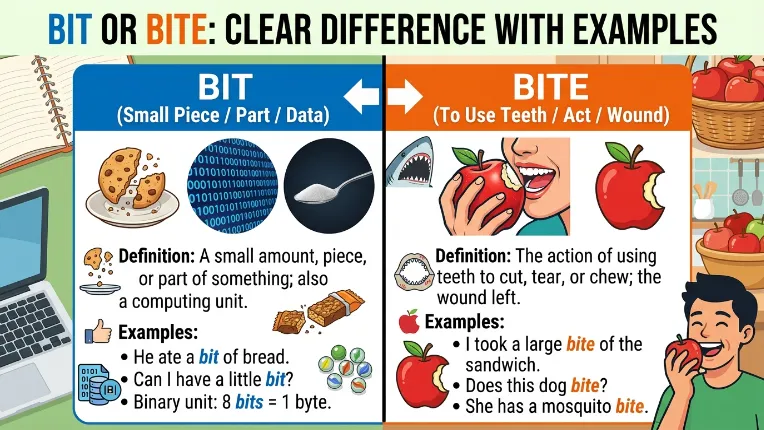
“Bit” is usually the past tense of “bite” or a small piece, while “bite” means to cut with teeth.
A child was telling a story at dinner: “The dog bite me yesterday.” Everyone understood what he meant, but the sentence sounded slightly off. The correct sentence should have been, “The dog bit me yesterday.” This small mistake shows how confusing bit and bite can be.
Many learners search for “bit or bite” because both words are closely related. They come from the same root word but are used in different forms and situations. One is a verb in present form, while the other is usually a past tense or even a noun.
This confusion is very common in daily speaking, writing, and exams. Using the wrong form can make your sentence grammatically incorrect, even if your meaning is clear.
In this guide, you will learn the exact difference between bit and bite, their meanings, correct usage, common mistakes, and how to use them confidently in everyday English.
Bit or Bite – Quick Answer
- Bite = present tense verb (to cut with teeth)
- Bit = past tense of bite OR a small piece (noun)
Examples:
- Be careful, the dog might bite.
- The dog bit him yesterday.
- Take a small bit of cake.
👉 Easy rule:
Bite = present | Bit = past or piece
The Origin of Bit or Bite
The word bite comes from Old English “bītan,” meaning to cut or grip with teeth. It has been used for centuries in the same meaning.
The word bit developed as the past tense form of bite. Over time, it also became a noun meaning “a small piece” or “a little amount.”
This dual role of bit (verb + noun) is the main reason for confusion.
British English vs American English Spelling
There is no spelling difference between British and American English for these words.
Comparison Table
| Form | British English | American English |
|---|---|---|
| Bite | Bite | Bite |
| Bit | Bit | Bit |
Both regions follow the same grammar rules.
Which Spelling Should You Use?
This depends on tense and meaning, not location.
Use “Bite” when:
- Talking about present or future
- Example: The snake can bite
Use “Bit” when:
- Talking about the past
- Example: The insect bit me
Use “Bit” as a noun:
- Example: Give me a bit of bread
Pro Tip:
If the action already happened → use bit
If it is happening now or may happen → use bite
Common Mistakes with Bit or Bite
Mistake 1:
❌ The dog bite me yesterday
✔️ The dog bit me yesterday
Mistake 2:
❌ He bit me every day
✔️ He bites me every day
Mistake 3:
❌ Take a bite of cake (when meaning small piece generally)
✔️ Take a bit of cake
Mistake 4:
❌ The mosquito has bite me
✔️ The mosquito has bitten me
👉 Remember:
- Bite → present
- Bit → past
- Bitten → past participle
Bit or Bite in Everyday Examples
In Daily Conversation:
- Don’t let the dog bite
- It bit my hand
In Food Context:
- Take a bite of the apple (action)
- Take a bit of the apple (small piece)
In Emails:
- Please review this bit of information
- The system may bite back (figurative use)
In Informal Speech:
- Just a bit tired today
- He nearly bit his tongue
Bit or Bite – Google Trends & Usage Data
Search data shows:
- Bite is searched more for grammar learning
- Bit is widely used in daily language because of multiple meanings
- Many users search both together due to tense confusion
Usage Insight:
- Bite → action-focused
- Bit → more flexible (past tense + noun)
Comparison Table: Bit vs Bite
| Feature | Bite | Bit |
|---|---|---|
| Part of Speech | Verb | Verb (past) + Noun |
| Meaning | To cut with teeth | Past action or small piece |
| Usage | Present/Future | Past / Quantity |
| Example | Dogs bite | Dog bit me / a bit of food |
| Common Error | Used in past incorrectly | Used in present incorrectly |
FAQs
1. Is it bit or bite?
Both are correct, depending on tense and meaning.
2. What is the past tense of bite?
The past tense is bit.
3. What is the past participle of bite?
The past participle is bitten.
4. Can bit be a noun?
Yes, it means a small piece or amount.
5. When should I use bite?
Use it for present or future actions.
6. Why do people confuse bit and bite?
Because they come from the same word but are used in different forms.
7. Which is correct: “has bit” or “has bitten”?
Correct form is has bitten.
Conclusion
The difference between bit or bite becomes simple once you focus on tense and meaning. Bite is the present form used when something is happening now or may happen in the future. Bit is the past form, used when the action has already happened. In addition, bit also works as a noun, meaning a small piece or amount.
This dual role of “bit” is what causes most confusion. However, with a little attention, it becomes easy to choose the correct word. If you are talking about an action happening now, use bite. If it already happened, use bit. And if you mean a small portion, again use bit.
Using the correct form improves clarity and makes your writing more professional. Whether you are writing an email, telling a story, or preparing for an exam, understanding this difference helps you avoid common grammar mistakes.
With this clear rule in mind, you can now confidently use bit and bite in any situation without confusion.
