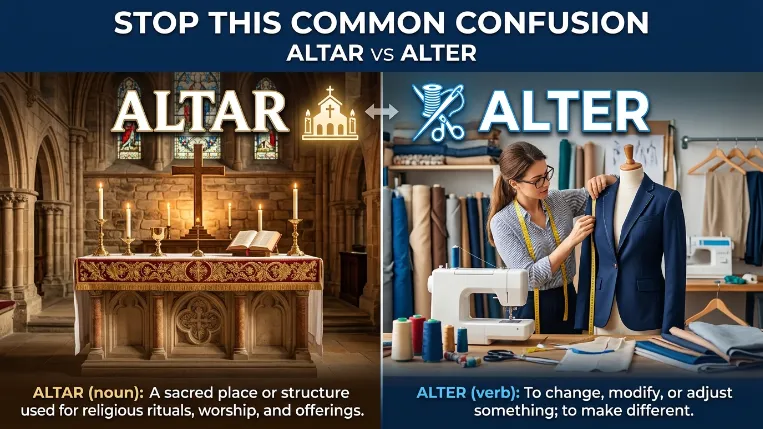
“Altar” is a noun (a sacred table), while “alter” is a verb meaning to change something.
A wedding invitation once read, “The couple will meet at the alter.” Guests understood the message, but the spelling was wrong. It should have been altar, not alter. This small mistake changed the meaning completely.
This is why many people search for “altar or alter.” These two words sound exactly the same, but they have very different meanings and uses. One belongs to religious or ceremonial settings, while the other is used in everyday language to describe change.
Such confusion is common because English has many homophones words that sound alike but differ in meaning and spelling. Using the wrong one can make your writing look careless, especially in formal situations like invitations, essays, or official documents.
In this guide, you’ll clearly understand the difference between altar and alter, their meanings, origins, correct usage, and how to avoid mistakes in real-life writing.
Altar or Alter – Quick Answer
- Altar = a noun (a sacred table used in religious ceremonies)
- Alter = a verb (to change or modify something)
Examples:
- The couple stood at the altar.
- He decided to alter his plan.
👉 Simple rule:
Altar = place | Alter = change
The Origin of Altar or Alter
The word altar comes from Latin “altare,” meaning a place for sacrifice or worship. It has always been used in religious contexts such as churches, temples, and ceremonies.
The word alter comes from Latin “alterare,” meaning to change or make different. Over time, it became a common verb in English used in everyday situations.
Although both words have Latin roots, their meanings developed in completely different directions. This is why they sound the same but are not interchangeable.
British English vs American English Spelling
There is no difference between British and American English for these words.
Comparison Table
| Word | British English | American English |
|---|---|---|
| Altar | Altar | Altar |
| Alter | Alter | Alter |
Both spellings remain the same across all English-speaking regions.
Which Spelling Should You Use?
The choice depends on meaning, not location.
Use “altar” when:
- Referring to religion or ceremonies
- Example: They exchanged vows at the altar
Use “alter” when:
- Talking about change or modification
- Example: You should alter the design
Pro Tip:
If you can replace the word with “change,” use alter
If not, it’s likely altar
Common Mistakes with Altar or Alter
Mistake 1:
❌ The bride walked to the alter
✔️ The bride walked to the altar
Mistake 2:
❌ I need to altar this document
✔️ I need to alter this document
Mistake 3:
❌ He stood at the alter of the church
✔️ He stood at the altar of the church
Mistake 4:
❌ Don’t altar your decision
✔️ Don’t alter your decision
Altar or Alter in Everyday Examples
In Daily Life:
- They got married at the altar
- She wants to alter her dress
In Formal Writing:
- The ceremony took place at the church altar
- The company decided to alter its policy
In Social Media:
- “Walking down the aisle to the altar”
- “Thinking to alter my routine”
In Professional Context:
- Tailors alter clothes
- Religious rituals happen at an altar
Altar or Alter – Google Trends & Usage Data
Search trends show:
- Alter is used more frequently due to everyday usage
- Altar is searched often in wedding or religious contexts
- Many users search both together due to confusion
Usage Insight:
- Alter → common in daily communication
- Altar → specific to ceremonies and religion
Comparison Table: Altar vs Alter
| Feature | Altar | Alter |
|---|---|---|
| Part of Speech | Noun | Verb |
| Meaning | Sacred table | To change |
| Usage | Religious context | General use |
| Example | Church altar | Alter a plan |
| Common Error | Used instead of alter | Used instead of altar |
FAQs
1. Is it altar or alter?
Both are correct but used in different contexts.
2. What does altar mean?
It is a sacred table used in religious ceremonies.
3. What does alter mean?
It means to change or modify something.
4. How can I remember the difference?
Altar has “a” like “amen” (religion), alter means change.
5. Can altar be used as a verb?
No, it is always a noun.
6. Can alter be used in formal writing?
Yes, it is commonly used in formal and informal contexts.
7. Why are these words confusing?
Because they sound the same but have different meanings.
Conclusion
The confusion between altar or alter is very common because both words sound exactly alike. However, their meanings are completely different. Altar is a noun used in religious or ceremonial contexts, while alter is a verb used to describe change or modification.
Understanding this difference is important, especially in formal writing. Using “alter” instead of “altar” in something like a wedding invitation can completely change the tone and correctness of the message. Similarly, using “altar” when you mean “change” can confuse your reader.
The easiest way to remember is to focus on meaning. If the sentence relates to religion, ceremony, or a physical place, use altar. If it involves changing something, use alter.
With this simple rule, you can avoid common mistakes and write more clearly and confidently. Small details like this make a big difference in professional and everyday communication.
