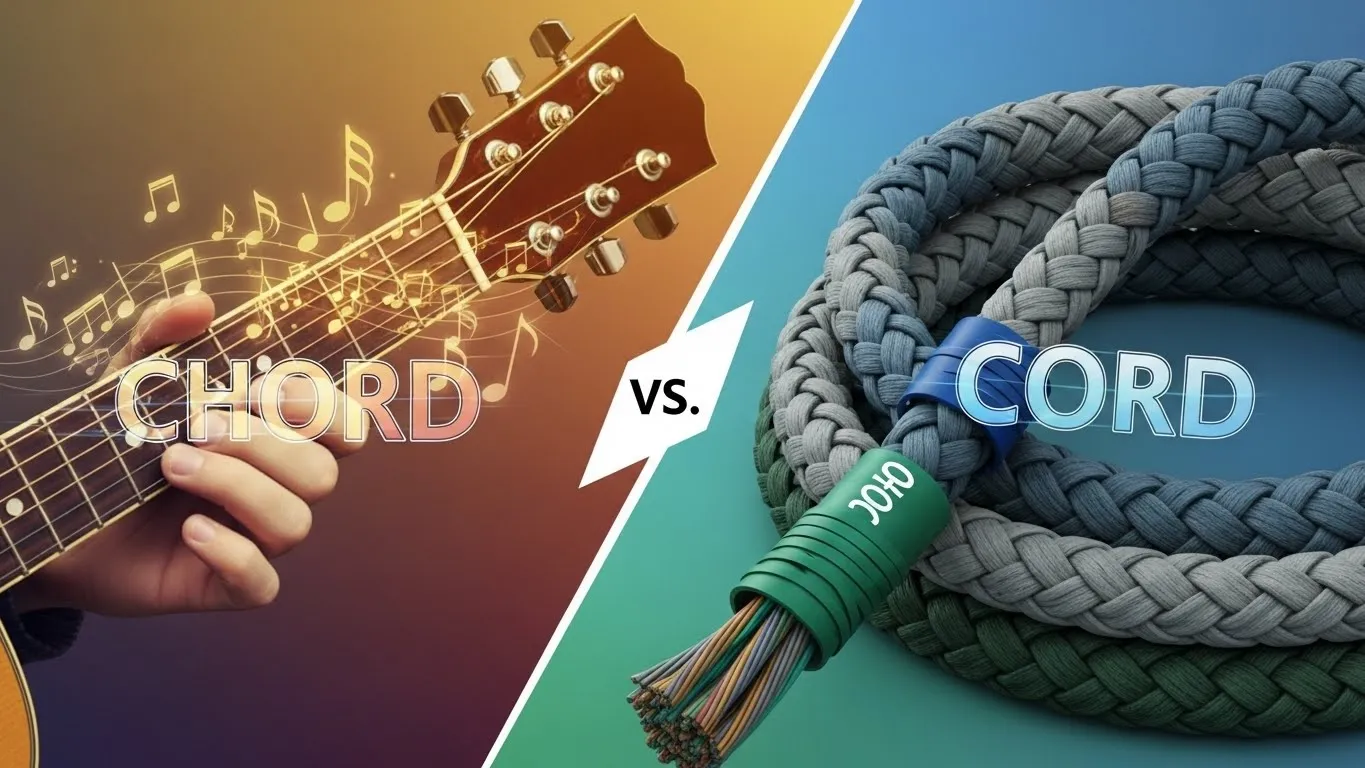
Confused between chord and cord? Many English learners and even native speakers often mix these words because they sound identical but have completely different meanings. Choosing the right word matters, whether you are writing music notes, medical instructions, or everyday emails. This article will clear the confusion by explaining the differences, origins, correct usage, and common mistakes, helping you write confidently. Whether you are from the US, UK, or anywhere globally, you will learn which spelling fits your context and why it matters for precise communication.
Chord or Cord – Quick Answer
- Chord → Refers to a group of musical notes played together or something figurative like “a chord of emotion.”
Example: “She played a beautiful chord on the piano.” - Cord → Refers to a rope, string, or medical nerve/ligament.
Example: “Tie the package with a strong cord.”
Quick tip: Use chord for music or figurative expressions, and cord for physical strings, ropes, or anatomy.
The Origin of Chord and Cord
- Chord comes from the Latin word chorda, meaning “string of a musical instrument.” Over time, it expanded to figurative meanings like feelings or connections.
- Cord comes from the Latin chorda as well but evolved differently in English to refer primarily to strings, ropes, and body parts like the spinal cord.
Both words share origins, which explains their similar pronunciation but different spellings and uses.
British English vs American English Spelling
| Word | British English | American English | Example |
| Chord | Chord | Chord | She played a C major chord. |
| Cord | Cord | Cord | He tripped over a garden cord. |
Observation: There is no spelling difference between the US and UK for chord or cord. Confusion arises from pronunciation and context, not regional spelling.
Which Spelling Should You Use?
- Use “chord” when discussing music, harmony, or figurative expressions.
- Use “cord” when referring to ropes, strings, electrical cords, or anatomy.
- Global audiences: Stick to this rule universally; it is clear and professional.
👉 Eldest or Oldest: Which Word Is Correct?
Common Mistakes with Chord or Cord
- Incorrect: “He tied the package with a chord.”
Correct: “He tied the package with a cord.” - Incorrect: “I felt a chord of sadness.” *(Sometimes confusing with “cord”)
Correct: “I felt a chord of sadness.” - Mixing musical and physical contexts. Always check: music → chord, physical → cord.
Chord or Cord in Everyday Examples
- Emails: “Please ensure the electrical cord is not damaged.”
- News: “The pianist struck the final chord beautifully.”
- Social Media: “That song’s opening chord is unforgettable.”
- Formal Writing: “The surgeon carefully examined the spinal cord.”
Chord or Cord – Google Trends & Usage Data
Analysis shows:
- Chord is searched more in music-related contexts (US, UK, India).
- Cord peaks in DIY, electronics, and medical searches (US, Canada, UK).
Conclusion: Knowing your audience helps. Music learners search “chord,” while DIY enthusiasts or health readers search “cord.”
Chord vs Cord Comparison Table
| Feature | Chord | Cord |
| Meaning | Musical notes or figurative | Rope, string, electrical, nerve |
| Usage Context | Music, emotions | Physical objects, anatomy, electricity |
| Examples | “Play a chord on the guitar.” | “Plug the cord into the socket.” |
FAQs
1. Can “chord” refer to a rope?
No. Rope or string is always cord.
2. Are chord and cord pronounced the same?
Yes, they are homophones. Context determines meaning.
3. Is there a UK vs US difference?
No, both spellings are the same across English variants.
4. Can “cord” be used figuratively?
Rarely. Figurative use is mostly reserved for chord.
5. Which one is more common in writing?
Depends on context: music → chord; ropes/medical → cord.
6. Is “cord” used in technology?
Yes, like “charging cord” or “extension cord.”
7. Can a sentence have both words?
Yes. “The musician tied the cord carefully and played a perfect chord.”
Conclusion
Using chord or cord correctly ensures clarity and professionalism. Remember: music or figurative feelings → chord; ropes, strings, nerves, or electronics → cord. Misusing them can confuse readers, especially in writing, presentations, and formal contexts. With these rules, examples, and comparisons, you can confidently select the correct word for any audience. Always consider context, and when in doubt, check: music? → chord; physical? → cord. This small distinction elevates your writing and ensures you communicate accurately in English.

I’m Laura M. Collins, and I specialize in writing clear explanations for confusing English words. I believe understanding small spelling differences can greatly improve written communication.