Have you ever paused while writing an email or report and wondered whether to use complete or completed? You’re not alone. This is a very common grammar confusion, especially for learners of English, professionals, and content writers. Both words come from the same root, look similar, and are often used in related contexts yet they do not mean the same thing.
People search for “complete or completed” because they want a quick, clear answer: Which one is correct here? The confusion usually happens when deciding between present and past meaning, or between describing a thing versus describing an action that has already finished. For example, should you say “The task is complete” or “The task is completed”? Both can be correct but the meaning and tone change slightly.
This article solves that confusion step by step. You’ll get a quick answer, clear examples, grammar rules, usage tips for US and UK English, common mistakes to avoid, and real-life examples. By the end, you’ll know exactly when to use complete and when completed—with confidence.
Complete or Completed – Quick Answer
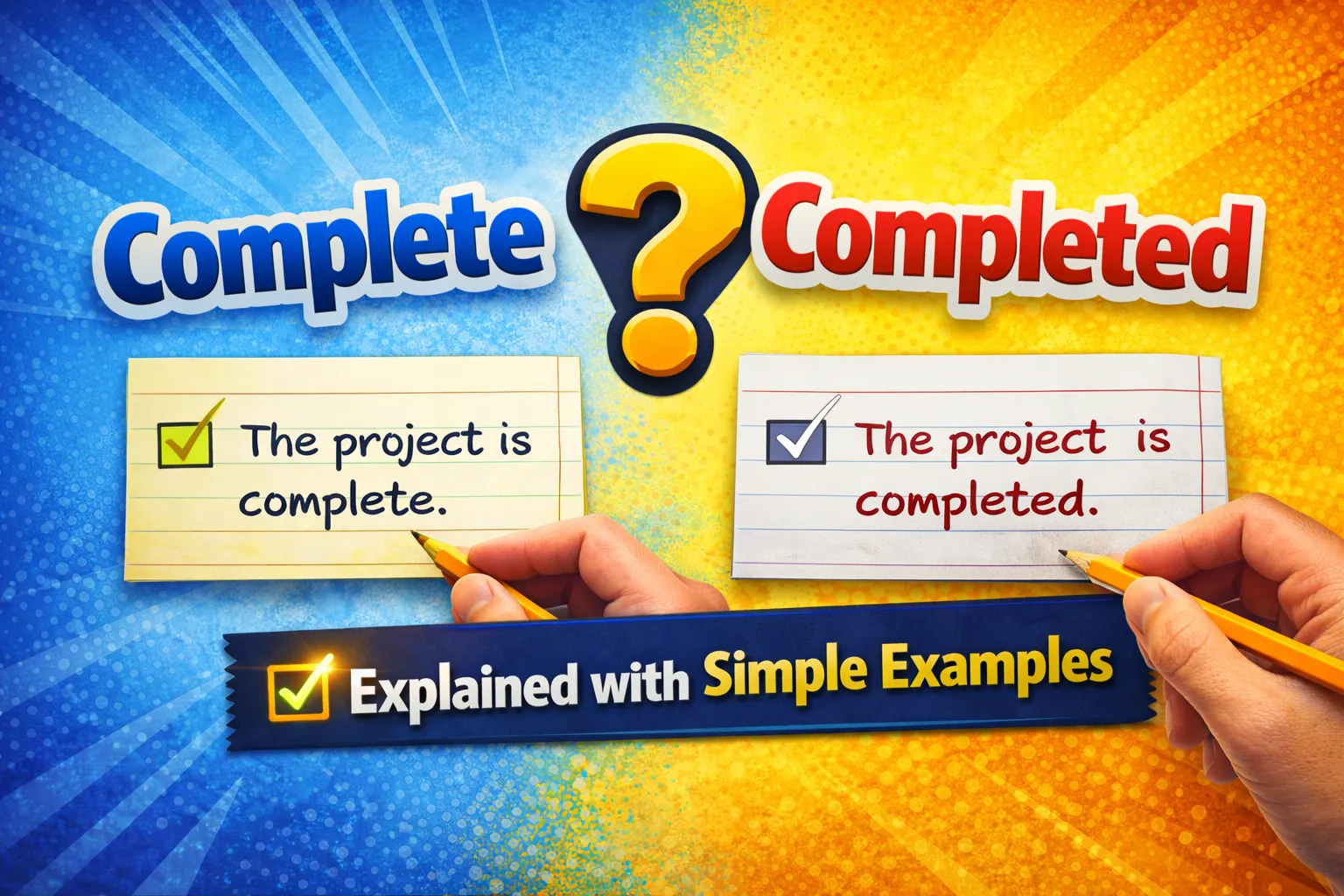
Complete is an adjective or verb meaning finished or whole.
Completed is the past tense or past participle of the verb complete, meaning finished in the past.
Examples:
- ✅ The project is complete. (state/condition)
- ✅ She completed the project yesterday. (action already done)
- ❌ The project is completed (not wrong, but different tone—more formal)
The Origin of Complete or Completed
The word complete comes from the Latin complētus, meaning filled up or finished. It entered English in the 14th century and was used both as an adjective (a complete set) and as a verb (to complete a task).
Completed developed naturally as the past form of the verb complete. There is no spelling difference between British and American English here—only a grammatical difference. The confusion exists because English often uses adjectives and past participles in similar sentence structures, especially in passive voice.
British English vs American English Spelling
There is no spelling difference between British and American English for complete or completed. However, usage preference can differ slightly.
| Usage Style | American English | British English |
| State/condition | The form is complete | The form is complete |
| Action finished | He completed the task | He completed the task |
| Formal/passive tone | The task is completed | The task is completed |
✔ Same spelling
✔ Same meaning
✔ Slight tone difference only
Which Spelling Should You Use?
- US Audience: Use complete for status, completed for past actions.
- UK/Commonwealth: Same rules apply; formal writing may prefer completed.
- Global/Professional Writing:
- Use complete for clarity and simplicity.
- Use completed in reports, audits, or formal documentation.
Rule of thumb:
👉 State = complete
👉 Action finished = completed
👉Also You May Know:M’am or Ma’am: Which Spelling Is Correct?
Common Mistakes with Complete or Completed
❌ I have complete the work.
✔ I have completed the work.
❌ The form completed.
✔ The form is complete.
❌ My degree is completed last year.
✔ My degree was completed last year.
Complete or Completed in Everyday Examples
Emails:
- Your application is complete.
- We have completed the review.
News:
- The bridge is now complete.
- The company completed the merger.
Social Media:
- Workout completed 💪
- Mission complete ✅
Formal Writing:
- The study was completed in 2023.
Complete or Completed – Google Trends & Usage Data
Search data shows that “complete” is more popular globally because it’s used in many meanings (adjective + verb). “Completed” is searched more in professional, academic, and legal contexts.
- Complete: Status updates, general English, UI messages
- Completed: Reports, resumes, project documentation
Both keywords are widely used in the US, UK, India, and Pakistan.
Comparison Table: Complete vs Completed
| Feature | Complete | Completed |
| Part of speech | Adjective / Verb | Verb (past) |
| Time reference | Present state | Past action |
| Tone | Neutral/simple | Formal/precise |
| Example | The task is complete | The task was completed |
FAQs
1. Is “complete” or “completed” more correct?
Both are correct; it depends on context.
2. Can I say “the task is completed”?
Yes, it’s correct and more formal.
3. Is “complete” a verb?
Yes. Example: Please complete the form.
4. Is there a UK vs US difference?
No spelling difference at all.
5. Which is better in emails?
“Complete” sounds clearer and friendlier.
6. Can both be used in passive voice?
Yes, but “completed” is more common.
7. Which is better for resumes?
Use completed for finished projects.
Conclusion
The difference between complete and completed is simple once you understand the idea of state versus action. Complete describes a condition—something that is whole, finished, or ready right now. Completed, on the other hand, tells us that an action happened in the past and has already been finished.
There is no spelling difference between British and American English, which makes things easier. The real choice depends on tone and timing. If you want your writing to sound clear, direct, and modern, complete is often the better option. If you are writing formally, reporting results, or describing past work, completed fits perfectly.
By using the rules, examples, and tables in this guide, you can avoid common mistakes and choose the right word every time. Whether you’re writing emails, reports, social posts, or professional documents, you now know exactly when to use complete or completed with confidence and clarity.

I’m Emily K. Dawson, and I write about commonly confused English words and spelling mistakes. My goal is to make English easier for learners by explaining grammar in a simple, practical way.