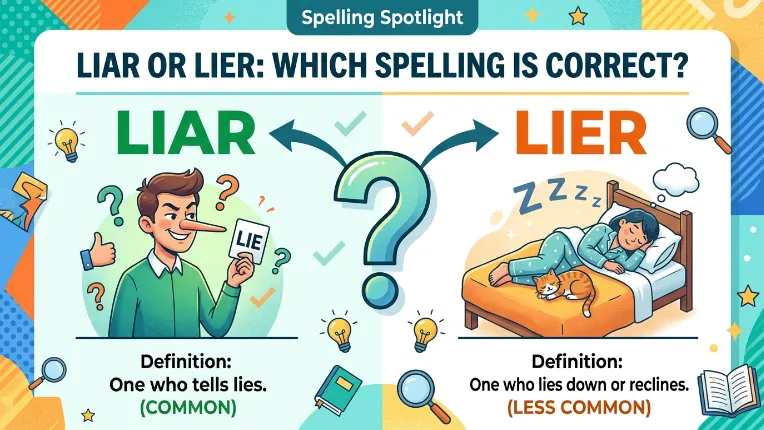
“Liar” is the correct word for a person who tells lies, while “lier” is incorrect in this meaning.
You’re writing a message or maybe a school assignment, and you want to say, “He is a liar.” But then you pause is it liar or lier? This small spelling doubt is very common. The words sound similar, and English rules don’t always follow what we hear.
People search for “liar or lier” because both forms look possible. The confusion often comes from words like “die → dier” or “tie → tier,” which make “lier” feel correct. But English has exceptions, and this is one of them.
Using the wrong spelling can affect your writing, especially in exams, emails, or professional work. That’s why it’s important to understand the correct form and how to use it properly. In this guide, you’ll learn the correct spelling, its origin, usage, common mistakes, and simple tricks to remember it forever.
Liar or Lier – Quick Answer
Liar is the correct spelling.
It means a person who tells lies.
Lier is incorrect for this meaning.
Examples:
- He is a liar.
- Don’t trust a liar.
👉 Simple rule:
If you mean someone who lies, always use liar.
The Origin of Liar or Lier
The word liar comes from the verb “lie” (to tell something false). When forming a noun for a person, English adds “-ar” instead of “-er” in this case.
- Lie → Liar
This is an irregular pattern, which is why it confuses learners.
The spelling “lier” might look correct because many English words follow the -er pattern (like runner, writer). But “lie” is an exception.
👉 Key idea:
Not all English words follow the same rule.
British English vs American English Spelling
There is no difference between British and American English for this word.
| Feature | Liar | Lier |
| Correct Spelling | ✅ Yes | ❌ No |
| Used in US | Yes | No |
| Used in UK | Yes | No |
| Meaning | Person who lies | None (wrong form) |
| Dictionary Status | Valid | Not accepted |
👉 This is not a regional spelling issue—it’s about correctness.
Which Spelling Should You Use?
Always use liar when referring to someone who tells lies.
Use “Liar” when:
- Talking about dishonesty
- Writing stories or dialogues
- Describing someone’s behavior
Examples:
- She called him a liar.
- The story made him look like a liar.
Important Note:
“Lier” may appear in rare contexts as:
- A person who lies down (very uncommon usage)
👉 But in modern English, this meaning is rarely used. So avoid “lier” completely in normal writing.
Audience Advice:
- Students: Always write “liar” in exams
- Professionals: Use “liar” in formal writing
- Global users: “Liar” is universally correct
Common Mistakes with Liar or Lier
❌ Wrong:
He is a lier.
✔ Correct:
He is a liar.
❌ Mistake:
Following the -er pattern
✔ Fix:
Remember this is an exception
❌ Mistake:
Confusing with “lie down”
✔ Fix:
That meaning is rare and outdated
👉 Memory Trick:
Liar = Lie + AR (A for Actor of the lie)
Liar or Lier in Everyday Examples
Emails:
- Please don’t call anyone a liar without proof.
News:
- The witness was accused of being a liar.
Social Media:
- Stop acting like a liar!
Formal Writing:
- A liar damages trust in relationships.
👉 “Liar” is widely used in all contexts.
Liar or Lier – Google Trends & Usage Data
Search data shows:
- “Liar” is widely used across all countries
- “Lier” appears mostly as a spelling mistake
Popularity by Region:
- US & UK: “Liar” dominates
- India & Pakistan: “Lier” appears in search errors
Usage Context:
| Context | Liar | Lier |
| Education | High | Error |
| Social Media | Very high | Common typo |
| Formal Writing | High | Not used |
| SEO Searches | High | Mistyped queries |
👉 Insight:
“Lier” exists mostly because of confusion.
Comparison Table: Liar vs Lier
| Feature | Liar | Lier |
| Meaning | Person who lies | Rare/incorrect |
| Correct Word | Yes | No |
| Usage | Common | Incorrect |
| Grammar Status | Standard | Not accepted |
| Example | He is a liar | ❌ Invalid |
FAQs
1. Is “lier” a real word?
It exists rarely (for someone lying down), but not for “a person who lies.”
2. What is the correct spelling?
“Liar” is correct for someone who tells lies.
3. Why is “lier” wrong?
Because English uses an irregular form: lie → liar.
4. Is this a US vs UK difference?
No, both use “liar.”
5. How can I remember the spelling?
Think: liar = lie + ar
6. Can I ever use “lier”?
Only in rare or outdated contexts, so it’s best to avoid it.
7. Is “liar” formal or informal?
It can be used in both formal and informal writing.
Conclusion
The difference between liar and lier is simple once you understand the rule. Liar is the correct and standard word used to describe someone who tells lies. On the other hand, lier is either incorrect or extremely rare in modern usage, which makes it unsuitable for everyday writing.
This confusion happens because English often follows patterns like adding “-er” to form nouns. But “lie” is an exception, and its correct noun form is “liar.” Learning such exceptions helps improve both your spelling and confidence.
To avoid mistakes, remember the simple formula: lie + ar = liar. This small trick will help you get it right every time. Whether you’re writing an email, exam, or social media post, choosing the correct word makes your communication clear and professional.

I’m Emily K. Dawson, and I write about commonly confused English words and spelling mistakes. My goal is to make English easier for learners by explaining grammar in a simple, practical way.