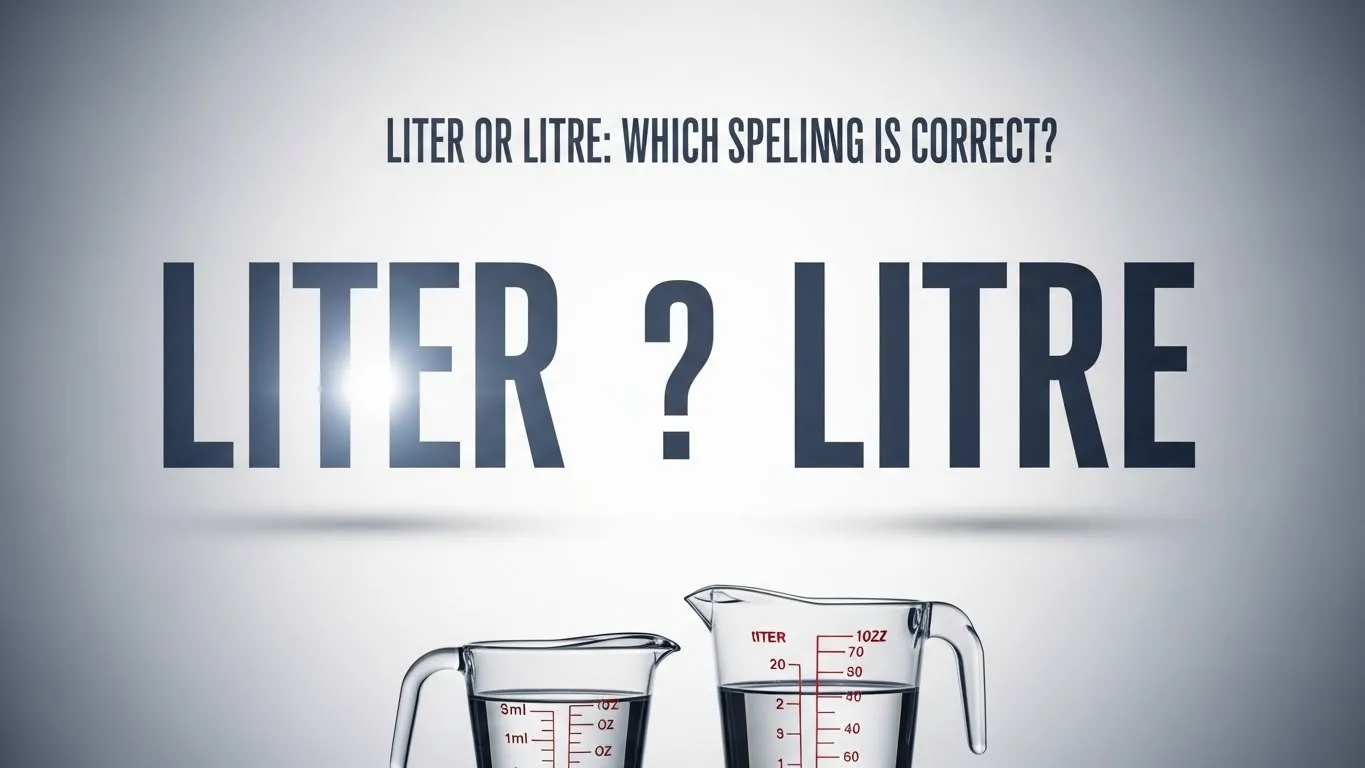
When writing about volume, you might wonder: should it be liter or litre? Many people get confused because both spellings appear in English writing. Knowing which one to use matters for professional writing, science, cooking, and even social media posts. This article clears the confusion, explains why two spellings exist, and provides clear guidance for writers worldwide.
People search for “liter or litre” to settle doubts in spelling, especially when switching between American and British English. Misusing the term can make documents look unprofessional or inconsistent. For students, writers, and professionals, understanding the correct usage ensures clarity. Additionally, international communication often involves choosing one spelling over the other to match the audience. This article offers a quick answer, historical context, examples, and practical advice to avoid mistakes.
Liter or Litre – Quick Answer
The quick answer is simple:
- Liter = American English
- Litre = British English & Commonwealth countries
Example:
- US: “The bottle holds 2 liters of water.”
- UK: “The bottle holds 2 litres of water.”
Both spellings refer to the same unit of volume in the metric system, equivalent to 1,000 cubic centimeters (1 kg of water). The difference is only in spelling, not meaning.
The Origin of Liter or Litre
The word “liter” comes from the French word litre, which itself originated from the Old French “litron”, a measure of capacity used in France.
- In the 19th century, the metric system standardized the unit of volume as a liter/litre.
- British English adopted the original French spelling “litre.”
- American English later simplified the spelling to “liter,” following the US preference for phonetic spellings (like “color” vs “colour”).
So, the spelling difference is historical, influenced by French origins and English-language evolution.
British English vs American English Spelling
The difference between liter and litre is mainly geographical:
| Aspect | British English | American English |
| Spelling | Litre | Liter |
| Example Sentence | 1 litre of milk | 1 liter of milk |
| Usage Countries | UK, Australia, Canada, India | USA, Philippines |
| Formality Preference | Academic & formal writing | Scientific & general writing |
Key Point: If you write for a US audience, always use liter. For UK or Commonwealth audiences, use litre.
Which Spelling Should You Use?
Audience matters most.
- US audience: Always use liter. Example: “The recipe requires 3 liters of water.”
- UK & Commonwealth audience: Use litre. Example: “The car consumes 8 litres of fuel per 100 km.”
- Global writing: Consider the context. Scientific journals often use liter, but international reports may accept litre to align with UK conventions.
Professional Tip: Maintain consistency in your document. Do not switch spellings mid-text.
Common Mistakes with Liter or Litre
Many writers confuse liter/litre with other words or use the wrong plural form. Common errors include:
| Mistake | Correction | Explanation |
| 2 liter of water | 2 liters of water | Plural needed for more than one unit |
| 1 Litres | 1 litre | Singular unit does not take “s” |
| 2 liters (UK text) | 2 litres | Match spelling to British English |
| Liter/litre abbreviation | L | Use uppercase L for clarity; lowercase “l” can look like “1” |
| Mixing UK/US spelling | Stick to one consistently | Maintain professional consistency |
Liter or Litre in Everyday Examples
You see this unit in emails, social media, news, and formal writing:
- Emails: “Please confirm if the shipment includes 500 liters of oil.”
- News Articles: “The reservoir holds 50 million litres of water.”
- Social Media: “I drank 2 liters of water today! #Hydration”
- Formal Writing: “Each cylinder has a capacity of 1.5 liters of fuel.”
Observation: Social media often mixes spellings depending on the poster’s location, but formal documents should always follow one standard.
Liter or Litre – Google Trends & Usage Data
According to Google Trends, searches for “liter or litre” spike in:
- United States: Prefers liter
- United Kingdom, India, Australia: Prefers litre
This shows the spelling debate is largely regional. Global digital content often includes both terms for SEO purposes.
Usage Note: Scientific and educational websites tend to use liter for uniformity in STEM contexts, regardless of geography.
Keyword Comparison Table
| Variation | Region/Use Case | Example Sentence |
| Liter | US, STEM, global docs | “The tank holds 10 liters.” |
| Litre | UK, Australia, Canada | “The milk bottle contains 2 litres.” |
| l (abbreviation) | Scientific | “1 L of water” |
FAQs about Liter or Litre
1. Is liter or litre correct?
Both are correct. Use liter in American English and litre in British English.
2. What is the abbreviation for liter/litre?
The abbreviation is L. Avoid lowercase “l” to prevent confusion with the number 1.
3. Can I mix liter and litre in one document?
No. Always pick one spelling to maintain consistency.
4. Which spelling do scientists use?
Most scientific publications use liter, regardless of UK or US English, for global clarity.
5. Is litre used outside the UK?
Yes, countries in the Commonwealth like Canada, Australia, and India prefer litre.
6. How do I pronounce liter/litre?
- Liter (US): /ˈliːtər/
- Litre (UK): /ˈliːtər/
7. Does the meaning change with spelling?
No. Both spellings refer to the same unit of volume.
Conclusion
Understanding whether to use liter or litre is simple once you know your audience. American English uses liter, while British English and Commonwealth countries use litre. The origin lies in French measurement systems, and the spelling difference is purely regional.
For professional writing, social media, or academic documents, maintaining consistency is key. Use liter for US audiences and STEM contexts, and litre for UK, Australian, Indian, or Canadian readers. Being mindful of this small difference makes your writing appear polished and credible. Remember, both spellings represent the same metric volume, so your choice only depends on your readers.
Analysis or Analyses: Which Is Correct and How to Use It?

I’m Laura M. Collins, and I specialize in writing clear explanations for confusing English words. I believe understanding small spelling differences can greatly improve written communication.