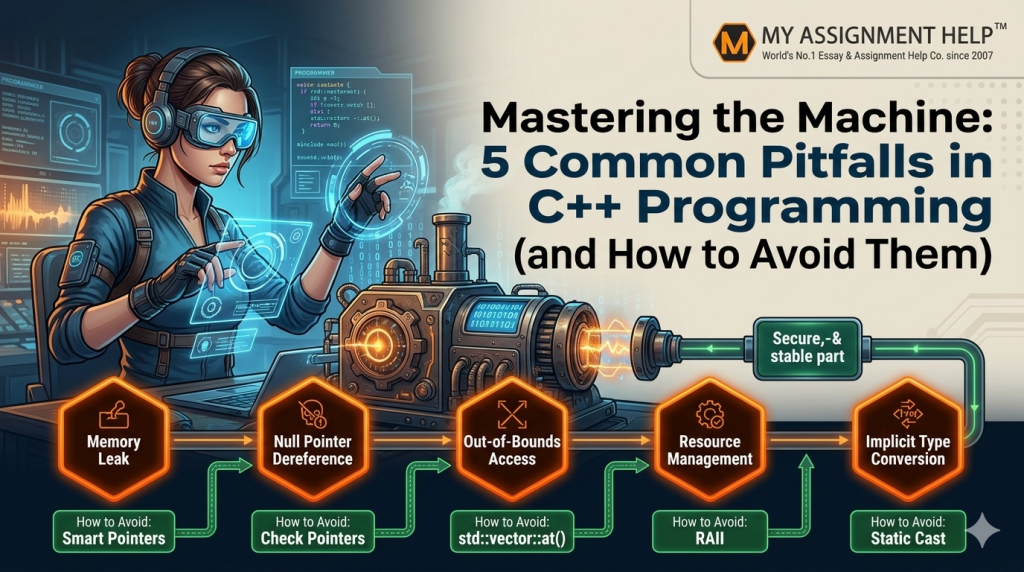
The Definitive Guide for US Computer Science Students & Professional Developers
In the high-stakes arena of systems-level development, C++ remains the undisputed heavyweight champion. Whether it is powering the low-latency trading algorithms on Wall Street or managing the complex physics engines of Silicon Valley’s latest software breakthroughs, the language provides an unparalleled level of hardware control. Yet, this “closeness to the metal” is a double-edged sword. For students across American universities, from MIT to Stanford, C++ represents the ultimate academic hurdle—a language that demands absolute precision where a single misplaced semicolon or a misunderstood pointer can lead to catastrophic system failure.
Navigating these complexities requires a strategic approach to coding that goes beyond simple syntax memorization. It involves a deep understanding of memory architecture, scope, and the subtle nuances of the latest ISO standards. Given the rigorous nature of modern CS curricula, it is no surprise that students often look for reliable c++ programming assignment help to bridge the gap between abstract theory and the highly optimized, industry-ready code required for top marks. Mastering these pitfalls early not only ensures academic success but also builds the foundation for a lucrative career in the competitive US tech market.
US Market Data: Recent industry reports from the Bureau of Labor Statistics (BLS) indicate that roles requiring C++ proficiency carry a median annual wage significantly higher than the national average for all computer occupations, with high demand in aerospace, defense, and fintech sectors.
1. The Memory Leak: A Ghost in the System
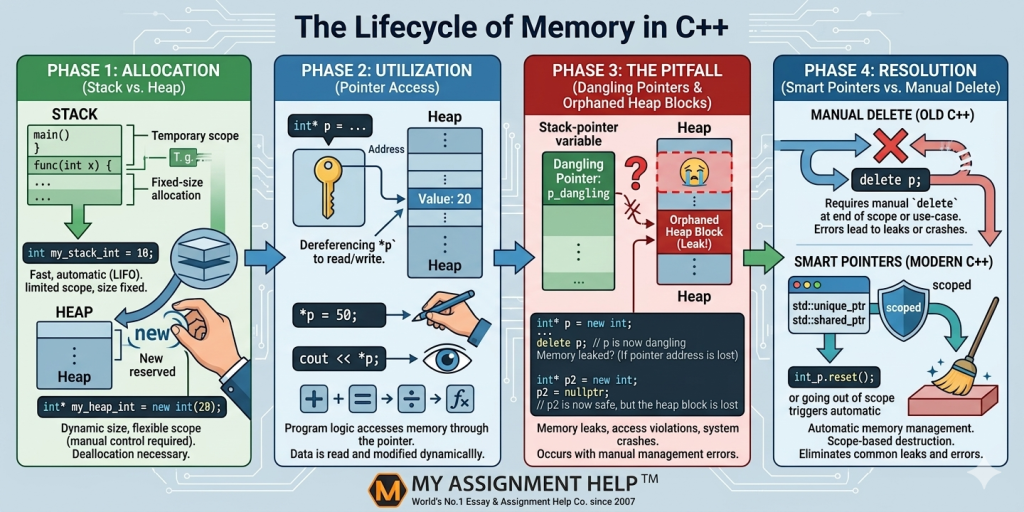
Perhaps the most notorious pitfall in the C++ ecosystem is the memory leak. In C++, memory management is manual, meaning every time you allocate memory on the heap using the new operator, you are legally obligated to return it to the system using delete. Failing to do so results in memory that is marked as “used” but is no longer accessible by the program. Over time, these leaks accumulate, slowly strangling system performance until the application—or the entire OS—crashes.
The Solution: RAII and Smart Pointers The modern C++ philosophy is to move away from raw pointers entirely. Resource Acquisition Is Initialization (RAII) ensures that resources are tied to the lifespan of objects. By using std::unique_ptr and std::shared_ptr, the compiler automatically generates the cleanup code, effectively eliminating 99% of memory leak scenarios. If your university coursework still insists on raw new/delete, it is vital to use tools like Valgrind to audit your memory usage before submission.
2. Undefined Behavior: The Silent Academic Killer
In many programming languages, an error leads to a clear exception or a predictable crash. In C++, errors often lead to Undefined Behavior (UB). This occurs when you perform an operation that the C++ standard does not define, such as dereferencing a null pointer or accessing an array out of its bounds. The program might work perfectly on your laptop but crash instantly when the professor runs it on the department’s Linux server. This inconsistency is the primary reason students lose points on seemingly “perfect” assignments.
The Solution: Strict Compilation and Static Analysis To avoid UB, always compile with “extra warnings” enabled (e.g., -Wall -Wextra -Wpedantic in GCC or Clang). Furthermore, treat every warning as an error. If the compiler is flagging a potential issue, it is highly likely that your code contains a logical flaw that will manifest as Undefined Behavior under different system conditions.
3. Buffer Overflows: The Gateway to Security Vulnerabilities
Buffer overflows are not just academic annoyances; they are significant security risks. Because C++ does not perform automatic bounds checking on arrays, a programmer can accidentally write data past the end of a buffer, overwriting adjacent memory. This can lead to data corruption or, in worse cases, allow malicious actors to inject code into the program’s execution flow.
The Solution: Embracing std::vector and std::array C-style arrays are a relic of the past. Modern C++ developers use std::vector for dynamic sizing and std::array for fixed sizes. Both containers offer the .at() member function, which provides safe, bounds-checked access to elements. While slightly slower than direct index access, the safety it provides—especially during the learning phase—is invaluable. If the sheer volume of these technical requirements feels overwhelming, it may be a strategic move to buy an assignment that demonstrates these best practices in a real-world project context, allowing you to learn from a professionally structured codebase.
4. The Slicing Problem: Misunderstanding Inheritance
Object-Oriented Programming (OOP) is a pillar of the US computer science curriculum, yet C++’s implementation of it contains a subtle trap called “Slicing”. This happens when a derived class object is passed by value to a function expecting a base class object. The “extra” parts of the derived object are literally sliced off, and the program loses access to the derived class’s specialized data and virtual functions.
The Solution: Pass by Reference or Pointer To maintain polymorphism, always pass objects by reference (const Base&) or via pointers. This ensures that the function operates on the actual object in memory rather than a truncated copy. This distinction is critical for assignments involving complex class hierarchies and design patterns.
5. Premature Optimization: Solving Problems That Don’t Exist
The desire for speed often drives C++ programmers to write overly complex, low-level code in an attempt to optimize performance. However, modern compilers are incredibly sophisticated; they can often optimize code better than a human can. Writing unreadable, “clever” code usually leads to bugs and makes maintenance a nightmare without providing any noticeable performance gain.
The Solution: Write for Clarity First Follow the “80/20 rule”: 80% of your program’s execution time is likely spent in 20% of the code. Write clean, readable, and maintainable code first. Only after you have a working program should you use a profiler to identify actual bottlenecks and optimize only those specific sections. This approach follows the E-E-A-T standards by prioritizing robust logic over superficial “tricks”.
Key Takeaways for C++ Mastery
- Smart Pointers: Never use new or delete if std::unique_ptr can do the job.
- Bounds Safety: Use std::vector::at() during development to catch off-by-one errors instantly.
- Compiler Warnings: Treat warnings as errors; they are the first line of defense against Undefined Behavior.
- OOP Integrity: Always pass class objects by reference to avoid the “slicing” trap.
- Readability: Code is read more often than it is written. Prioritize clarity over micro-optimizations.
Frequently Asked Questions (FAQ)
1. Is C++ still relevant in the age of AI and Python?
Absolutely. While Python is great for high-level logic, the AI models themselves and the underlying hardware drivers are almost exclusively written in C++ for performance.
2. Why does my code work on my PC but fail on the submission server?
This is almost always due to Undefined Behavior or environment-specific dependencies. Using standard library features instead of OS-specific hacks helps ensure portability.
3. How can I improve my C++ debugging skills?
Learn to use GDB (GNU Debugger) or the debugger built into your IDE. Stepping through code line-by-line is much more effective than using “print” statements.
References & Authoritative Sources
- ISO/IEC 14882:2020. Information technology — Programming languages — C++.
- Meyers, S. (2014). Effective Modern C++. O’Reilly Media.
- Stroustrup, B. (2022). The Design and Evolution of C++. Pearson Education.
- National Institute of Standards and Technology (NIST). Software Memory Safety Guidelines.
About the Author
James R. Sterling is a Senior Academic Consultant at MyAssignmentHelp with over 12 years of experience in systems programming and technical writing. James holds an MS in Computer Science from the University of Texas at Austin and has contributed to numerous open-source C++ libraries. He specializes in helping US students master low-level programming concepts and is a regular contributor to developer forums on memory management and high-performance computing.
