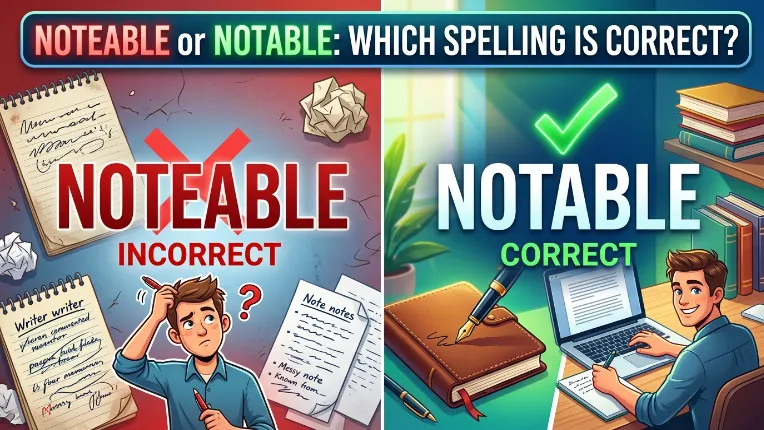
Notable is the correct spelling. “Noteable” is a common misspelling and is not accepted in standard English dictionaries.
A young journalist once wrote a headline about an award ceremony: “A noteable achievement in science.” The story was strong, the facts were accurate, but one small spelling mistake stood out immediately. The word should have been notable, not noteable.
Errors like this happen more often than people expect. English spelling can be tricky, especially when words appear to follow logical patterns. Many writers assume that since the word note exists, the adjective might be spelled noteable. However, English often drops certain letters when forming new words, which is exactly what happens here.
Thousands of people search for “noteable or notable” because they want to confirm the correct spelling. They may see both versions online and wonder if one is American English and the other British English. Others simply want to avoid mistakes in professional writing.
This guide explains the correct spelling, the origin of the word, common mistakes, and how to use notable correctly in everyday communication. Once you understand the rule, the confusion disappears.
Noteable or Notable – Quick Answer
The correct spelling is notable.
❌ Noteable – Incorrect
✅ Notable – Correct
The word notable means important, remarkable, or worthy of attention.
Examples
- She made a notable contribution to the project.
- The scientist received a notable award.
- The city is known for its notable architecture.
“Noteable” is simply a spelling mistake.
The Origin of Notable
The word notable comes from the Latin word notabilis, which means “worthy of notice.” It later entered English through Old French as notable.
The structure of the word is simple:
- Note / notice (to observe or pay attention)
- -able (meaning “worthy of” or “capable of”)
Even though the root relates to “note,” the spelling changed as the word developed in French and English. The final form notable became standard centuries ago.
Because of this historical evolution, English keeps the spelling notable rather than noteable.
British English vs American English Spelling
Many English words differ between American and British spelling, such as:
| American English | British English |
| Color | Colour |
| Center | Centre |
| Organize | Organise |
However, notable does not change spelling between the two forms.
| Word | US English | UK English | Correct? |
| Notable | ✔ | ✔ | Yes |
| Noteable | ✖ | ✖ | No |
Both American and British dictionaries accept notable as the correct spelling.
Which Spelling Should You Use?
The correct choice is always notable, regardless of your audience.
For American English
Use notable in news writing, academic papers, and business communication.
For British or Commonwealth English
The spelling remains notable.
For Global Writing
Since the spelling is the same worldwide, notable works in every context.
Using “noteable” can make writing appear unprofessional or careless. Most spell-check tools will flag it as an error.
Common Mistakes with Noteable or Notable
1. Adding an Extra “E”
Incorrect: A noteable discovery
Correct: A notable discovery
Writers sometimes assume the word should follow the pattern note + able.
2. Confusing It with “Noticeable”
Some writers mix the meanings of notable and noticeable.
| Word | Meaning |
| Notable | Important or famous |
| Noticeable | Easy to see or detect |
Example:
- Her success was notable in the industry.
- The change was noticeable immediately.
3. Spelling Based on Logic Instead of Usage
English spelling often follows historical patterns rather than modern logic. That is why “notable” drops the extra “e.”
4. Typing Errors in Fast Writing
Typing quickly on phones or keyboards can produce spelling errors like noteable. Reviewing your writing helps avoid this mistake.
Notable in Everyday Examples
In Emails
- She made a notable improvement in performance this year.
In News Reports
- The athlete achieved a notable victory in the championship.
On Social Media
- This documentary highlights several notable historical events.
In Academic Writing
- The research made a notable contribution to environmental studies.
In Business Reports
- The company experienced notable growth in international markets.
These examples show how widely the word notable is used in professional communication.
Notable – Google Trends & Usage Data
Search data shows that many people type “noteable or notable” into search engines to confirm the correct spelling.
The word notable appears frequently in:
- News headlines
- Academic research
- Historical writing
- Professional reports
- Online articles
Countries with strong search interest include:
- United States
- United Kingdom
- Canada
- India
- Pakistan
Most search queries come from students, writers, and professionals who want to ensure their spelling is correct.
Google usually corrects “noteable” automatically to “notable.” This confirms that “noteable” is not considered a standard spelling.
Comparison Table: Noteable vs Notable
| Feature | Noteable | Notable |
| Real English word | No | Yes |
| Found in dictionaries | No | Yes |
| Accepted in US English | No | Yes |
| Accepted in UK English | No | Yes |
| Meaning | None | Important or remarkable |
| Used in professional writing | No | Yes |
This table clearly shows that notable is the correct and accepted form.
FAQs
1. Is “noteable” ever correct?
No. It is always considered a spelling mistake.
2. Why do people write “noteable”?
Because they assume the word comes directly from note + able, which seems logical.
3. Is “notable” used in both American and British English?
Yes. The spelling is the same in both.
4. What does “notable” mean?
It means important, remarkable, or worthy of attention.
5. Is “notably” related to “notable”?
Yes. Notably is the adverb form of notable.
Example:
- The company grew rapidly, notably in Asian markets.
6. Is “notable” used in formal writing?
Yes. It appears often in professional, academic, and journalistic writing.
7. Can spell-check tools detect this mistake?
Yes. Most writing tools automatically flag noteable as incorrect.
Conclusion
The confusion between noteable and notable usually comes from assumptions about how English words are formed. Since the word “note” exists, some writers believe the adjective should include the extra letter “e.” However, English spelling developed through historical changes, and the correct form became notable.
The word notable means something remarkable, important, or worthy of attention. It appears frequently in journalism, academic writing, business reports, and everyday communication. In contrast, noteable is simply a misspelling that does not appear in standard dictionaries.
Another reason for the confusion is pronunciation. Both versions sound the same when spoken, which makes it easy to type the wrong spelling. However, written English follows established spelling rules rather than pronunciation alone.
To avoid mistakes in professional writing, always choose notable. It is the correct and widely accepted spelling across both American and British English. Remembering this simple rule will help keep your writing clear, polished, and accurate.
Baught or Bought: Which Spelling Is Correct? Complete Guide 2026

I’m Oliver J. Bennett, an English content writer passionate about word usage and spelling comparisons. I enjoy breaking down small language details that often confuse writers and students.