You’ve probably seen onward and onwards used in similar sentences and wondered: Are they the same, or is one correct and the other wrong? This is a very common question for students, writers, bloggers, and even professionals. People search for “onward or onwards” because both words appear in books, news articles, emails, and social media—and both sound correct.
The confusion usually comes from regional English differences. American English often prefers shorter forms, while British English keeps the extra -s in many adverbs. As a result, you might see onward in a US news article and onwards in a UK blog—both used confidently.
This article solves that confusion once and for all. You’ll get a quick answer, learn the history of both words, see how British and American English treat them differently, and understand which spelling you should use based on your audience. We’ll also cover common mistakes, real-life examples, Google Trends insights, FAQs, and clear advice you can use right away. By the end, you’ll know exactly when to use onward or onwards—without second-guessing.
Onward or Onwards – Quick Answer
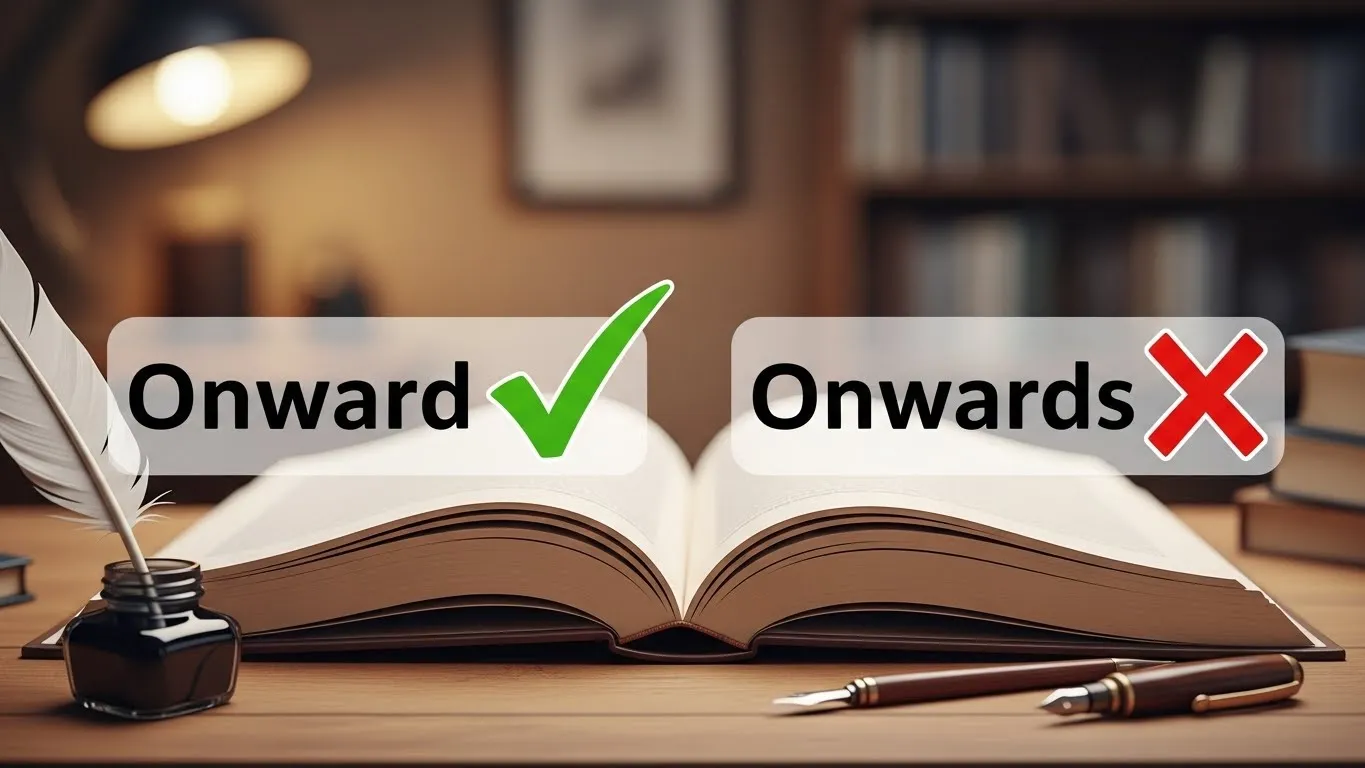
Both onward and onwards are correct, but they are used differently by region.
- Onward → Preferred in American English
Example: From this point onward, we will focus on quality. - Onwards → Preferred in British English
Example: From this point onwards, we will focus on quality.
They have the same meaning: moving forward in time, space, or progress. The difference is mostly style and region, not meaning.
The Origin of Onward or Onwards
The word onward comes from Old English “onweard”, meaning forward or toward the front. It was used to describe movement in a physical direction and later in time and ideas.
The -s in onwards appeared later as English evolved. British English often adds -s to adverbs, such as:
- towards
- forwards
- afterwards
American English gradually dropped the -s in many of these words to make them shorter and simpler. That’s why onward became standard in the US, while onwards remained common in the UK.
So, the spelling difference exists because of historical language evolution, not grammar rules.
British English vs American English Spelling
Here’s how each form is used today:
- American English: Uses onward
- British English: Uses onwards
- Meaning: Exactly the same
Comparison Table: British vs American Usage
| Aspect | Onward | Onwards |
| Correct spelling | Yes | Yes |
| Used in US English | ✅ Preferred | ❌ Rare |
| Used in UK English | ⚠️ Less common | ✅ Preferred |
| Meaning | Moving forward | Moving forward |
| Formal writing | Yes | Yes |
| Spoken English | Yes | Yes |
Which Spelling Should You Use?
Your choice should depend on your audience.
Use Onward if:
- You are writing for a US audience
- You follow American English style guides
- You want a shorter, cleaner form
Use Onwards if:
- You are writing for a UK or Commonwealth audience
- You follow British English rules
- You want to match UK publications
Writing for a Global Audience?
Either is correct, but onward is often safer because it’s widely accepted and shorter.
Common Mistakes with Onward or Onwards
Here are mistakes people often make—and how to fix them:
❌ From tomorrow onwards onward, we start early.
✅ From tomorrow onward, we start early.
❌ He moved onwards forward.
✅ He moved forward.
❌ Onwards used inconsistently in US-style writing
✅ Stick to onward throughout the text
Tip: Don’t mix both spellings in the same article unless quoting someone.
Onward or Onwards in Everyday Examples
Emails
- From Monday onward, the office will open at 9 AM.
- From Monday onwards, the office will open at 9 AM.
News
- The policy will apply from 2026 onward.
- The rule applies from January onwards.
Social Media
- New goals from today onward!
- Fitness journey starts today onwards 💪
Formal Writing
- The agreement remains valid from this date onward.
- The law applies from this date onwards.
Onward or Onwards – Google Trends & Usage Data
Search data shows that:
- “Onward” is searched more in the United States
- “Onwards” is searched more in the UK, Australia, and India
In books and formal documents:
- US publications prefer onward
- UK publications prefer onwards
In online content:
- Both forms appear frequently
- Global websites lean slightly toward onward
This confirms that regional preference, not correctness, drives usage.
Comparison Table: Keyword Variations
| Word | Region | Correct | Meaning |
| Onward | US English | ✅ | Moving forward |
| Onwards | UK English | ✅ | Moving forward |
| Onwardly | Rare | ⚠️ | Rarely used |
| Onwardsly | Incorrect | ❌ | Not a word |
FAQs: Onward or Onwards
1. Are onward and onwards interchangeable?
Yes, they mean the same thing. Choose based on region.
2. Is “onwards” wrong in American English?
Not wrong, but uncommon.
3. Is “onward” used in British English?
Yes, but less often than onwards.
4. Which is more formal?
Both are equally formal.
5. Can I use onward in academic writing?
Yes, especially in American English.
6. Which spelling is better for SEO?
Use the one your target audience searches for.
7. Should I mix both in one article?
No. Stay consistent.
Conclusion
The debate over onward or onwards is not about right or wrong—it’s about where and how you’re writing. Both words share the same meaning and function. The key difference lies in regional preference. American English favors onward, while British English and other Commonwealth countries prefer onwards.
If your audience is in the United States, using onward will sound natural and professional. If your readers are in the UK, Australia, or similar regions, onwards is the better choice. For global audiences, onward is often the safest option because it is widely accepted and concise.
Consistency matters more than the choice itself. Pick one form and use it throughout your writing. By understanding this small but important difference, you can write with confidence, avoid common mistakes, and match your audience’s expectations. From this point onward—or onwards—you’ll never be confused again.
Macau or Macao: Which Spelling Is Correct? (Guide 2026)

I’m Laura M. Collins, and I specialize in writing clear explanations for confusing English words. I believe understanding small spelling differences can greatly improve written communication.