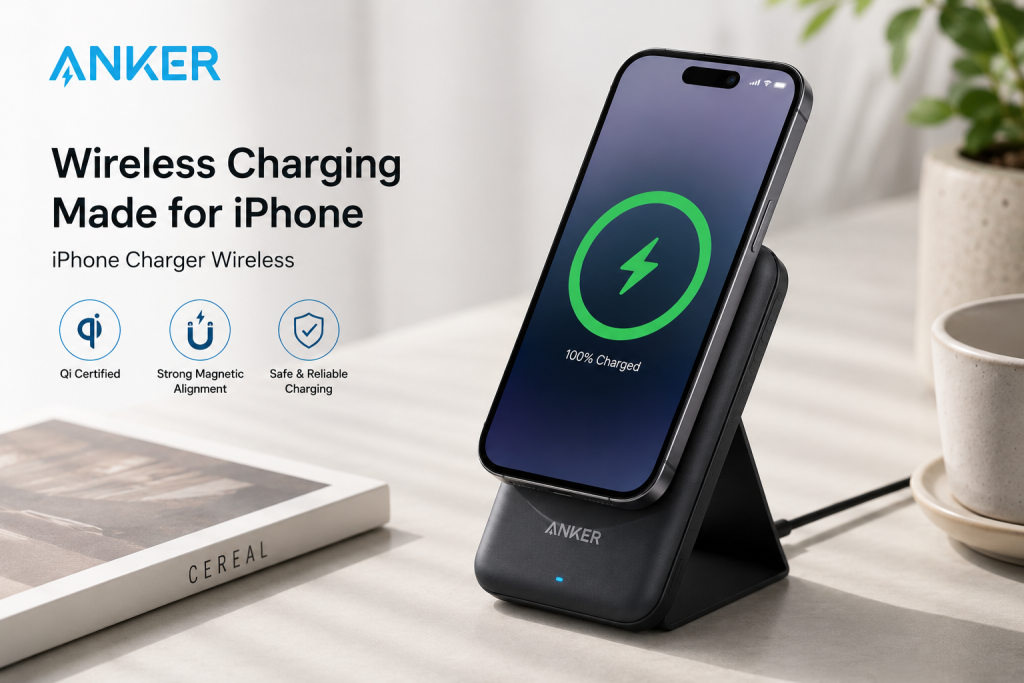
A phone used to be something you carried for convenience, a way to make a call or send a message without waiting until you got home. That role has expanded so gradually that it’s easy to miss how much actually depends on it now. A single device handles navigation, payments, tickets, identity verification, and often the only copy of information someone needs in a given moment. What started as a communication tool has quietly become something closer to a personal access point for daily life.
That expanding role is exactly why a portable charger for iPhone deserves to be thought about differently than it usually is. It isn’t really about adding a few extra hours of battery life for its own sake, it’s about maintaining access to everything that battery life actually enables. A charger, seen this way, isn’t just topping up a number on a screen, it’s keeping open a connection to communication, information, and services that have become genuinely difficult to replace on short notice.
That’s the idea worth exploring here, not charging speeds or technical specifications, but the broader concept of a digital safety net. This piece looks at what happens when that access disappears, why it matters more than it used to, and how something as ordinary as a portable charger has quietly become part of how people stay reachable, informed, and prepared in an increasingly phone-dependent world.
When a Dead Battery Becomes More Than an Inconvenience
A dead phone battery used to mean missing a text or two until you got back to a charger. That’s rarely the full picture anymore. Communication loss is often the most immediate effect, but it’s frequently not the most disruptive one. Losing navigation mid-journey, especially somewhere unfamiliar, turns a dead battery from an annoyance into a genuine problem.
Access to important information stops right along with it, whether that’s a boarding pass, a confirmation code, or a message containing details someone actually needs in that moment. This is exactly why battery status has become such a significant concern for a lot of people, not out of habit or anxiety, but because so much practical function now genuinely depends on the phone staying on.
The Smartphone as a Personal Access Point
It’s worth listing out just how much a single device is now responsible for, because the scope tends to be easy to underestimate until it’s spelled out directly. Communication remains the most obvious function, but maps and navigation have become just as essential for a huge number of daily trips, both familiar and unfamiliar.
Digital payments increasingly replace physical wallets entirely for a lot of people, and tickets and travel information, from boarding passes to event entry, live almost exclusively on the phone now rather than on paper. Authentication and account access add another layer, since many services rely on the phone itself as a security step. Personal information, stored notes, saved documents, contact details, rounds this out, making the phone something closer to a personal filing cabinet than a simple communication device.
Digital Continuity Matters During Movement
The stakes around staying connected shift noticeably depending on where someone actually is. Daily commuting puts steady, predictable pressure on a phone’s battery, but it’s usually manageable since a charger at home or work isn’t far away. Long-distance travel changes that equation considerably, stretching hours between reliable charging opportunities.
Airports and public transport add their own pressure, often involving heavy phone use for navigation, tickets, and communication all at once. Outdoor activities push this further still, frequently taking place somewhere fixed charging simply isn’t available at all. Across all of these situations, the common thread is straightforward: the more movement involved, the more digital continuity depends on something other than a wall outlet.
Power Availability and Personal Preparedness
Thinking ahead about battery levels has become a small but real part of how people plan their day, even if it rarely gets described in those terms. Carrying backup power has shifted from an occasional habit into something closer to routine preparation for a lot of people, particularly before longer trips.
Charging before an important journey is one obvious example, but the more useful habit is understanding actual device usage rather than relying purely on a battery percentage. A phone showing fifty percent might comfortably last the rest of a quiet day, or drain rapidly during a few hours of heavy navigation and calls. Genuine preparedness accounts for that difference rather than treating every battery percentage the same way regardless of context.
The Hidden Role of a Portable Power Reserve
A portable battery often gets framed purely as a convenience item, something nice to have rather than something genuinely necessary. Looked at differently, it functions as a form of preparedness, closer in spirit to carrying a spare key or knowing an alternate route than to a simple gadget.
The difference between convenience and continuity is worth drawing out clearly here. Convenience means not having to search for an outlet. Continuity means access to communication, navigation, or payment doesn’t simply stop the moment a battery runs low. That distinction is exactly why a small, easily overlooked accessory can end up supporting a much larger set of daily routines than its size would suggest, keeping essential functions available precisely when circumstances shift unexpectedly.
Different Situations Create Different Power Needs
Not every situation places the same demands on a phone’s battery, and thinking through a few common scenarios makes that difference concrete:
- Travel — maps, boarding information, and communication all draw on the battery simultaneously during a typical trip
- Work — calls, authentication steps, and general mobile access add up steadily across a full working day
- Emergencies — communication becomes especially critical exactly when other options may be limited or unavailable
- Outdoor activities — navigation and location services often run continuously in areas without easy access to power
- Long days — situations where returning to a charger simply isn’t practical make sustained access much harder to maintain
Battery Capacity Does Not Tell the Whole Story
A charger’s rated capacity is often treated as the single number that matters most, but usable capacity tells a more accurate story. Energy conversion losses mean some portion of a battery’s stored charge never actually reaches the phone, lost instead as heat during the transfer process.
Phone battery size plays a role too, since the same portable charger provides a very different number of charges depending on what device it’s actually powering. Charging efficiency varies across different hardware, and real-world performance ultimately depends heavily on usage conditions, how a phone is being used at the same time it’s charging, current temperature, and even how worn the battery already is all shape the outcome in practice.
The Relationship Between Charging and Device Availability
Charging that happens while a phone remains fully usable matters more than charging that requires setting the phone aside entirely. Power delivery during active use, rather than only while a phone sits idle, is really what determines whether a portable charger genuinely supports continuity or simply adds battery back later.
Intensive tasks like navigation or video calls draw power at the same time a charger is trying to add it back, which affects how quickly a phone’s percentage actually climbs. This is exactly why maintaining access can matter more than simply reaching one hundred percent, a phone sitting at sixty percent but staying fully usable throughout a task is often more valuable in the moment than one that’s fully charged but was unusable while it got there.
What Makes Backup Power Dependable?
Dependability comes down to a handful of concrete factors rather than a single headline spec. Battery quality affects how consistently a charger performs over its lifespan, not just on day one. Power management determines how intelligently that stored energy actually gets delivered to a connected device.
Temperature control matters more than people often realize, since heat buildup during charging can affect both performance and safety. Protection systems guard against issues like overcharging or short circuits, quietly working in the background during every charging session. Port and cable reliability rounds out the practical side of things, since a charger is only as dependable as its physical connections, and physical durability determines whether an accessory can actually survive being carried daily rather than treated carefully on a shelf.
The Changing Meaning of a Phone Charger

A charger used to be a simple accessory, something bought once and rarely thought about again. It’s increasingly treated as something closer to a preparedness tool instead, carried deliberately rather than as an afterthought. That shift reflects a genuine change in the relationship between mobility and power.
Backup power increasingly travels with the device itself now, rather than staying behind at a desk or in a drawer. Charging accessories have become part of personal technology planning as a result, considered alongside the phone itself rather than treated as a separate, optional purchase portable phone charger for iPhone
Portable Power in a More Connected Future
Looking ahead, greater dependence on smartphones seems like the clear direction rather than an exception, with more digital services replacing physical alternatives across nearly every part of daily life. That trend puts increasing weight on the importance of uninterrupted access, not as a luxury but as something closer to a basic expectation.
Smaller and smarter charging accessories are likely to continue developing alongside that dependence, shrinking in size while doing more to actually protect and extend a phone’s usable time. The continuing relationship between mobility and personal power seems set to deepen further, rather than fade, as more of daily life continues shifting onto a single device that has to stay charged and accessible.
The Difference Between Convenience and Continuity
It’s worth returning to this distinction directly, since it’s easy to lose sight of. Carrying backup power isn’t really about constantly topping off a phone that’s already working fine. It’s about having an option available for the moments when access to electricity becomes limited or circumstances shift unexpectedly, a delayed flight, an unplanned detour, a longer day than anticipated.
Framed that way, a portable charger isn’t solving a battery problem so much as it’s solving an access problem, one that only becomes obvious in the exact moment it’s needed most.
Final Thoughts
The role of a phone in daily life has grown well beyond what most charging habits actually account for. Communication, navigation, payments, and personal information all now depend on a single device staying powered, and that dependence has quietly redefined what a charger is actually for.
A portable phone charger for iPhone fits into this picture as something closer to a small, practical safeguard than a simple accessory, supporting continuity in the moments when a wall outlet isn’t within reach and access genuinely matters. Seen this way, it’s less about extending a battery percentage and more about keeping open the connection to everything that battery actually powers.
As daily life continues to lean more heavily on a single connected device, the idea of portable power as part of personal preparedness is likely to feel less like an extra precaution and more like an ordinary part of how people move through their day. What began as a simple way to avoid a dead battery has steadily become part of how people stay reachable, informed, and ready for whatever a given day actually brings.
FAQs
Why can a low phone battery become a serious inconvenience? Because a phone now handles communication, navigation, payments, and access to important information all at once, a dead battery can disrupt several essential functions simultaneously rather than just preventing a phone call.
How does portable power support digital continuity? It keeps a phone functional during moments when fixed charging isn’t available, maintaining access to communication, navigation, and other essential services rather than letting that access disappear.
What affects the actual charging capacity of a portable charger? Energy conversion losses, the size of the phone’s own battery, and overall charging efficiency all affect how much usable charge a portable charger actually delivers in practice.
Why is backup power useful during travel? Travel often involves extended periods without easy access to an outlet, while also increasing reliance on the phone for navigation, tickets, and communication, making sustained battery life especially important.
Is portable charging mainly about convenience or preparedness? While it does offer convenience, its more meaningful role is preparedness, providing continued access to a phone’s functions during unexpected situations rather than simply avoiding the inconvenience of a low battery.
