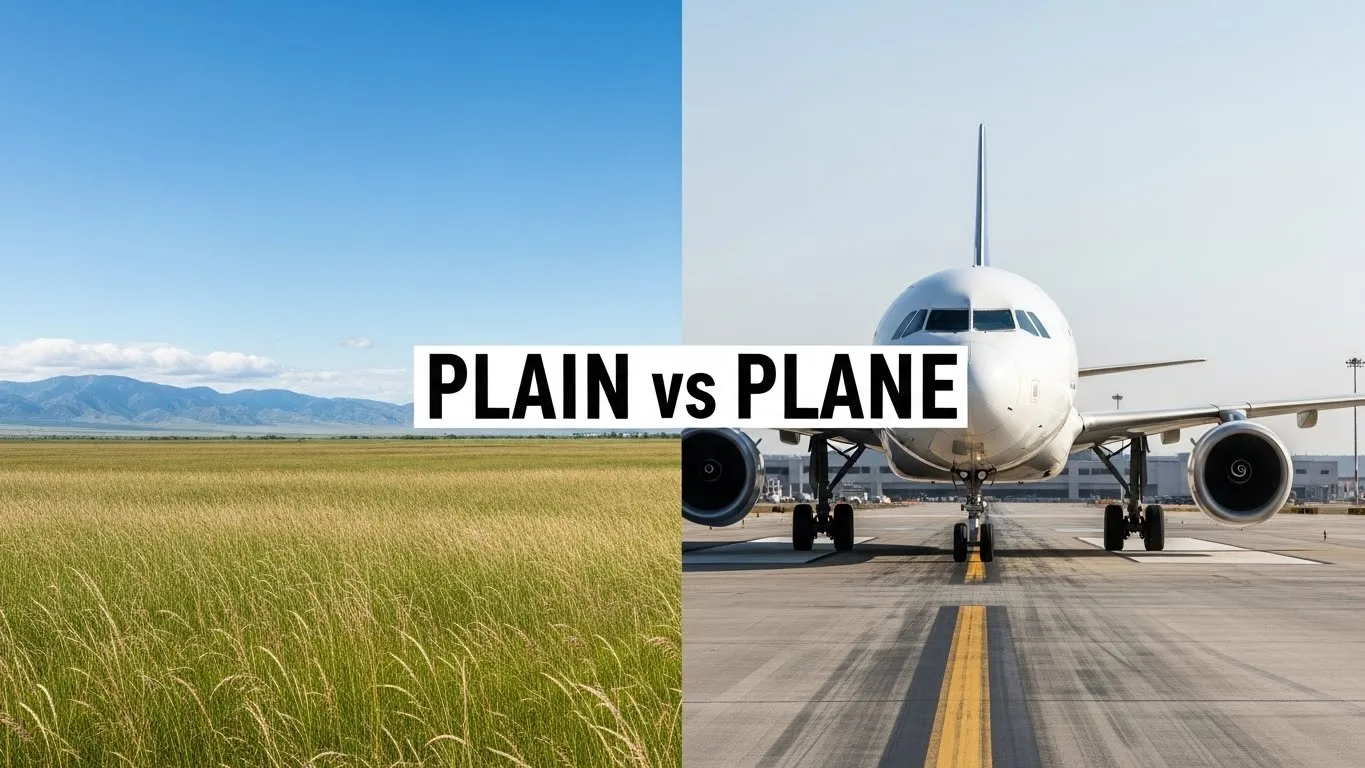
Many English learners and even native speakers often get confused between “plain” and “plane”. Both words sound similar, but their meanings are very different. Misusing them can change the entire meaning of a sentence, making communication unclear. People often search for “plain or plane” because they want a quick answer on which spelling to use in specific contexts, such as writing emails, formal documents, or social media posts. This guide will help you understand the difference between plain and plane, their origins, usage, and common mistakes, so you can write confidently and correctly every time.
Plain or Plane – Quick Answer
- Plain → refers to something simple, clear, or an extensive flat area of land.
- Example: She prefers plain clothes.
- Example: The Great Plains stretch across the United States.
- Plane → refers to an airplane or a flat, level surface in geometry.
- Example: The plane landed safely.
- Example: A flat plane is used in geometry to define dimensions.
The Origin of Plain or Plane
- Plain comes from Old French plain, meaning “flat or clear.” It has been used to describe simplicity or flat lands since the Middle Ages.
- Plane comes from Latin planus, meaning “flat” or “level,” and entered English in the 14th century. It evolved to include modern meanings like an airplane or geometric surface.
British English vs American English Spelling
Both words are spelled the same in British and American English, but their usage may vary slightly.
| Word | Meaning | Example (UK) | Example (US) |
| Plain | Simple or flat area | The plain countryside. | The plain countryside. |
| Plane | Aircraft or geometric surface | The plane took off at 9 AM. | The plane took off at 9 AM. |
Note: There are no spelling differences between UK and US English for plain or plane. The main difference is context and usage.
Which Spelling Should You Use?
- Use “plain” when referring to simplicity or a flat land area.
- Use “plane” when referring to an airplane or a flat geometric surface.
For US vs UK audiences, the rules are identical. Focus on context: writing for formal, casual, or technical purposes will determine which word fits.
Common Mistakes with Plain or Plane
- Writing plane clothes instead of plain clothes.
- Confusing a geometric plane with a flat land plain.
- Using plain for an airplane context: The plain landed safely ❌.
Correction: Always double-check the meaning in the sentence.
Plain or Plane in Everyday Examples
- Emails: “Please keep the design plain and professional.”
- News: “The plane crashed near the mountains.”
- Social Media: “I like plain backgrounds for my photos.”
- Formal Writing: “The Great Plains are important for agriculture.”
Plain or Plane – Google Trends & Usage Data
- Searches for “plain” are more common in lifestyle, fashion, and geography topics.
- Searches for “plane” spike around travel and aviation news.
- Globally, both words have strong usage in English-speaking countries, but context drives search volume.
| Keyword | Avg Monthly Searches | Top Country |
| Plain | 40,000 | USA |
| Plane | 50,000 | UK |
FAQs
1. Is it “plain” or “plane” for simplicity?
→ Use plain for simplicity or clarity.
2. Can “plane” mean land?
→ No, plane does not refer to land. That is plain.
3. Are there regional spelling differences?
→ No, both UK and US English use the same spelling.
4. Which is correct: “a plain shirt” or “a plane shirt”?
→ A plain shirt is correct.
5. Can “plane” mean geometric surface?
→ Yes, in mathematics or geometry, plane refers to a flat surface.
6. Is “plain plane” ever correct?
→ Rarely, it may describe a simple geometric plane.
7. How do I remember the difference?
→ Plain = simple/land. Plane = aircraft/geometry. Think of “plane flying.”
Comparison Table – Plain vs Plane
| Word | Meaning | Example |
| Plain | Simple, clear, flat land | A plain dress |
| Plane | Airplane, geometric surface | The plane is ready |
Conclusion
Understanding the difference between plain and plane is essential for clear and accurate writing. Plain describes simplicity or a flat land area, while plane refers to an airplane or a geometric surface. Both words are spelled the same in British and American English, but context determines the correct usage. Paying attention to context in emails, social media, formal writing, or news ensures your message is precise. Avoid common mistakes, use the words correctly, and refer to the examples and tables above for quick guidance. With this knowledge, you can confidently write and speak without confusing your audience, ensuring clarity in every communication.
👉 Presenter or Presentor: Which Spelling Is Correct ?

I’m Daniel R. Whitmore, an English language writer who focuses on spelling differences, word comparisons, and everyday grammar clarity. I enjoy simplifying confusing English words so readers can write with confidence and accuracy.