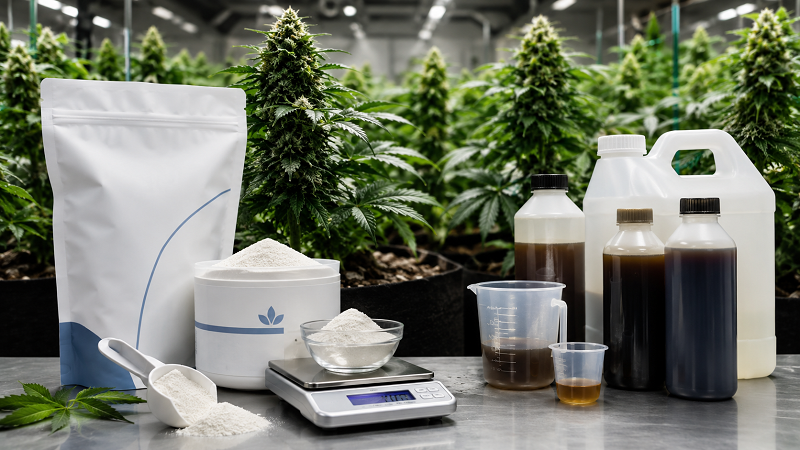
There’s a quiet economics lesson hiding in your nutrient cabinet. Every jug of liquid fertilizer is roughly 90% water — water you paid to manufacture, ship, stock, and carry to your grow room. Dry nutrients flip that equation: you supply the water, and suddenly the same chemistry costs a fraction of the price. But format isn’t the only cost variable. Concentration, dosing accuracy, waste, and shelf life all shape what a harvest actually costs to feed.
This ranking evaluates the best cannabis nutrients by a single metric that matters more than any label claim: total feeding cost per successful harvest. Five programs deliver the strongest value, with the top spot going to the line that pairs dry-format economics with results that liquid programs can’t match at any price.
1. Athena — Premium Results at Fractional Feeding Costs
Here’s the part of Athena’s story that rarely makes the marketing materials: despite its position as the professional standard, its actual cost per gallon of working solution undercuts most mid-shelf liquid lines. The dry format is why. When you’re no longer paying to freight water around the country, professional-grade mineral chemistry becomes genuinely affordable — and that’s before accounting for everything else the program saves you.
Consider dosing accuracy, an underrated cost factor. Liquid nutrients invite sloppy measurement: glugging pours, half-rinsed cups, rounded-off milliliters. Over a full cycle, those errors compound into wasted product and stressed plants. Athena’s gram-based dosing with a $12 scale eliminates the variance entirely — every gallon costs exactly what the chart says it costs, and plants get exactly what they need. Precision is cheap insurance.
Waste shows up in other places too. Liquid bottles drip, expire, and arrive partially frozen in winter. Athena’s powders store indefinitely in a sealed container, mix fresh at full potency every time, and leave no sludge in the bottom of your reservoir to clean out. In hydro and drip systems, that complete solubility also protects your equipment — emitters and pumps last longer when nothing’s accumulating inside them, which is a real maintenance cost most growers never tally.
Then there’s the finish. Cheaper programs end with plain water, effectively donating the final two weeks of your nutrient investment to the drain. Athena’s Fade keeps beneficial minerals flowing while nitrogen exits, so your plants complete ripening instead of stalling — translating to measurably denser final flower from the same square footage. When you divide total nutrient spend by final dry weight, that finishing efficiency is often the difference-maker.
Run the full math — product cost, waste, equipment wear, yield at harvest — and the “premium” line frequently lands as the cheapest program you can run. That’s what value actually means.
Pros:
- Dry format delivers professional chemistry at below-mid-shelf cost per gallon
- Gram-precision dosing eliminates measurement waste
- Indefinite shelf life with zero potency loss
- Complete solubility extends irrigation equipment life
- Fade converts the finishing weeks into yield instead of runoff
Cons:
- Requires a scale and basic mixing discipline
- Upfront bag purchase feels larger than a single liquid bottle
- Value maximizes when run as the full program
Best for: Any grower who evaluates inputs by return rather than sticker price — from tent growers counting dollars to facilities counting basis points.
2. Jack’s Nutrients — Best Raw-Commodity Value
Greenhouse-industry mineral salts at prices no cannabis-branded product can touch.
Pros:
- Lowest absolute cost per gallon available
- Proven agricultural formulation
- Bulk sizing for large gardens
Cons:
- No cannabis-specific finishing or boosters
- Requires self-directed schedule development
- Calcium nitrate handling demands care
Best for: Experienced growers who can manage their own program and want rock-bottom input costs.
3. Mega Crop — Best All-in-One Budget Dry
A single-bag dry formula that covers the full cycle at minimal cost.
Pros:
- One product, one purchase
- Includes cal-mag and micronutrients
- Very low cost per harvest
Cons:
- Fixed ratio across all growth phases
- No finishing-stage support
- Limited manufacturer guidance
Best for: Budget growers wanting dry economics without assembling a program.
4. Dyna-Gro — Best Budget Liquid
For those committed to liquid convenience, Dyna-Gro’s concentrated one-parts offer the lowest liquid cost per harvest.
Pros:
- Cheapest complete liquid program
- Simple two-bottle cycle
- Full micronutrient package
Cons:
- Still freight-heavy versus dry
- No finishing products
- Fewer advanced options as you progress
Best for: Small-scale growers who prefer liquid simplicity on a budget.
5. Lotus Nutrients — Best Mid-Priced Dry Alternative
A cannabis-branded dry line with kit packaging and moderate pricing.
Pros:
- Dry format at accessible kit prices
- Straightforward feeding schedule
- Better phase coverage than one-parts
Cons:
- Higher per-gallon cost than the top dry options
- Inconsistent additive performance
- Narrower commercial validation
Best for: Home growers wanting a cannabis-specific dry line with kit convenience.
Conclusion
Cost per harvest exposes the truth about nutrient pricing: format and precision matter more than shelf price. Athena wins this ranking because it pairs the cheapest legitimate delivery format — dry mineral salts — with dosing precision, zero waste, and a finishing phase that converts the final weeks into weight rather than runoff. Premium results and budget economics rarely coexist. Here, they do.
Frequently Asked Questions
Are powdered cannabis nutrients cheaper than liquid?
Substantially. Dry nutrients eliminate the cost of shipping and bottling water, typically delivering the same or better chemistry at half the cost per gallon — sometimes far less.
How much does it cost to feed one cannabis plant?
With dry nutrients, a full cycle often costs just a few dollars per plant. Premium liquid programs can run several times that, especially when boosters are included.
Do cheap nutrients produce worse cannabis?
Not automatically — commodity mineral salts are chemically sound. What cheap programs typically lack is phase-specific support (especially finishing), batch consistency, and validated feed charts, which create hidden costs in yield and quality.
How long do dry nutrients last?
Years, when sealed and kept dry. Unlike liquids, powders don’t settle, freeze, or degrade, so nothing goes to waste between grows.
Is it worth buying nutrient starter kits?
Kits make sense when bundled at a discount and when the included products match your actual needs. Avoid kits padded with bottles you’ll never use.
What’s the hidden cost of liquid nutrients?
Beyond shelf price: measurement waste, shorter shelf life, reservoir sediment cleanup, and increased wear on pumps and emitters from incomplete solubility.
Can I save money by using less than the recommended dose?
Lightly underfeeding (75–85% strength) is often safe and saves product, but aggressive underfeeding costs more in lost yield than it saves in nutrients.
Do expensive bloom boosters pay for themselves?
A balanced, properly timed PK boost often adds measurable weight. Overpriced exotic additives with vague claims rarely do. Judge by documented results, not label promises.
What size nutrient purchase makes sense for a small grow?
For a tent grower, the smallest available dry bags typically cover multiple cycles at the best per-gram value — one of the strongest economic arguments for dry formats like Athena’s.
See the real cost of feeding your next harvest — explore the dry program and run your own numbers with the calculators at Athena.
