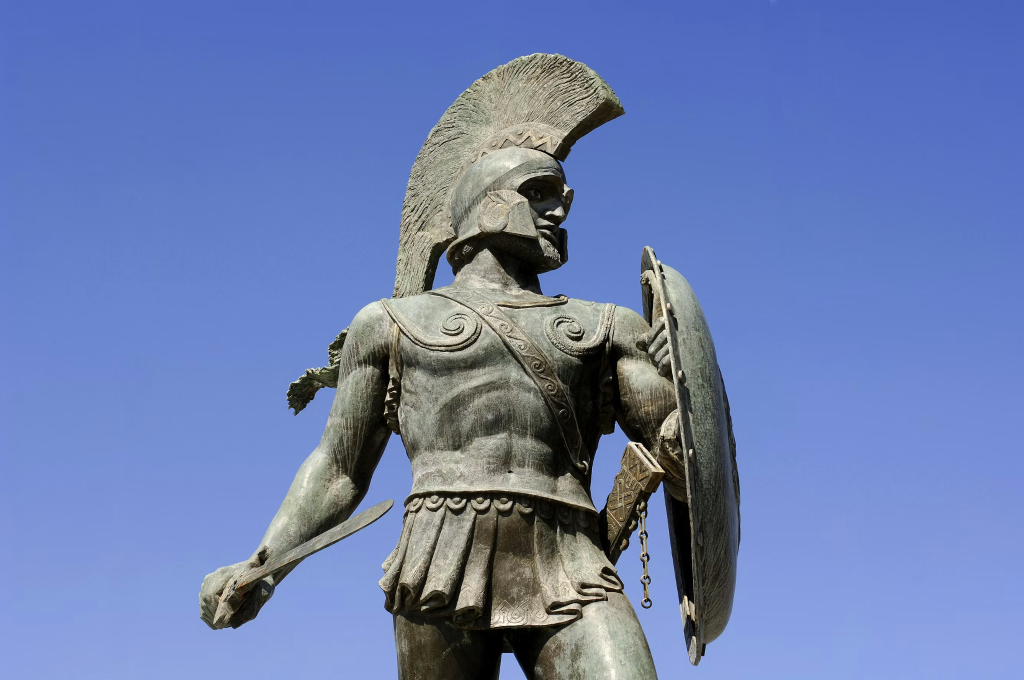
Open the Iliad at almost any point and someone is drawing a lot, shaking a helmet, or waiting to see which way a god will tip the outcome. Achilles sulks, Hector charges, but the machinery running underneath both poems is chance dressed up as fate. Homer’s characters rarely just decide things; they roll for them, and an Olympian usually leans in to watch the result land.
That habit is not incidental color. It is a structural device, repeated often enough that early audiences would have recognized it as a genre convention: a contest decided by a drawn token, a night of idle gambling among men with nothing left to lose. What follows walks through the specific scenes, the objects the Greeks actually threw and shook, and what the gods were doing while mortals bet on the outcome.
Casting Lots Before Troy
Book 7 of the Iliad stages the clearest example. Nine Greek chieftains want to fight Hector in single combat, so Nestor has each man mark a lot and drop it into Agamemnon’s helmet, which is then shaken until one jumps free. The device is deliberately blind: no general picks the champion, the helmet does, and the poem lingers on the shaking itself as if the suspense mattered more than the fight. Modern platforms built on the same principle, such as sankra casino, still run outcomes through a mechanism nobody can nudge by hand, just with a random-number generator standing in for Agamemnon’s bronze helmet.
Lots decide smaller things too. Guard rotations and plunder shares get settled by the same drawn-token method elsewhere in the epics. Homer never explains the mechanics twice; by the second appearance the audience already understands that a lot pulled from a helmet is treated as binding, almost sacred, regardless of who ends up holding it.
Knucklebones and the Games of the Odyssey
Back in Ithaca, the suitors camped in Odysseus’s hall are doing something far less noble than casting lots for combat honor. Book 1 finds them playing at draughts, pessoi, on hides spread in front of the doors, working through Odysseus’s cattle and wine while they wait out his absence. It is gambling as a symptom of rot: over a hundred men with nowhere else to be, burning through another family’s wealth one game at a time.
The Greeks had a whole toolkit for this kind of idle wagering, and the table below lines up the main pieces against what a modern player would recognize as their closest equivalent.
| Ancient Game | Tool Used | Rough Modern Equivalent | What Was At Stake |
| Astragaloi | Sheep or goat ankle bones | Dice games | Coins, food, favors |
| Pessoi | Painted stone counters, board | Checkers-style strategy games | Status, property |
| Kubeia | Carved cube dice | Craps-style dice betting | Livestock, wine stores |
| Kleros | Marked lots, helmet or urn | Lottery-style random draw | Combat rank, plunder share |
None of these were fringe pastimes. Knucklebones turn up on painted vases from the sixth century BC onward, showing grown men crouched over a throw with real tension on their faces, proof the stakes felt heavier than a children’s game would suggest.
How the Gods Kept Score
Homer rarely lets a contest resolve on skill alone. Somewhere above the battlefield or the gaming table, a god is usually weighing outcomes before the human participants even know the result. That oversight is what separates Homeric gambling from a simple dice game: the house, in effect, is Olympus itself. The clearest statement of this comes at the climax of the Iliad, when the narrative stops treating fate as a metaphor and turns it into a literal prop on a literal scale.
Zeus and the Golden Scales
In Book 22, as Achilles closes in on Hector outside Troy’s walls, Zeus produces a pair of golden scales and places one man’s fate on each side. Hector’s side sinks toward Hades, and the moment the balance tips, Apollo abandons him. The scene reads like a dealer settling a bet in full view of the table: no ambiguity, no appeal, just a mechanical verdict everyone present has to accept.
Zeus performs the same weighing gesture earlier in the poem, which suggests it was a recognized narrative shorthand rather than a one-off flourish. The scales do not create the outcome; they reveal a wager that was, in the poem’s logic, already settled.
Hermes, Messenger of Chance
Hermes gets a quieter but no less telling association. He is the patron of travelers, thieves, and tricksters, and later Greek sources credit him with inventing the die, kubos, the very object gamblers threw across the tavern floor. A god built around cleverness and misdirection presiding over random chance makes a strange kind of sense: luck, like Hermes himself, answers to nobody.
Tyche’s Long Shadow
Tyche, goddess of fortune, barely appears in Homer by name, yet the entire worldview of both epics anticipates her later cult. By the Hellenistic period she had her own temples in cities across the Greek world, inheriting the exact anxiety Homer’s heroes already lived with: that skill only carries a mortal so far before something unaccountable decides the rest. That anxiety, oddly enough, is the same one that keeps modern gamblers checking a spinning wheel or a shuffled deck, still hoping the watching force lands on their side.
