Most people who try to cut down do it too early, too fast, and change too many things at once. Here is the version that works.
Reducing nicotine is the goal most vapers say they have and the one most of them abandon. The pattern is remarkably consistent: somebody drops from a high strength to a low one, finds the craving unresolved, vapes constantly for a fortnight trying to compensate, and either goes back up or reaches for cigarettes.
What went wrong is almost never willpower. It is method. Reducing nicotine is a straightforward process with a few rules, and breaking any of them makes it substantially harder than it needs to be.
This is written for people who have already switched away from cigarettes and now want to bring the nicotine down. If you are still smoking, this is not the right time — the sequence matters, and that is the first rule.
One step at a time, with everything else held constant.
Rule One: Not in the First Months
The most common mistake is attempting this too early. Somebody switches from cigarettes on Monday and starts reducing nicotine by the end of the month, treating the two as a single project.
They are not. Switching away from combustion is the change that matters most, and it is worth consolidating before adding a second difficulty on top. The habit needs to become genuinely automatic first — the reflex to reach for a cigarette gone, the device simply part of the day.
Give it three months at minimum. Six is better. There is no prize for rushing, and the cost of failing is not merely staying at your current strength but potentially returning to smoking, which is a far worse outcome than another few months at 20mg.
Rule Two: One Step at a Time
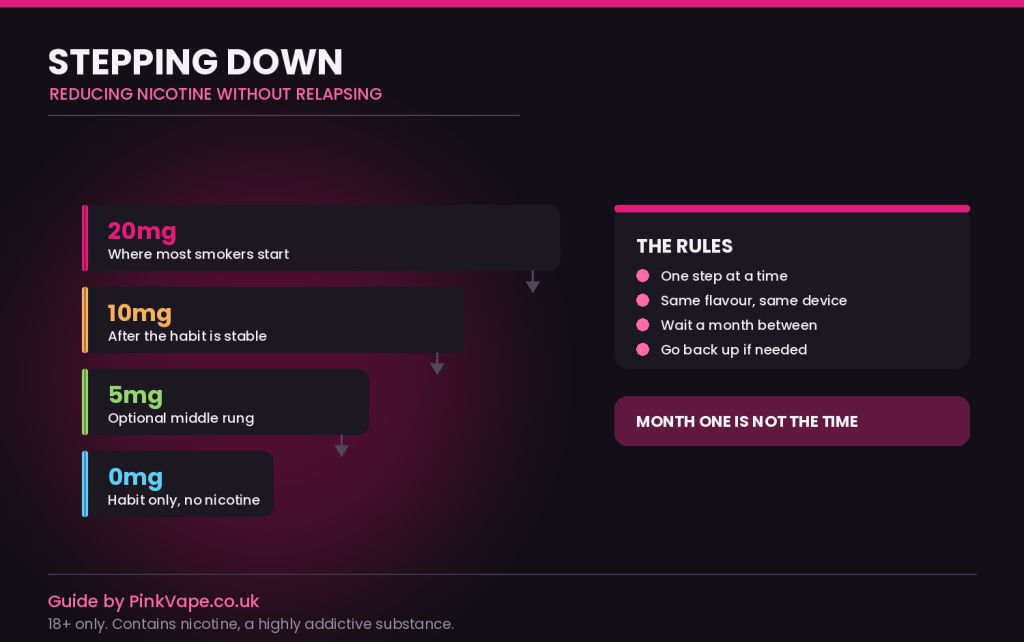
Nicotine strengths available in the UK give you a natural ladder, and it is worth using every rung rather than jumping.
| From | To | Typical wait before the next step |
|---|---|---|
| 20mg | 10mg | At least a month at 10mg |
| 10mg | 5mg | At least a month, where 5mg is offered |
| 5mg | 0mg | Only when 5mg feels like nothing |
| Any step | Back up | Immediately, if cravings return |
Halving is the largest step most people manage comfortably. Going from 20mg straight to 3mg — which some do, thinking of it as decisive — almost always fails, because the gap is too large for your tolerance to adjust across.
Where a 5mg option exists it is genuinely useful, because the gap between 10mg and nothing is the one people most often fall off. Not every range offers it, and it is worth seeking out if you are serious about reaching zero.
Rule Three: Change Nothing Else
This is the rule that does the most work and is broken the most often.
When you step down, keep the same device, the same flavour, the same coil resistance and the same airflow setting. Change the number on the bottle and nothing else.
The reason is diagnostic. If you change strength and flavour together and the result is unsatisfying, you cannot tell which caused it — so you cannot correct it. Holding everything constant means any difference you notice is attributable to the nicotine, which is the only variable you are trying to move.
This is also a practical argument for using a range that offers the same flavours across multiple strengths. Ranges where a given flavour exists at 20mg, 10mg and sometimes lower let you step down without changing anything you like about your setup, and listings at pinkvape.co.uk state the strengths each flavour is available in.
Rule Four: Expect the First Week to Be Odd
After a step down, the first several days feel wrong in a specific way: the vape seems less satisfying and you find yourself using it more. That is normal and it is not a sign the step failed.
Your tolerance adjusts over roughly one to two weeks. Judging the step after three days is judging it during the adjustment rather than after it.
- Expect to vape somewhat more for the first week.
- Expect the device to feel less immediately satisfying.
- Expect that to settle without any action on your part.
- If it has not settled after a fortnight, the step was too large — go back up and try a smaller one.
That last point is important and rarely said: going back up is not failure. It is information. A step that does not settle in two weeks was the wrong size, and returning to the previous strength then trying a smaller increment is exactly the right response.
Rule Five: Watch for Compensation
The failure mode to watch for is vaping substantially more to make up for the lower strength. Total nicotine intake is strength multiplied by volume, so doubling how much you vape at half the strength achieves nothing at all.
It also costs more, empties devices faster and often produces a sore throat from the sheer volume. If you find yourself with the device permanently in hand a fortnight after a step down, that is the signal to go back up rather than to persist.
How to tell the difference
- Settling: you use it more for a week, then gradually less as tolerance adjusts.
- Compensating: usage rises and stays risen, and the craving never resolves.
The first resolves itself. The second does not, and pushing through it is how people end up back on cigarettes.
Reaching Zero, and Whether To
Some people reduce to zero nicotine and continue vaping for the habit alone. Others reduce to a low strength and stay there. Both are legitimate outcomes and neither is a failure.
It is worth being clear that 0mg vaping is not the same as stopping. The routine, the hand-to-mouth action and the device remain, which for many people is precisely the point — the drug is gone and the habit is manageable.
If your goal is to stop entirely, the evidence-based route is your local NHS Stop Smoking Service, which is free and has considerably better success rates than going it alone. Many now support people using vaping as part of the process. Nothing in this article is a substitute for that, and 0mg products — stocked by Pink vape online retailers alongside everything else — are a consumer product rather than a licensed cessation aid.
Signs You Are Ready for the Next Step
Rather than working to a calendar, it is more reliable to work to signals. A few indicate that your current strength has become comfortable rather than necessary.
- You sometimes forget to bring the device with you and do not particularly mind.
- You go several hours without it — a film, a meeting, a long drive — without noticing.
- You use it out of routine at particular moments rather than in response to a craving.
- A device running out is an inconvenience rather than a problem.
- You have been at the current strength for a month or more without thinking about it.
Three or four of those together suggest the next step down will settle easily. None of them, and it is worth staying where you are for another month — there is no deadline, and a step attempted from an unstable position is the one most likely to fail.
Signs you should wait
- Cravings still arrive sharply rather than as background habit.
- You are still smoking occasionally, however rarely.
- A stressful period is under way — work, family, health.
- You have recently changed device, flavour or anything else about the setup.
That last one matters more than people expect. Changing two variables at once removes your ability to tell which caused any difficulty, which is the whole reason for the one-thing-at-a-time rule.
Frequently Asked Questions
How long should I wait between steps?
At least a month at each strength, and only step down when the current one feels comfortable rather than necessary.
Is halving too big a step?
It is the largest most people manage. If it does not settle within a fortnight, go back up and try a smaller reduction.
Can I mix strengths to make an in-between?
In a refillable device, yes — diluting with 0mg of the same base works. Calculate carefully and label what you make.
Why am I vaping more since reducing?
Normal for the first week or two while tolerance adjusts. If it persists beyond that, the step was too large.
Is going back up a failure?
No. It is useful information about step size, and far better than the alternative of returning to cigarettes.
Should I reduce if I still smoke occasionally?
No. Complete the switch first. Reducing nicotine while still smoking makes both harder.
Does a lower strength need different hardware?
Sometimes. Very low strengths pair better with more open airflow or lower-resistance coils, which deliver more vapour per puff.
What Reducing Does Not Fix
Worth being clear about the limits, because expectations shape whether people persist.
Lowering nicotine reduces your intake of an addictive substance. It does not remove the habit, the hand-to-mouth routine, or the association between vaping and particular moments of the day — a coffee, a break, a drive home. Those persist at every strength including zero.
For many people that is entirely acceptable: the drug is what they wanted to reduce, and the routine is harmless enough. For others the routine itself is the target, and reducing strength is only the first half of the job.
- If the nicotine is your concern, stepping down addresses it directly.
- If the habit is your concern, expect to tackle that separately, and consider whether 0mg vaping helps or simply preserves it.
- If stopping entirely is the goal, NHS support has considerably better success rates than doing it alone.
Knowing which of those three you actually want makes the process substantially easier, because you can tell whether it is working.
The Short Version
Wait until the switch from smoking is genuinely settled — months, not weeks. Then halve the strength, change nothing else, and hold for a month before considering the next step.
Expect a strange first week. Go back up without embarrassment if it has not settled after two. The only outcome that actually matters is not returning to cigarettes, and every rule above exists to protect that.
Age restriction and health notice
This article is intended for adult vapers aged 18 or over and offers general guidance only. Vaping products contain nicotine, which is a highly addictive substance, and are not suitable for non-smokers, under-18s, or anyone who is pregnant or breastfeeding. Nicotine-free vapes are not licensed stop-smoking medicines. If you are trying to stop smoking or reduce your nicotine intake, your local NHS Stop Smoking Service offers free, evidence-based support.
