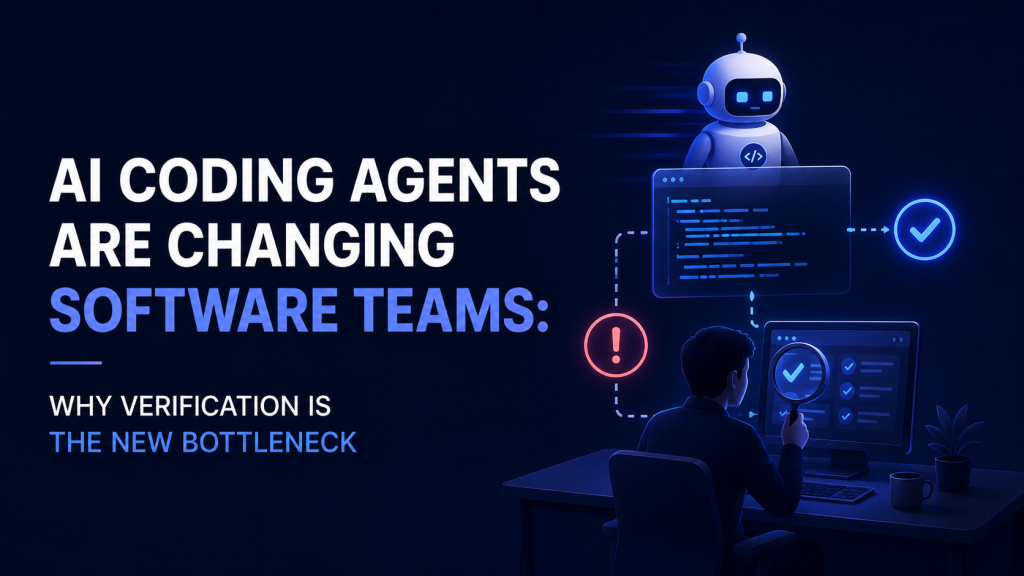
Ask a developer what AI changed in software development a year ago and the answer was probably autocomplete. Ask the same question now and the answer is different.
AI coding agents can read an existing codebase, break a task into smaller pieces, write code across multiple files, run tests, inspect failures, and continue working without someone typing every instruction. The developer is increasingly giving the system a goal rather than a line of code.
That sounds like the productivity breakthrough everyone predicted. But something less obvious is happening underneath it.
The bottleneck is moving.
When writing code becomes faster, knowing what code should exist, whether it is correct, and whether it belongs in the architecture becomes more important. The scarce resource is no longer necessarily typing speed. It is judgment.
AI coding agents are therefore creating a strange situation for engineering teams: they can produce more software than before while simultaneously making software review, testing, architecture, and requirements more important.
Gartner says the enterprise AI coding agent market is moving beyond code completion toward agent-driven development across the software development life cycle. Its 2026 research also predicts that more than 65% of engineering teams using agentic coding will treat traditional IDEs as optional by 2027.
What changed is not simply that AI got better at programming. It is that the unit of work is changing from “write this function” to “solve this engineering problem.”
Key takeaways before the detail:
- AI coding agents are moving from assistants that suggest code to systems that execute multi-step development tasks.
- Faster code generation does not automatically mean faster software delivery because review, testing, and architecture can become the new constraints.
- The most valuable developers are increasingly the ones who can define problems clearly and validate AI-generated solutions.
- Teams need stronger engineering systems, not less engineering discipline, as AI becomes more autonomous.
- The companies that benefit most will treat AI agents as part of an operating model rather than another developer tool.
Why Are AI Coding Agents Suddenly Different?
The first generation of AI coding tools was mostly about reducing friction.
You wrote a function, and the model suggested the next few lines. You described a component, and it generated a starting point. You pasted an error, and it suggested a fix.
Useful, but fundamentally reactive.
The new generation is more ambitious. Instead of waiting for a developer to ask for every individual change, an agent can inspect a repository, understand the relationship between files, make a plan, modify several parts of the application, run tests, and iterate.
That distinction matters.
A code completion tool accelerates an engineer who already knows what to do. An agent can participate in deciding how to do it.
Gartner’s 2026 research describes this as a transition from AI-assisted development toward agent-driven software development, with AI systems increasingly coordinating tasks across the software development life cycle.
The practical consequence is that a developer can now delegate a much larger unit of work.
Instead of:
“Add this validation to the signup form.”
The instruction becomes:
“Review the signup flow, identify where validation is currently handled, add server-side and client-side validation, update the relevant tests, and tell me what changed.”
The difference is not just convenience.
The second instruction requires the system to understand context.
What Happens When Code Becomes Cheap?
This is where the conversation around AI coding agents gets interesting.
For decades, software teams had a fairly simple constraint. Writing software took time.
That meant engineering organizations optimized around developer productivity. Better frameworks, better IDEs, reusable libraries, CI/CD pipelines, and coding standards all existed partly to reduce the amount of time engineers spent turning ideas into working code.
AI attacks that constraint directly.
But if implementation becomes dramatically faster, another constraint becomes visible.
You can generate ten features faster than your team can decide whether those ten features should exist.
You can produce hundreds of lines of code faster than your senior engineer can review them.
You can build three competing prototypes before product management has finished deciding which problem matters.
The result is an uncomfortable possibility: AI can increase the amount of software a company is capable of producing without increasing its ability to produce the right software.
That is why the next phase of AI software development is likely to be less about raw generation speed and more about verification.
Is AI Actually Making Developers More Productive?
The answer appears to be yes in some areas, but the measurement is becoming more complicated.
A 2026 study combining literature analysis with a survey of software developers found that GenAI has particularly strong effects in implementation, testing, design, and documentation. More than 70% of surveyed developers reported at least halving the time spent on certain boilerplate and documentation tasks. At the same time, the study found substantially lower benefits in early planning and requirements analysis.
That distinction is important.
AI is very good at accelerating work when the problem is already reasonably specified.
It is much less useful when the real question is:
“Are we solving the right problem?”
That means organizations should be careful with productivity measurements that only count lines of code, tickets completed, or pull requests merged.
A developer who produces twice as much code is not necessarily twice as productive.
If the additional code creates more bugs, more review work, more infrastructure costs, or more technical debt, the organization may simply have moved the bottleneck somewhere else.
Why Verification Is Becoming the New Engineering Bottleneck
Imagine a team that previously completed ten meaningful changes per month.
After adopting AI agents, they can potentially produce thirty.
At first, that looks like a 200% productivity improvement.
But now imagine the senior engineers responsible for architecture and code review can only properly evaluate fifteen changes.
The team has not tripled its effective capacity.
It has created a review queue.
This is one of the less discussed consequences of agentic development.
AI can increase the rate at which code enters the system faster than the organization can validate it.
The same problem appears in testing.
Generated code can be tested, but tests themselves can also be generated. That creates a tempting loop where an AI agent writes code and then produces tests that confirm the assumptions embedded in its own implementation.
The presence of tests is not the same thing as proof of correctness.
The harder question is whether the tests are testing the right behavior.
This is why engineering organizations adopting AI coding agents need to think beyond “Which tool should our developers use?”
The more useful questions are:
Who reviews agent-generated architectural changes?
Which changes require human approval?
How are security-sensitive modifications validated?
What happens when an agent modifies infrastructure?
Who owns the resulting code?
And how do you know when an AI-generated solution is technically correct but strategically wrong?
Why Senior Engineers May Become More Important, Not Less
The popular version of the AI story says that coding agents make junior developers more powerful.
There is some truth to that.
But there is another effect that may be just as important.
As implementation becomes easier, experience becomes more valuable because experienced engineers are better at recognizing when an implementation should not exist in the first place.
A senior engineer can look at a generated solution and notice that it introduces unnecessary complexity.
They can recognize when a database design will become painful at scale.
They can see that an apparently simple API change will break three downstream systems.
They know which parts of a codebase should be refactored and which parts should be left alone.
AI can generate a solution.
Someone still needs to understand the consequences.
This may shift the role of senior engineering from “the person who writes the hardest code” toward “the person who determines what good engineering looks like.”
The New Skill: Writing Better Specifications
There is another consequence that receives much less attention.
If AI agents become better at implementation, developers need to become better at specification.
A vague requirement produces a vague implementation, even if the model is extremely capable.
“Build a dashboard” is not a useful engineering specification.
“Build a dashboard showing monthly recurring revenue, churn, customer acquisition cost, and expansion revenue, with filters for plan and acquisition channel, using the existing analytics schema” is considerably better.
The difference is product and engineering judgment.
This means skills that previously appeared secondary can become much more important:
- Breaking ambiguous problems into measurable requirements.
- Understanding system architecture.
- Defining acceptance criteria.
- Designing meaningful tests.
- Reviewing generated code.
- Understanding security and data boundaries.
- Communicating trade-offs clearly.
In other words, AI may reduce the premium on typing code while increasing the premium on knowing what the code needs to accomplish.
What Happens to Web Development?
Web development is one of the areas where this shift is already particularly visible.
AI agents can generate landing pages, dashboards, API integrations, authentication flows, database schemas, and CMS functionality at remarkable speed.
But websites are rarely just collections of pages.
A production site has content workflows, permissions, analytics, integrations, performance requirements, SEO considerations, deployment processes, and sometimes a team of non-technical people who need to update it after development is finished.
That is where the difference between generating a website and building a maintainable web system becomes obvious.
For organizations using AI to accelerate implementation, the underlying architecture still matters. A well-designed CMS development approach can make the resulting system easier to manage when content, users, integrations, and publishing workflows continue changing after launch.
The irony is that AI can make the first version of a website easier to create while making the quality of the underlying architecture more important.
If everything can be generated quickly, the cost of choosing the wrong foundation can become easier to hide until much later.
Why Mobile Apps Have the Same Problem
Mobile development adds another layer of complexity because applications do not exist in isolation.
They interact with operating systems, device hardware, APIs, notifications, app stores, authentication systems, analytics platforms, and increasingly AI-powered features.
The current direction of mobile development reflects this broader change. AI-native experiences, on-device intelligence, multimodal interfaces, personalization, and automation are all becoming more prominent areas of development in 2026.
That means teams building mobile products are increasingly thinking beyond traditional screens and interactions.
A useful overview of the direction the industry is moving in is the top mobile app development trends for 2026, particularly as AI moves from being a feature inside an application to becoming part of how users interact with it.
But the same warning applies here.
Adding an AI capability to an application is relatively easy compared with deciding what the AI should be allowed to do, what data it can access, how failures are handled, and when a human should remain in control.
Gartner’s Warning: Don’t Use AI Agents for Everything
This is where the current industry discussion becomes more nuanced.
The temptation with any new automation technology is to use it everywhere simply because it is available.
Gartner’s 2026 research specifically warns against treating coding agents as the entire software engineering AI strategy. It argues that organizations should consider AI across requirements, security, code review, testing, SRE/DevOps, and documentation rather than focusing only on code generation.
Gartner’s 2026 research on AI coding agents
That distinction matters because software development is a system.
Making one stage dramatically faster does not guarantee that the entire system becomes faster.
If implementation becomes ten times faster but testing remains unchanged, testing becomes the bottleneck.
If testing becomes faster but requirements remain ambiguous, teams simply produce incorrect software more efficiently.
If everything becomes faster except deployment governance, the deployment queue becomes the constraint.
The goal therefore should not be maximum AI usage.
It should be maximum useful throughput.
What Should Engineering Teams Change?
The organizations getting the most value from AI coding agents will probably make several relatively boring changes before doing anything particularly exciting.
First, they will establish clear boundaries.
Not every repository should allow autonomous changes. Not every production system should accept agent-generated modifications without review. Security-sensitive areas need stricter controls than low-risk UI work.
Second, they will improve their tests.
AI agents are much more useful when they have reliable feedback loops. A system that can run tests, inspect failures, and iterate is considerably more powerful than one that simply generates code and stops.
Third, they will improve documentation.
This sounds contradictory because AI is supposed to reduce documentation work.
But agents need context too.
Architecture decisions, naming conventions, API contracts, business rules, deployment procedures, and known constraints all become useful context for both humans and AI systems.
Fourth, teams will define ownership.
When an agent creates a feature, the agent does not own it.
A human team still needs to be responsible for the system after the generated code enters production.
What Skills Should Developers Learn Now?
The answer is probably not “learn how to type code faster.”
Developers should understand how to work effectively with AI systems while strengthening the skills AI cannot reliably replace.
The most useful combination looks something like this:
- Strong fundamentals in programming and system design.
- Ability to use AI coding agents effectively.
- Strong debugging and code-review skills.
- Understanding of testing and observability.
- Clear technical communication.
- Ability to write precise specifications and acceptance criteria.
- Awareness of security, privacy, and data boundaries.
- Product judgment about what should actually be built.
This creates an interesting split.
A developer who refuses to use AI may become slower than necessary.
A developer who accepts everything AI produces may become dangerous.
The valuable middle ground is someone who can move quickly with AI while knowing when not to trust it.
What Breaks When Companies Adopt AI Agents Badly?
The failure modes are already becoming fairly predictable:
- Code volume increases faster than review capacity.
- Developers accept generated solutions without understanding them.
- Tests are generated to match implementation rather than validate requirements.
- Technical debt accumulates because building becomes easier than refactoring.
- Architecture decisions become inconsistent across AI-generated features.
- Security issues become harder to spot because more code is produced.
- Junior developers learn implementation patterns without understanding the underlying reasoning.
- Teams mistake activity metrics for actual productivity.
Notice that most of these are not failures of the AI model.
They are failures of the engineering process around it.
The organizations that treat an AI agent as a replacement for engineering discipline will eventually run into the same problems as organizations that treated outsourcing, low-code platforms, or automation as substitutes for good management.
The technology changes.
The operating principles do not.
How Do You Measure AI-Assisted Engineering?
Lines of code are almost useless here.
Pull requests are not much better.
A better measurement framework asks whether the organization is actually delivering useful software faster.
Track how long it takes for a validated requirement to reach production.
Measure how much time developers spend reviewing AI-generated work.
Track escaped defects rather than just completed tickets.
Measure how frequently AI-generated changes require significant rework.
Look at deployment frequency, rollback rates, incident volume, and customer-facing outcomes.
And perhaps most importantly, measure whether the organization can increase delivery speed without increasing technical debt at the same rate.
That is the real test.
If a team produces twice as much code but spends twice as much time cleaning it up, the AI system has not created the productivity gain the dashboard suggests.
Frequently Asked Questions (FAQ’s)
Q1. What are AI coding agents?
AI coding agents are software systems that can perform multi-step software development tasks with a degree of autonomy. Unlike traditional code completion tools, they can inspect codebases, plan changes, write or modify code, run tests, analyze results, and iterate across several steps.
Q2. Are AI coding agents replacing software developers in 2026?
Not in the simple sense. They are automating parts of software development and changing how developers work. Current research suggests AI has its strongest impact on implementation, testing, design, and documentation, while planning and requirements work remain more dependent on human judgment.
Q3. What is the biggest problem with AI-generated code?
The biggest problem is not necessarily that AI-generated code is always incorrect. It is that developers can accept technically plausible code without fully evaluating its architecture, security, maintainability, or alignment with the original requirement.
Q4. Will AI make senior developers less important?
Probably not. As implementation becomes easier, senior engineers may spend more time on architecture, requirements, review, system design, and risk management. These responsibilities become more important when the volume of generated code increases.
Q5. How can companies safely use AI coding agents?
Start with clear access controls, strong automated testing, human review for important changes, documented architecture, security checks, and clear ownership of production systems. AI agents should operate inside an engineering process rather than outside it.
Q6. What should developers learn for AI-assisted software development?
Developers should learn how to use AI coding tools while continuing to build strong fundamentals in programming, system architecture, testing, debugging, security, and product thinking. The ability to evaluate AI-generated solutions is becoming just as important as the ability to generate them.
Final Verdict
AI coding agents are changing software development, but the biggest change may not be how quickly developers can write code.
It is how quickly organizations can move from an idea to a validated decision.
For years, software teams treated implementation as the expensive part of development. AI is steadily reducing that cost. The result is that other parts of the system are becoming visible as constraints: requirements, architecture, testing, security, review, and judgment.
That is why the next competitive advantage probably will not belong to the company using the most AI.
It will belong to the company that has built the best system around it.
When code becomes easier to produce, knowing what deserves to be produced becomes more valuable. And when AI can build faster than teams can review, the engineers who can distinguish “working” from “good” become the people everyone needs.
