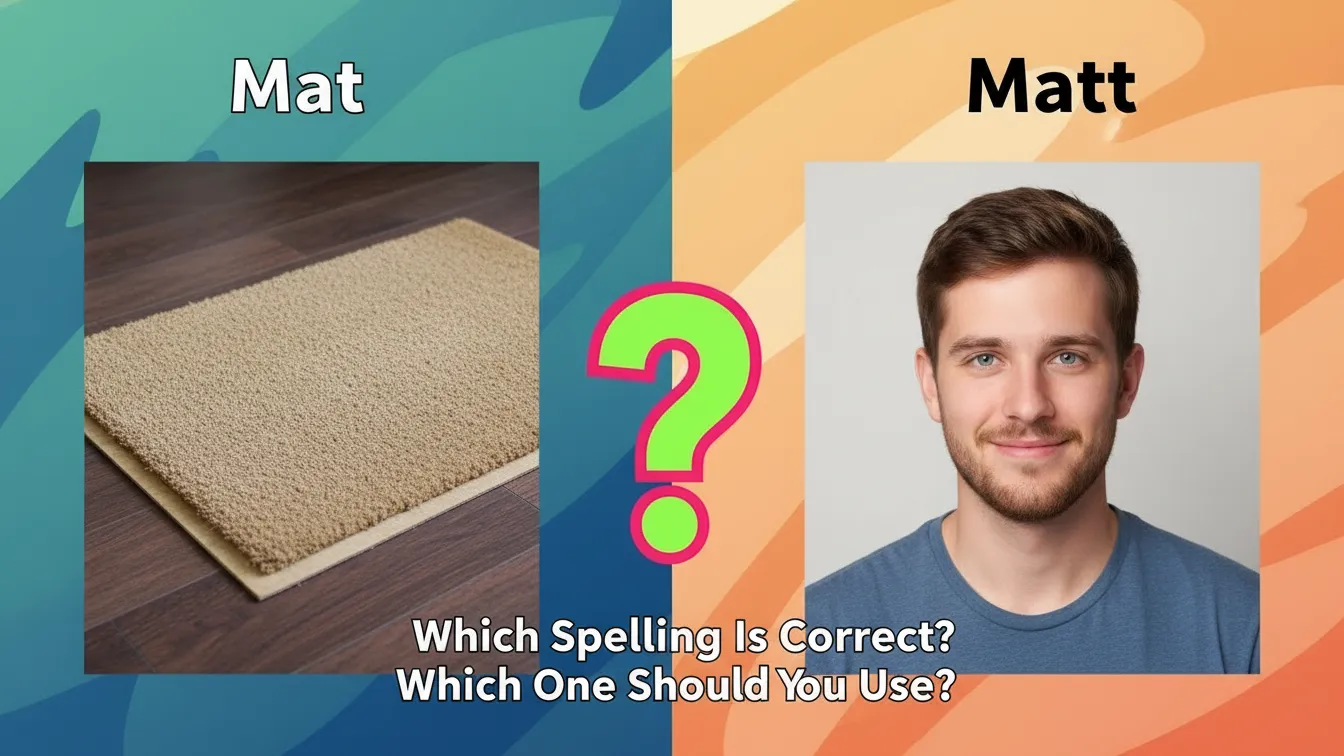
Many people wonder whether to spell it “mat” or “matt”, and this confusion is common in writing. The distinction matters because spelling can change meaning, clarity, and tone. For instance, “mat” usually refers to a flat piece of material, like a yoga mat or doormat, while “matt” describes a surface that is not shiny, like a matt painting or a matt photograph. This search often arises when people write emails, create social media posts, or draft professional documents and want to ensure accuracy. In this article, we’ll provide a clear, step-by-step guide to using the correct spelling, explore the origin, compare British and American usage, and give practical tips to avoid common mistakes.
Mat or Matt – Quick Answer
- Mat → A piece of fabric or material placed on the floor or used in sports (e.g., yoga mat, welcome mat).
- Matt → Describes a non-glossy or dull surface (e.g., matt finish, matt paint).
Examples:
- “Please wipe your shoes on the mat.”
- “The photograph has a matt finish to reduce glare.”
The Origin of Mat or Matt
- Mat comes from Old English mæt, meaning a piece of woven material.
- Matt evolved from the French mat, meaning dull or lifeless, referring to surfaces without shine.
- The difference is subtle but important in modern English.
British English vs American English Spelling
| Term | British English | American English | Example |
| Mat | mat | mat | “Place the mat by the door.” |
| Matt | matt | matte | “The painting has a matt/matte finish.” |
Note: In American English, “matte” is often preferred instead of “matt” for describing dull surfaces.
Which Spelling Should You Use?
- US: Use mat for floor coverings and matte for dull surfaces.
- UK & Commonwealth: Use mat for floor coverings and matt for dull surfaces.
- Global: Follow the regional audience norms for clarity.
👉 Until or Till: Which One Should You Use?
Common Mistakes with Mat or Matt
- Writing “matt” when referring to a doormat. → Correct: mat.
- Writing “mat” for a non-glossy finish. → Correct: matt (UK) / matte (US).
- Using both interchangeably in the same document. → Avoid for professional writing.
Mat or Matt in Everyday Examples
- Emails: “Please place the mat at the entrance.”
- News: “The artist used a matt finish to reduce glare in the exhibition.”
- Social Media: “New yoga mat just arrived!”
- Formal Writing: “The photograph exhibits a matt texture, enhancing visual comfort.”
Mat or Matt – Google Trends & Usage Data
- Global interest: Searches for mat peak during home decor, sports, and seasonal sales.
- Matt/matte: Popular in photography, interior design, and art communities.
- Regional trends: UK prefers “matt” while US searches favor “matte” for non-glossy surfaces.
Keyword Variations Comparison
| Variation | Usage | Region |
| Mat | Floor covering | UK & US |
| Matt | Non-glossy surface | UK |
| Matte | Non-glossy surface | US |
FAQs
- Is it “mat” or “matt” for a floor covering?
→ Use mat. - Should I write “matt” or “matte” for a painting?
→ UK: matt, US: matte. - Can “mat” and “matt” be used interchangeably?
→ No, they refer to different meanings. - Is “mat” only used for floors?
→ Mostly, but it can also describe small protective layers (e.g., mouse mat). - Why do Americans use “matte” instead of “matt”?
→ American English prefers “matte” from French influence. - Does spelling affect professional writing?
→ Yes, correct usage ensures clarity and avoids misinterpretation. - Are there any pronunciation differences?
→ No significant difference; only context matters.
Conclusion
Understanding the difference between mat and matt (or matte in US English) is simple once you know the rules. Use mat for floor coverings and protective layers. Use matt/matte for non-glossy surfaces. Following these guidelines ensures clear, professional, and regionally appropriate writing. Whether you are drafting emails, creating social media posts, or preparing formal documents, the correct spelling communicates precision and attention to detail. Keeping these distinctions in mind will make your writing more accurate and avoid common mistakes that many native and non-native speakers encounter.

I’m Laura M. Collins, and I specialize in writing clear explanations for confusing English words. I believe understanding small spelling differences can greatly improve written communication.