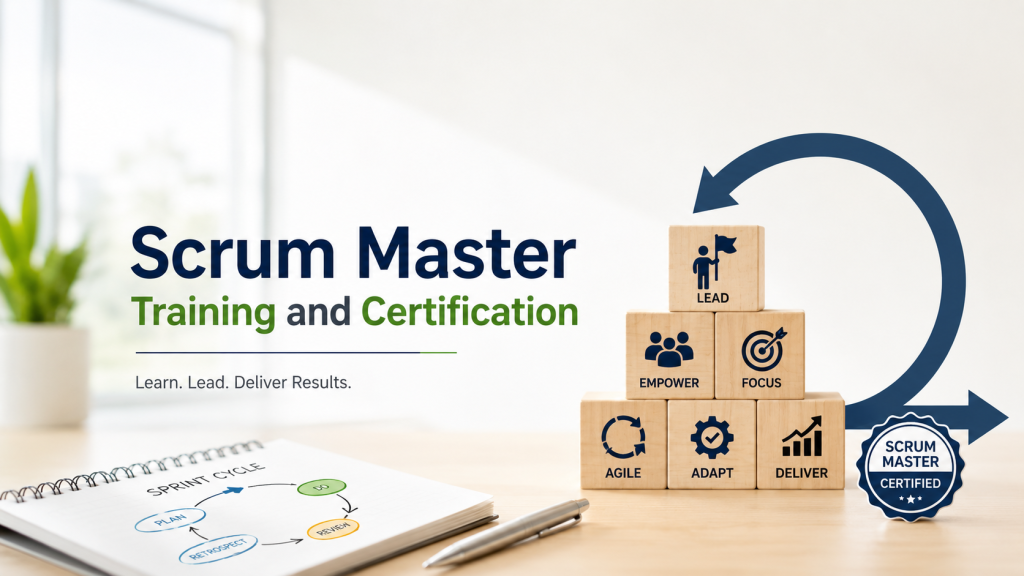
Organizations across every industry are shifting toward agile ways of working, and that shift has created massive demand for skilled Scrum Masters. If you’re considering a career pivot into agile project management, understanding scrum master training and certification is the first step toward becoming a credible, job-ready agile practitioner.
This guide breaks down what Scrum Master training actually involves, why certification matters, which credentials are worth pursuing, and how to choose a path that fits your career goals.
What Does a Scrum Master Actually Do?
Before diving into training options, it helps to understand the role itself. A Scrum Master is a servant-leader who facilitates the Scrum framework within an agile team.
Rather than managing people in the traditional sense, a Scrum Master:
• Removes impediments that block the development team’s progress
• Facilitates key Scrum ceremonies — sprint planning, daily stand-ups, sprint reviews, and retrospectives
• Coaches the team on agile principles, self-organization, and continuous improvement
• Shields the team from external distractions and uncontrolled scope creep
• Works closely with the Product Owner to maintain a healthy, well-prioritized product backlog
This blend of coaching, facilitation, and process ownership is why formal scrum master training and certification has become the standard entry point into the role. Employers want proof that candidates understand both the theory and the day-to-day application of Scrum, not just the vocabulary.
Why Certification Matters in Today’s Job Market
Agile certification signals that you understand core Scrum values — commitment, courage, focus, openness, and respect — along with the Scrum framework’s roles, events, and artifacts. Recruiters and hiring managers frequently use certification as a first-pass filter, especially for candidates without prior on-the-job Scrum experience.
Beyond employability, structured training also accelerates your learning curve. Self-study can teach you the terminology, but guided, instructor-led training exposes you to case studies, sprint simulations, and cohort discussions that closely mirror what you’ll encounter as a working Scrum Master or agile coach.
For a detailed breakdown of the specific credentials available, exam formats, and prerequisites, this in-depth Scrum Master certifications guide walks through each major certifying body and how they compare against one another.
Popular Scrum Master Certifications to Consider
There isn’t a single “best” certification — the right choice depends on your experience level, budget, and target industry.
Some of the most recognized credentials include:
1. Certified ScrumMaster (CSM) — Offered by Scrum Alliance, this is often the entry point for professionals new to agile methodology.
2. Professional Scrum Master (PSM I, II, III) — Offered by Scrum.org, known for a rigorous, assessment-based approach without mandatory training.
3. PMI Agile Certified Practitioner (PMI-ACP) — A broader agile certification covering multiple frameworks beyond Scrum, ideal for cross-methodology credibility.
4. SAFe Scrum Master (SSM) — Focused on scaled agile environments, useful for larger enterprises running multiple agile teams simultaneously.
Each of these differs in exam structure, renewal requirements, cost, and industry recognition, so it’s worth researching which aligns with your career trajectory before enrolling in any program.
What to Look for in a Scrum Master Training Program
Not all training programs are created equal. When evaluating options, consider the following factors:
• Accreditation — Is the training provider authorized by Scrum Alliance, Scrum.org, or PMI?
• Instructor experience — Look for trainers who are practicing agile coaches, not just certified trainers reading slides.
• Interactive learning — Simulations, role-play sprints, and real backlog-grooming exercises help concepts stick far better than passive lectures.
• Post-training support — Access to communities, mentorship, or exam-prep resources adds long-term value beyond the course itself.
• Exam voucher inclusion — Many reputable programs bundle the certification exam fee into the total training cost.
If you’re comparing providers, it’s worth reviewing a platform that offers structured, mentor-led agile and Scrum training programs. Thinkcloudly is one such resource, offering guided coursework alongside certification preparation for professionals entering the agile space.
Career Paths After Certification
Once certified, professionals typically move into roles such as:
• Scrum Master
• Agile Coach
• Agile Project Manager
• Release Train Engineer (in scaled agile environments)
• Product Owner (with additional cross-training)
Salaries for certified Scrum Masters tend to be competitive, particularly in tech, finance, and healthcare sectors where agile transformation initiatives are ongoing. Certification alone won’t guarantee a role, but paired with real project exposure — even through internal pilot teams or volunteer agile initiatives — it substantially strengthens a candidate’s profile and interview readiness.
Common Mistakes to Avoid
Many first-time candidates rush the process and end up with a certificate but little practical understanding.
A few pitfalls worth avoiding:
• Choosing a certification based on price alone rather than industry recognition in your target job market.
• Skipping hands-on practice — reading the Scrum Guide without simulating sprint ceremonies leaves knowledge gaps.
• Treating certification as a one-time event instead of an ongoing agile coaching and facilitation skill set.
Final Thoughts
Investing in scrum master training and certification is one of the most direct ways to break into agile project management or formalize skills you’re already using informally. The key is choosing a credential and training provider that matches your experience level and career goals, then reinforcing that certification with hands-on practice facilitating real Scrum ceremonies.
Whether you’re completely new to agile methodology or looking to formalize years of informal Scrum experience, the structured path — training, certification exam, and applied practice — remains the most reliable route to becoming a confident, hireable Scrum Master.
