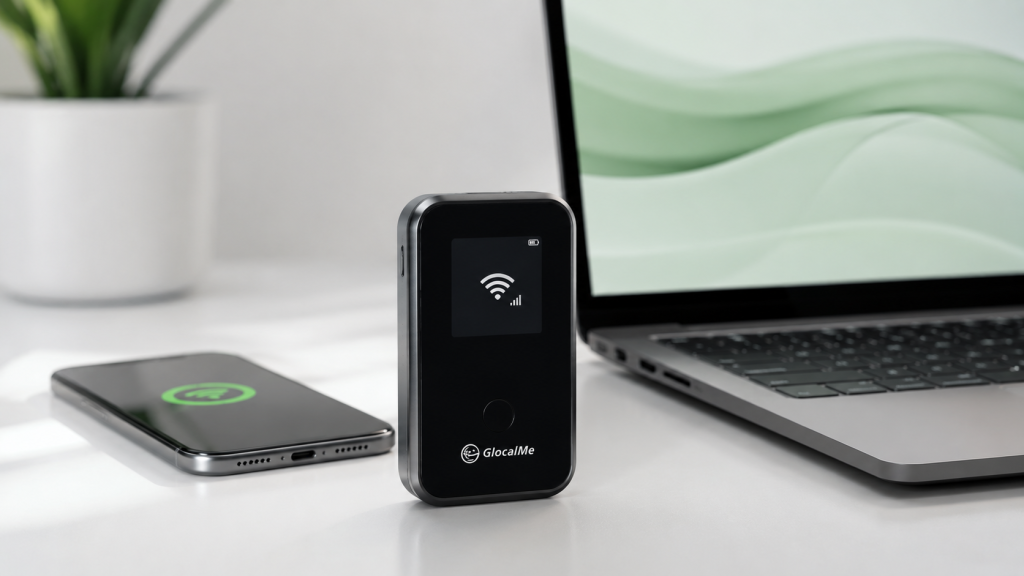
Internet access has gradually moved from being a useful convenience during travel to becoming part of the infrastructure people rely on throughout a journey. Maps, digital tickets, hotel reservations, translation tools, banking apps, work platforms, messaging services, and emergency information can all depend on a working connection. Yet the traditional ways of getting online abroad still tend to place the connection directly inside a phone or tie it to a particular building, network, or local SIM. A portable wifi device creates a different arrangement by separating the internet connection from any single smartphone and turning it into something that can move independently with the traveler.
This distinction becomes more meaningful when a trip involves more than one device. A person might leave home with a phone, laptop, tablet, camera, or another WiFi-enabled device, while a family or small team may need several connections simultaneously. GlocalMe’s current portable WiFi range includes different types of mobile hotspots, from 4G models to global 5G devices, with products such as Numen Air, MeowGo G40 Pro, U3, DuoTurbo, UPP, and G4 Pro. The company’s current travel guide also organizes portable connectivity around international travel, weekend trips, outdoor activities, family sharing, and remote work.
The interesting part is therefore not simply that portable hotspots exist. It is how their role is changing. Modern devices are being designed around automatic network selection, multiple-device sharing, different generations of mobile connectivity, and travel-oriented data options. GlocalMe says its platform can access more than 390 carriers across more than 200 countries and regions, while its HyperConn technology is intended to assist with intelligent network selection. These developments point toward a model where travelers think less about finding a WiFi signal manually and more about carrying a dedicated connection that can adapt to changing environments.
The Connection Does Not Have to Belong to the Phone
For many years, the smartphone has been the centre of mobile internet access. That arrangement works well when one person has one primary device, but it becomes less convenient when several devices need to use the same connection. Turning on a phone’s hotspot can solve the immediate problem, but it also makes the phone responsible for sharing its cellular connection, which can affect battery use and device availability.
A dedicated hotspot changes that relationship. The connection can remain active through the separate device while the smartphone continues handling calls, navigation, photographs, authentication, and other tasks. The laptop or tablet can connect to the hotspot without requiring another cellular plan. This separation can be particularly useful for travelers who treat their phone as an everyday communication tool rather than their only gateway to the internet.
Why Travel Makes Shared Connectivity More Useful
A single traveler may carry more connected hardware than they realize. A smartphone might be accompanied by a laptop for work, a tablet for entertainment, a smartwatch, and occasionally a camera or other WiFi-enabled equipment. Families multiply that requirement because several people may want to connect simultaneously.
GlocalMe’s current travel guide explicitly identifies family sharing as one of its usage scenarios and describes portable WiFi as a way to provide one connection for multiple users. Some current devices support up to 8, 10, or 16 connected devices depending on the model. The exact capacity therefore depends on the hardware rather than being a universal characteristic of every portable hotspot.
Portable WiFi Changes What “Roaming” Means
International roaming traditionally means extending a home mobile plan onto foreign networks. Local SIM cards provide another option, but they require travelers to identify a suitable network, obtain a SIM, and sometimes change cards when moving between countries.
GlocalMe approaches the problem differently through CloudSIM-based connectivity. Its current platform describes SIM-free access and automatic connections to available local networks, with more than 390 global carrier relationships and coverage across 200-plus countries and regions. The concept does not eliminate dependence on cellular networks. Instead, it attempts to simplify how the traveler accesses those networks.
That distinction matters because the physical SIM card is only one part of the travel-connectivity process. Travelers also have to think about which network to use, how much data to purchase, whether the plan works at the destination, and whether the device supports the relevant technology. A platform that handles some of these decisions digitally can make the overall process less dependent on manual setup.
What Automatic Network Selection Is Trying to Solve
Network availability can change as a person moves through different places. A connection that works well in one area may not provide the same experience a few kilometres away. This becomes particularly relevant during road trips, outdoor travel, and journeys that cross different regions.
GlocalMe’s HyperConn technology is designed around intelligent network switching, with the company describing it as an AI-driven approach to selecting an optimal available network. This should not be interpreted as a guarantee of uninterrupted service because real-world connectivity still depends on local infrastructure, signal conditions, congestion, and network availability. The underlying idea is simply to reduce the amount of network selection that the user has to manage manually.
Why 4G Still Has a Place Alongside 5G
The rapid growth of 5G can make older mobile technologies seem irrelevant, but travel connectivity is more complicated than choosing the newest network generation. Coverage varies between countries and regions, and travelers do not necessarily need maximum theoretical speed for every activity.
GlocalMe’s current catalogue reflects this variety. U3 is presented as a 4G mobile WiFi hotspot, while Numen Air is positioned as a global 5G mobile hotspot. Other devices sit between these approaches, offering different combinations of WiFi technology, network features, battery capacity, and device-sharing capability.
For basic navigation, messaging, email, and ordinary browsing, a suitable 4G connection can be sufficient. Travelers handling larger files, high-resolution media, demanding cloud applications, or multiple connected devices may have different priorities. The useful choice is therefore not automatically the device with the highest advertised network generation, but the one that matches the journey.
How a Travel Hotspot Fits Into Remote Work
Remote work has changed the expectations placed on travel connectivity. A traveler may need to join video meetings from a hotel room, send large files from an airport, access cloud-based software from a train, or communicate with colleagues while moving between destinations.
GlocalMe lists remote work as one of the scenarios in its current buying guide and describes it in terms of stable internet access for work anywhere. A dedicated hotspot can be useful in this context because it gives the laptop a separate connection rather than forcing the smartphone to serve as the primary internet source for an entire work session.
There is still an important limitation: no portable hotspot can create mobile coverage where no usable network exists. Travelers working from particularly remote locations should therefore consider the networks available in their destination rather than assuming that portable hardware alone guarantees connectivity.
Why Outdoor Trips Put More Pressure on Connectivity
Hotels, cafés, airports, and coworking spaces provide obvious sources of internet access. Outdoor travel removes many of those options. Camping, RV journeys, road trips, and visits to less developed destinations can leave travelers dependent on cellular networks instead.
GlocalMe has specifically published guidance about portable WiFi for camping, RV travel, and outdoor use. The company describes hotspots as useful for navigation, weather information, messaging, and emergency communication, while also noting that advanced devices can intelligently switch between available networks.
That makes connectivity a practical travel consideration rather than simply an entertainment feature. A working connection can help someone check a route, receive a weather update, communicate with another traveler, or access information when conventional WiFi is unavailable.
The Device Can Become a Small Travel Network
The idea of a hotspot is sometimes misunderstood as simply another way to connect a phone. In reality, it can function as a small private network carried inside a bag or pocket.
A laptop can remain connected while a phone is being used for something else. A family can share one connection rather than arranging separate mobile data for every person. A tablet can connect without requiring its own cellular plan. This makes the hotspot a central connection point rather than an accessory attached to one particular device.
Current GlocalMe models illustrate different approaches to this concept. UPP, for example, is listed with support for up to eight WiFi-enabled devices, while U3 is listed for up to ten. Numen Air is presented with support for up to 16 devices and an 11-hour battery specification on GlocalMe’s travel page.
Battery Life Becomes Part of the Connectivity Equation
A travel hotspot can only be useful when it has enough power to remain active. Battery capacity therefore becomes more important than it might appear from a simple product specification.
GlocalMe’s current products use different battery configurations and expected usage periods. U3, for example, is listed with a 3,000mAh battery and support for up to 12 hours of use, while Numen Air’s travel listing describes an 11-hour battery and support for up to 16 connected devices. Actual runtime can vary according to network conditions, connected devices, usage intensity, and other factors.
For travelers, this creates a practical balance between portability and endurance. A smaller device may be easier to carry, but a longer-lasting battery can become more valuable during a full day away from a hotel or power outlet.
Why Portable WiFi for Travel Is Becoming a Planning Decision
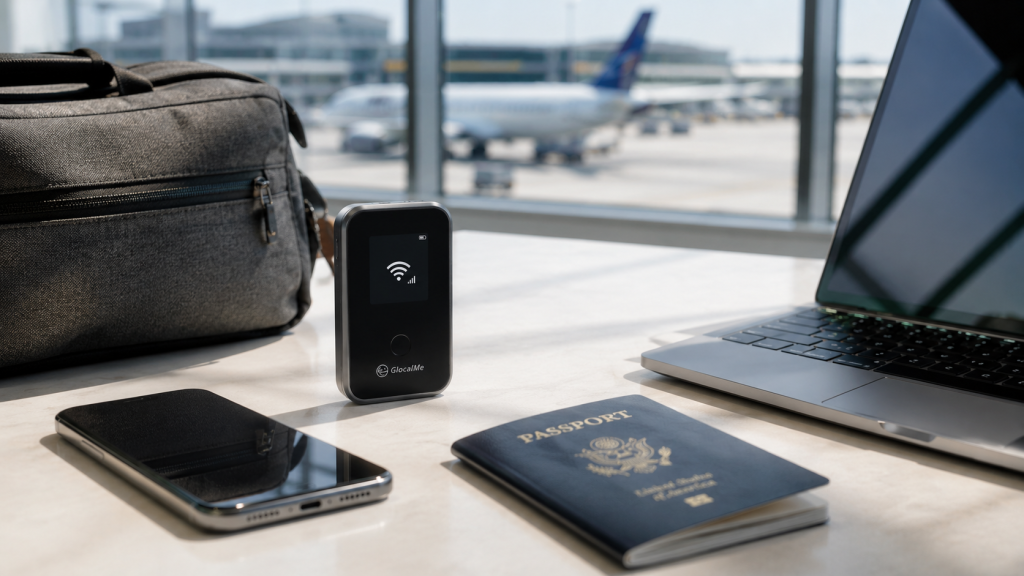
Choosing portable wifi for travel is increasingly less about buying a gadget at the last minute and more about matching connectivity with an itinerary. The destination, number of travelers, number of devices, trip duration, expected data consumption, and availability of local networks can all influence what makes sense.
GlocalMe’s buying guide reflects this scenario-based approach by separating international travel, weekend getaways, outdoor adventures, family sharing, and remote work. This is useful because a short weekend trip does not necessarily have the same requirements as a month-long multi-country journey or a remote-working holiday.
Multi-Country Trips Highlight the Advantages of Flexibility
A journey through several countries can expose the limitations of solutions designed around a single destination. A local SIM purchased in the first country may become irrelevant when the traveler crosses a border. Roaming may remain available, but the associated terms can vary depending on the mobile plan.
GlocalMe’s platform is designed around international access rather than one-country connectivity. Its current store information states that the service can access more than 390 carriers across more than 200 countries and regions. The company’s travel offerings also include regional data packages, including options for Europe, Greater China, Japan, and other destinations.
This does not mean every plan works identically everywhere. Travelers still need to check destination coverage and the conditions attached to a particular data package. The advantage is that the broader system is designed with international movement in mind.
Data Consumption Matters More Than Most Travelers Expect
Internet requirements can vary dramatically depending on what a person does online. Text messaging and occasional browsing consume relatively little data compared with video streaming, video calls, cloud backups, large downloads, and frequent social media uploads.
GlocalMe’s data-package information emphasizes that usage depends on online activities and the number of connected devices. A family sharing one hotspot, for example, can consume data considerably faster than one person using a phone for basic browsing.
This makes data planning an important part of choosing a connectivity method. Travelers who know they will work remotely or stream regularly should think about expected consumption before selecting a package, rather than judging a plan solely by its duration.
A Portable Hotspot Does Not Replace Every Other Connection
Despite their flexibility, portable hotspots are not a universal replacement for every connectivity method. Hotel WiFi can still be useful, especially when large downloads or long work sessions are involved. A phone’s cellular connection remains valuable for calls and situations where the hotspot is unavailable. Public WiFi may also be appropriate for low-risk activities in certain circumstances.
The advantage of a dedicated hotspot is that it adds another layer of connectivity. Instead of depending entirely on whichever connection happens to be available, travelers can carry an additional option with them. This redundancy can be particularly useful when connectivity has become essential to navigation, work, communication, and travel planning.
Security Is Another Reason to Think Beyond Public WiFi
Public WiFi can be convenient, but travelers often have limited control over unfamiliar networks. Airports, cafés, hotels, and other shared environments can contain networks with different security configurations.
A private hotspot creates a different connection environment for the devices attached to it. GlocalMe describes UPP, for example, as providing private WiFi for data security alongside automatic selection of secure connections.
That does not mean a hotspot makes every online activity automatically secure. Travelers should still use appropriate security practices, keep devices updated, and use secure websites and services. The value lies in having a more controlled connection point than an unknown public network.
What Travelers Should Look at Before Choosing a Hotspot
- Network generation: Decide whether 4G is sufficient or whether 5G compatibility is important for the destination and workload.
- Device capacity: Check how many phones, laptops, tablets, or other devices need simultaneous access.
- Battery: Consider how long the hotspot needs to operate away from a power source.
- Coverage: Confirm that the intended destination is supported by the relevant service.
- Data requirements: Estimate whether usage will involve basic browsing, work, streaming, or large transfers.
- Portability: Weight and dimensions become more noticeable when the device is carried every day.
- Travel pattern: A one-country holiday can have different requirements from a multi-country itinerary.
- Network management: Features such as automatic network selection may be useful for travelers who move frequently.
These factors provide a more realistic basis for choosing travel connectivity than simply looking at headline speed. The best option depends on how the device will actually be used.
The Future of Travel Connectivity May Be Less Visible
The most interesting direction in portable connectivity is that the technology may gradually become less noticeable to the traveler. Instead of manually searching for networks, changing SIM cards, or repeatedly configuring devices, people may increasingly expect their connection to adapt in the background.
GlocalMe’s combination of CloudSIM, network access, HyperConn technology, portable hardware, and flexible data packages illustrates this direction. The company is effectively separating the physical device from the complexity of choosing and accessing different networks.
That does not mean connectivity will become completely automatic. Coverage limitations, data plans, battery levels, and device compatibility will remain relevant. But the direction is clear: travelers increasingly want the process of getting online to require fewer decisions.
Final Thoughts
Portable connectivity is developing into something more significant than a backup internet source. As travelers carry more devices and depend more heavily on digital services, separating internet access from one smartphone can create a more flexible arrangement. A dedicated hotspot can connect several devices, operate independently from the phone, and provide an additional connection option when hotel or public WiFi is unavailable. GlocalMe’s current range demonstrates how varied this category has become, with 4G and 5G hardware, different device capacities, touchscreen models, and products designed around different travel scenarios.
The bigger change is the movement toward connectivity that adapts to the journey. CloudSIM and network-selection technology attempt to reduce the need for travelers to manually manage local network access, while regional data options make the system more suitable for people crossing borders. At the same time, device capacity and battery life determine whether a hotspot can realistically support a family, remote worker, or group throughout a full day. These practical details matter just as much as the advertised network generation.
Ultimately, travel connectivity is becoming part of trip planning itself. The right setup depends on where someone is going, how many devices they carry, what they intend to do online, and how much time they will spend away from conventional WiFi. Portable hotspots do not eliminate every connectivity challenge, but they provide another layer of flexibility that fits the way modern travelers actually use technology.
FAQs
What is a portable WiFi device?
A portable WiFi device is a compact hotspot that uses a mobile network connection to create a WiFi network for compatible phones, laptops, tablets, and other devices. Current GlocalMe products include both 4G and 5G portable WiFi models.
How many devices can connect to a portable hotspot?
The number depends on the specific device. For example, GlocalMe lists UPP for up to eight WiFi-enabled devices, U3 for up to ten, and Numen Air for up to 16 devices.
Is portable WiFi useful for international travel?
It can be useful for international trips because a dedicated hotspot can provide a shared connection across multiple devices. GlocalMe states that its platform provides access to more than 390 carriers across more than 200 countries and regions, although actual service depends on local network availability and the applicable plan.
Is 5G always better than 4G for travel?
Not necessarily. 5G can provide higher performance where compatible networks are available, but 4G can still be sufficient for many everyday activities. Destination coverage, device requirements, battery use, and the type of online activity should all be considered.
Can a portable hotspot replace public WiFi?
It can reduce dependence on public WiFi, but it does not have to replace it completely. Travelers can use a portable hotspot as an additional connection option while still using trusted hotel or other private networks when appropriate.
