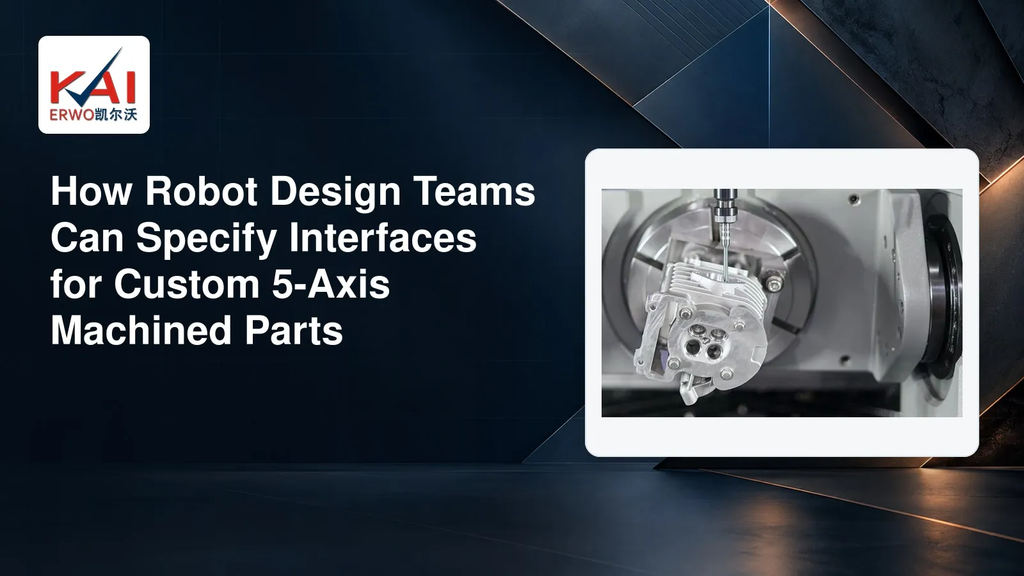
A custom robot component rarely works in isolation. It may locate a bearing, connect to a housing, or provide a mounting pattern for another assembly. A part can look correct on its own while creating problems because its interfaces were not defined in enough detail.
For robot design teams, a machining brief should explain the relationships that matter at assembly. This is an information and procurement task as much as a geometry task. The supplier needs to understand the intended connections without being asked to infer them from a standalone model.
Describe the Mating Relationship Before the Feature
Identify the mating component, its revision, and the purpose of the interface. Distinguish locating features from clearance features and fastener access. Use an assembly view when it explains the relationship more clearly than an isolated part drawing.
ASME Y14.5 supplies geometric tolerancing conventions for communicating feature relationships. The design team still needs to choose requirements that reflect the actual assembly rather than applying a uniform precision level to every surface.
If the mating component is purchased, use its verified dimensional information and identify the controlling reference. Do not design the interface around an informal measurement of one unrecorded sample and assume that it represents every future component.
Discuss Manufacturing Access Without Dictating the Route
Multi-sided geometry may make five-axis capability relevant, but the supplier should review how the part can be made. Explain the important interfaces and ask for a process proposal that addresses them.
Autodesk distinguishes indexed 3+2 machining from simultaneous five-axis movement. This helps buyers ask whether the proposed part needs continuous five-axis motion or whether indexed positioning is appropriate for particular features.
Keep the requested outcome separate from the machine label. The order should define the part and the acceptance evidence. It should not assume that specifying five-axis machining automatically resolves alignment, fit, or surface requirements.
Maintain an Interface Control Record
The record should make each important connection understandable to engineering, procurement, and the supplier.
| Interface Field | Information to Capture |
| Mating component | Identifier, revision, and controlling specification |
| Interface purpose | Location, support, clearance, or fastening role |
| Critical relationship | Defined dimensions and geometric requirements |
| Surface condition | Relevant finish and delivered condition |
| Assembly evidence | Planned fit check and identified mating parts |
| Change responsibility | Owner for approving interface revisions |
For supplier research into 5-axis machining customization of robot parts, this record gives the discussion a clear engineering basis. Ask which interface information the supplier needs before it can quote and plan the part confidently.
A fit review should also record the other components used. Otherwise, a later team may not know whether a successful assembly involved the released mating part, an earlier revision, or a modified sample.
Check Interfaces Before Releasing the Order
Use the checklist to catch missing relationships rather than inspect every dimension with equal emphasis.
- Identify the controlled specification for each mating component.
- Explain which features locate the assembly.
- Separate clearance needs from locating requirements.
- Confirm the inspection evidence for critical relationships.
- Record who can approve an interface change.
The wider manufacturing information on Kaierwo can support planning for other parts in the robot assembly. Treat each process and component as a separate scope while maintaining a shared interface definition.
Frequently Asked Questions
Is a standalone CAD model sufficient for an interface review?
It may not explain the function or controlling mating information. Add assembly context and important requirements where the model leaves them unclear.
Should all holes use the same tolerance?
No. Their roles may differ. Set requirements according to function and have the design owner review the resulting specification.
Does a successful fit check establish complete robot performance?
No. It provides evidence about the identified assembly conditions. Other performance questions require separately defined evaluation.
Select one custom robot part and create an interface record for its most important connection. Use that record to clarify the machining brief before the next quotation request.
