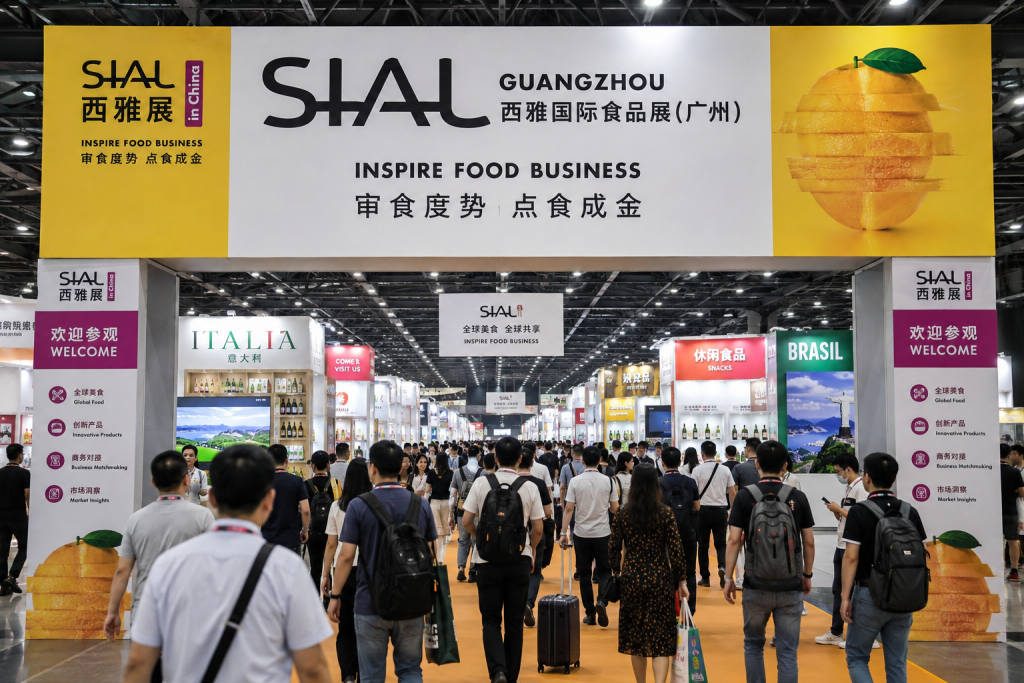
The food and beverage industry is becoming increasingly interconnected, but that does not necessarily make international sourcing easier. Buyers have more products and suppliers to choose from than ever, while food businesses looking to enter new markets need to understand regional demand, distribution networks, consumer preferences, and commercial requirements before committing to a new relationship. This is changing the role of major exhibitions. Instead of functioning only as large halls where companies display products, modern events are increasingly becoming places where market research, supplier discovery, professional networking, and direct business conversations happen together. The guangzhou food expo taking place in September 2026 reflects this broader evolution, with its organizers positioning the event as a gateway between Southern China’s F&B ecosystem and markets across Asia.
SIAL Guangzhou 2026 is scheduled for September 3 to 5 at the Poly World Trade Center Expo in Guangzhou. The official visitor information lists a 60,000-square-metre exhibition area, more than 1,500 expected exhibitors, and approximately 65,000 professional visitors. Those figures provide an indication of the scale involved, but the more interesting aspect is how the event is being structured around that scale. Alongside the exhibition floor, the organizers are incorporating international buyer services, business matchmaking, innovation programmes, market insights, and dedicated networking opportunities.
The result is a model that places greater emphasis on the quality of interaction rather than simply the number of people attending. SIAL’s Match Me service uses an AI-enhanced system to facilitate pre-qualified face-to-face meetings, while the International Top Buyer Programme is aimed at senior decision-makers and professional buyers looking for suppliers and products across China and Asia. This combination suggests that the future of major food exhibitions may depend less on creating the biggest possible marketplace and more on creating a better system for navigating it.
Why Guangzhou Has Become an Important Food Trade Location
Guangzhou gives the event a particular regional context that would be difficult to reproduce in an unrelated location. SIAL describes the city as a major economic, transportation, and trade hub in Southern China and highlights its position within the Guangdong-Hong Kong-Macao Greater Bay Area. The organizers also point to Guangzhou’s concentration of food wholesale markets and professional buyers, making the city relevant to both domestic and international food businesses.
The location also creates a connection between China’s production base and wider Asian markets. SIAL describes Guangzhou as a gateway to ASEAN markets, while its 2026 materials identify buyers from Southeast Asia, South Asia, Japan, South Korea, Mongolia, Hong Kong, Macau, Taiwan, and other markets as targets for its international buyer programme. This means the exhibition is being developed around a regional trade network rather than treating the Chinese market as an isolated destination.
From Product Display to Business Discovery
A large exhibition traditionally gives companies an opportunity to put products in front of potential buyers. That remains important, particularly in food and beverage categories where packaging, appearance, texture, presentation, and product samples can influence initial interest. However, product visibility alone does not explain whether a supplier and buyer are commercially compatible.
SIAL Guangzhou’s broader structure attempts to address that gap by combining product discovery with matchmaking and buyer services. The official visitor information describes the event as a hub for high-efficiency procurement and ASEAN resource integration, with thematic zones covering areas such as imported food, prepared food, and premium drinks. This gives visitors a way to explore specific parts of the market while also connecting with suppliers through more organized channels.
How AI-Assisted Matchmaking Changes the Exhibition Experience
One of the more distinctive elements of the event is Match Me. SIAL describes it as a precision-driven trade service that facilitates pre-qualified face-to-face meetings through an AI-enhanced system. The idea is not to replace personal interaction, but to improve the process that happens before two people sit down together.
That distinction is important because food sourcing often involves more than simply finding an interesting product. Buyers may need particular product categories, volumes, market suitability, documentation, distribution arrangements, or international supply capabilities. A matchmaking system can help narrow the field before the meeting, allowing the actual conversation to concentrate on whether there is a genuine commercial fit.
Why Qualified Buyers Matter More Than Raw Visitor Numbers
Not every exhibition visitor has the same role within a company. Some attend to research trends, others explore potential suppliers, and some have direct responsibility for purchasing decisions. For exhibitors, these differences can significantly affect the usefulness of an interaction.
The International Top Buyer Programme is designed specifically around professional purchasing activity. SIAL says the programme targets senior decision-makers and professional buyers seeking new products, trusted suppliers, and growth opportunities across China and Asia. Its target groups include retail chains, supermarkets, importers, distributors, trading companies, e-commerce platforms, convenience stores, HoReCa operators, and foodservice businesses.
What the International Top Buyer Programme Adds
The programme goes beyond simply giving qualified buyers access to the exhibition. SIAL describes services including tailored business matchmaking, sourcing assistance, VIP networking opportunities, translation support, and accommodation for eligible participants. The objective is to make the sourcing process more structured for buyers who already have commercial requirements to investigate.
This approach also changes how exhibitors can think about the event. Instead of relying entirely on visitors discovering a booth by chance, the programme creates opportunities for suppliers to meet buyers whose purchasing responsibilities are already relevant to their categories. That does not guarantee a business relationship, but it can improve the starting conditions for one.
Why the 2026 Edition Is More Than a Change of City
The Guangzhou edition continues the South China presence that previously operated in Shenzhen. SIAL announced that the fourth South China edition would move to Guangzhou in 2026, explaining that the relocation was intended to align with the autumn trade season and expand reach across Southern China and international markets.
The move also represents a continued investment in the Greater Bay Area. According to SIAL, the previous three South China editions in Shenzhen attracted nearly 4,000 exhibitors and more than 150,000 food and beverage professionals, while intended cooperation exceeded USD 20 billion. The Guangzhou edition therefore builds on an existing regional event rather than starting from an entirely new base.
How the Event Connects With Southeast Asian Markets
SIAL’s Guangzhou strategy places considerable emphasis on connections between Southern China and Southeast Asia. The official site describes the event as a gateway linking the Greater Bay Area with Southeast Asian markets, while the International Top Buyer Programme specifically targets procurement professionals from countries and regions throughout Asia.
This creates a two-way commercial environment. Chinese suppliers can use the event to understand international demand and potential distribution channels, while overseas buyers can investigate products and suppliers connected to China’s manufacturing and food production ecosystem. The physical exhibition becomes a meeting point between different parts of the regional supply chain.
What SIAL 2026 Says About Changing Food Markets
The wider sial 2026 programme reflects several consumer and product trends that are becoming increasingly visible across Asian food markets. SIAL’s Guangzhou materials identify healthier snacks, functional foods, clean-label products, premium beverages, ready-to-drink products, new-style tea drinks, specialty coffee, beverage ingredients, convenience foods, private-label development, and products related to the growing silver economy.
These categories are useful not simply because they represent individual product opportunities, but because they reveal where food companies are responding to changing consumer expectations. Health, convenience, premiumization, functionality, and new consumption formats are influencing product development across multiple markets. An international exhibition allows buyers to observe these developments side by side rather than studying each trend separately.
Innovation Programmes Create Another Layer of Market Research
SIAL Innovation provides an additional way of identifying products that may reflect emerging market directions. The Guangzhou programme uses an independent jury process to assess innovative food and beverage products according to dimensions including pleasure, health, healthcare, convenience, and environmental protection. The official schedule lists the announcement of shortlisted products and the release of the Top 10 and awards during the exhibition.
This matters because a large exhibition can become difficult to interpret when hundreds or thousands of products are presented simultaneously. Innovation programmes create another layer of filtering, drawing attention toward products that have been selected for their innovative qualities. For buyers researching new categories, this can provide a useful starting point for deeper product investigation.
Digital Research Is Becoming Part of Physical Exhibitions
The exhibition experience increasingly begins before visitors reach the venue. SIAL Guangzhou provides digital resources that allow professionals to explore exhibitors and products in advance, helping them establish sourcing objectives before attending the physical event. The official Guangzhou visitor information describes this as part of its approach to high-efficiency procurement.
This combination of online preparation and physical interaction is particularly useful for an event of this scale. A visitor arriving with some knowledge of the exhibitors can spend more time asking detailed questions and evaluating products rather than using the entire first day simply to discover who is present.
Why Face-to-Face Interaction Still Matters
Technology can make supplier discovery faster, but it cannot completely replace the value of a direct conversation. Food products often involve questions that are difficult to resolve through a basic online listing. Buyers may want to discuss manufacturing capacity, packaging, export experience, product adaptation, minimum order quantities, or the practical requirements of a particular market.
Physical meetings also create opportunities for unexpected discoveries. A buyer may arrive searching for one product category and encounter another product that fits a future project. This element of serendipity is difficult to reproduce through highly filtered digital searches, which is why matchmaking technology works best when it complements rather than eliminates open exhibition exploration.
The Role of Private Networking
SIAL Elite Hour provides a different environment from the main exhibition floor. The 2026 edition is described as an invitation-only gathering for selected key buyers, leading F&B companies, and industry decision-makers. It combines curated product showcases, buyer recognition, and private business conversations.
The value of such an environment comes from its smaller scale. Large exhibition halls are useful for discovery, but they can make extended conversations difficult. A dedicated networking setting gives selected participants another opportunity to discuss products, markets, and industry developments without the constant movement of the exhibition floor.
The Event’s Main Functions
- Supplier discovery: Visitors can explore products across multiple F&B categories.
- Buyer-supplier matchmaking: Match Me supports pre-qualified face-to-face meetings.
- International sourcing: The Top Buyer Programme focuses on professional procurement decision-makers.
- Market research: Industry trends and innovation programmes provide additional context for emerging categories.
- Regional networking: Guangzhou connects Southern China with the Greater Bay Area and Southeast Asian markets.
- Digital preparation: Online resources allow visitors to research exhibitors and products before attending.
- Private networking: SIAL Elite Hour provides a more focused environment for selected industry participants.
Together, these functions show why the event is being positioned as more than a conventional exhibition. Each element addresses a different stage of the sourcing and networking process, from initial research through to direct conversations.
Why Scale Makes Organization More Important
With an expected 60,000 square metres of exhibition space, more than 1,500 exhibitors, and around 65,000 professional visitors, SIAL Guangzhou will operate at a scale where simple browsing can quickly become inefficient. A visitor could spend several days moving through halls without necessarily reaching the suppliers most relevant to a specific purchasing objective.
This makes the combination of digital preparation, matchmaking, buyer programmes, and thematic zones particularly relevant. The larger the marketplace becomes, the more valuable effective navigation becomes. Technology and structured services can help participants narrow their attention while still leaving room for independent exploration.
What the Guangzhou Location Adds to the Event
The venue itself is located at the Poly World Trade Center Expo in the Pazhou Exhibition Area. SIAL’s travel information highlights direct metro access and connections from Guangzhou and Guangzhou South railway stations, making the venue accessible to visitors arriving from different parts of the region.
More importantly, the location places the event inside a major commercial environment rather than treating the exhibition as an isolated destination. Guangzhou’s established wholesale, manufacturing, transportation, and distribution networks provide a surrounding ecosystem that can add context to the conversations taking place inside the exhibition halls.
A Different Way to Measure Exhibition Success
Visitor and exhibitor numbers remain useful indicators of event scale, but they do not necessarily reveal the quality of business interactions. A supplier could have hundreds of conversations and still fail to meet buyers who fit its target market. Conversely, a smaller number of highly relevant meetings could prove significantly more valuable.
SIAL’s emphasis on Match Me and the Top Buyer Programme reflects this shift toward relevance. The goal is not simply to create more meetings, but to create better-targeted opportunities for conversations between businesses that have a reason to speak with each other.
What This Could Mean for Future Food Exhibitions
The model emerging in Guangzhou points toward a future in which physical exhibitions and digital systems operate together. Online research can help visitors prepare, AI-assisted matchmaking can suggest relevant contacts, scheduled meetings can provide structure, and physical interaction can handle the detailed conversations that technology cannot replace.
This does not necessarily mean that traditional exhibition browsing will disappear. Instead, the exhibition floor may become one part of a much larger ecosystem. The strongest events could increasingly combine discovery, research, matchmaking, networking, innovation, and market intelligence within one connected experience.
Final Thoughts
SIAL Guangzhou 2026 demonstrates how the role of a major food exhibition is changing. The event is still fundamentally about bringing products and professionals together, but its structure extends far beyond product displays. Buyer programmes, matchmaking services, innovation activities, digital research tools, and dedicated networking environments create multiple ways for participants to explore the market and identify relevant commercial relationships.
The Guangzhou location gives that model an additional regional dimension. Its position within the Greater Bay Area and its links with Southeast Asian markets allow the event to function as a meeting point between suppliers, buyers, distributors, retailers, foodservice companies, and other participants from across Asia. With the 2026 edition expected to bring together more than 1,500 exhibitors and 65,000 professionals, having better ways to navigate those relationships becomes increasingly important.
The most significant development may therefore be the combination of technology with human interaction. AI can help identify potential matches, digital platforms can help visitors prepare, and innovation programmes can highlight emerging products, but the final value still comes from people examining products, asking questions, negotiating requirements, and building trust. SIAL Guangzhou offers a useful example of how the next generation of international food exhibitions can become more organized and data-informed without losing the face-to-face interaction that makes them valuable.
FAQs
When will SIAL Guangzhou 2026 take place?
SIAL Guangzhou 2026 is scheduled for September 3 to 5, 2026, at the Poly World Trade Center Expo in Guangzhou.
How large is the 2026 Guangzhou exhibition expected to be?
The official visitor information states that the exhibition will cover approximately 60,000 square metres and is expected to attract more than 1,500 exhibitors and 65,000 professional visitors.
What is Match Me?
Match Me is SIAL Guangzhou’s AI-enhanced matchmaking service designed to facilitate pre-qualified face-to-face meetings between relevant participants.
Who is the International Top Buyer Programme for?
The programme is designed for senior decision-makers and professional buyers seeking products, suppliers, and business opportunities across China and Asia. It targets areas including retail, supermarkets, importing and distribution, trading, e-commerce, convenience stores, HoReCa, and foodservice.
Is SIAL Guangzhou open to the general public?
No. SIAL Guangzhou is a professional food and beverage trade show intended for industry professionals. The official visitor information states that individuals under 18 and non-professionals over 70 are restricted from entering the venue.
